
Image acquired from the Internet Hive Mind
Image acquired from the Internet Hive Mind
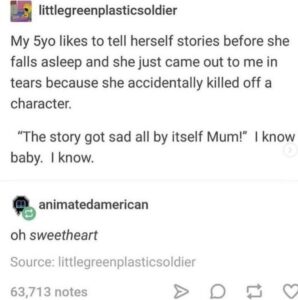
Image acquired from the Internet Hive Mind
I know last month we talked about B is for Bleed. This week could be entitled T is for Tears. Explore the emotion of grief / loss. It doesn’t have to be loss of life; there are many things devastating to lose.
WRITING EXERCISE: Create a scene where “the story got sad all by itself.” You know that story you told yourself once that went somewhere you never expected. Five hundred words or less. Good luck!
My attempt: Last month I mentioned the Ymir’s Songs duology.

Do you need encouragement to write a little something to drop each Sunday, but don’t want the commitment of a full-time blog, maybe the Snippet Sunday facebook group can help. They are found here:
https://www.facebook.com/groups/SnippetSunday/
Their opening is: Welcome to Snippet Sunday, where writers come together to share a few sentences of their current project–whether it’s a recently released novel, a WIP (work in progress), or an older manuscript that’s being revived. Intended to hook readers, gather feedback and build an author’s fan base, Snippet Sunday is the FB group that does all three. Please read the group’s guidelines, ask any questions in the comments, and feel free to join!
They aren’t really great at dropping a reminder each week; it seems to be more of a vibe thing. But connecting to a community is important and maybe this one is a good fit for you.
ALSO READERS!!!! – Want to meet new authors, this is a good choice – and you can paw back through their history to find all kinds of prizes.

Photo by Christian Chomiak on Unsplash
What is in a name?
A lot actually.
The history of language shaped over time. People who have worn the name with honor or infamy. Family members. Religious ties. Locations. Countries. Word forms with constants and vowels. A thousand different things to hold meaning.
Carrie-Ann has a website dedicated to names:
Onomastics Outside the Box: Names beyond the Top 100, from many nations and era
I ran into her during A-to-Z April blogging, and her themes include “Apple Names”, “The Many Forms of Sarah”, and longer series like “Theophoric names” which is up to part 14.
Her most viewed post of all time from October 12, 2020 is “Doll and Puppet Names.”
If you are a writer and stuck on a name, you might want to hit up this blog for ideas.
If you prefer to copy and paste instead of direct links – here is the link to her blog: https://onomasticsoutsidethebox.wordpress.com/

Photo 2865655 © R. Gino Santa Maria / Shutterfree, Llc | Dreamstime.com (Picture paid for)
“The movie isn’t as good as the book.” “I don’t know why people think this statue is so great, I mean look at this photo of it.” “This song is awful (when played on my phone).”
“Medium” in art covers both the skill set needed to create the art (painting, photography, scrapbooking, violin, orchestra), and the materials used to create the artwork (marble, wood, instrument).
And when judging art, Medium Matters. One of the most amazing books I read was an urban fantasy by Darin Kennedy, The Mussorgsky Riddle. The mystery centered around a piano suite in ten movements (Pictures at an Exhibition) written by Mussorgsky, inspired by paintings at a show in the Imperial Academy of Arts from Viktor Hartmann. Plot, piano, and paintings mixed together (and if you hear it on audiobook, another artist is added into the mix).
Not any one medium is better than the other, but being aware of the limitations can help one appreciate the transference of art from one medium to another. How is a painting different from a sculpture? What happens when pop music is played by an orchestra (as sometimes happens with songs by Queen)? Should we judge a book against a movie or are they two different things with two different audiences?
I recently heard people comparing a single book to the three-season television show which spun off it, saying the secondary characters, which developed as the television show ran beyond the original story, lacked depth in the book. No kidding. Yet both the book and the television show felt the same as they explored victory and growth, adulthood and loss.
Other conversations I had recently compared black and white movies to technicolor television. Comics to graphic novels – and I’m not talking about long comics, I’m talking about well-loved science fiction and fantasy novels translated to book format, for example “More than Human” by Theodore Sturgeon (published 1953) released as a hardback graphic novel in 1978. Each of these have their own particular imprint on my soul.
Pulling this back to writing and reading. Medium Matters. Figure out what best fits your story. Is it a flash (under 1,000 words) or novel (75,000 words)? Should it be shrunk to a short story (5,000 words) or will a novella length be better (20,000 words)? Will one hundred words, precisely, for a drabble be the right size? Should it be a play, or a serial? Could it work in audiobook, and, if so, should one person or a cast read it?
Choose the presentation of the story. Write it to the end, then carve it like a statue until only the parts that should be there remain.