Flash: Fence Post

Photo by Qasim Malick on Unsplash

Watching the world walk by is nothing new. Malik held up the fence at the sector’s edge monitoring those going from home to work, looking for discrepancies. Behavior changes, new faces, different groupings, someone arriving late or showing up too early. The “haves” relied on him and others like him to keep their “staff” in line. Unlike most in the queue below, he rarely dealt with the privileged directly, staying on this side of the fence.

Carefully ignoring “silver-trim” for the fifth day running, he wondered how long he would tolerate his life. Noor, the poor buffoon, jogging up late again gave him an excuse to miss the woman he carefully wasn’t seeing. Malik jumped down the thirty feet from the fence posting, cybernetic legs easily handling the landing, a gift thanks to the combination of landmines from the war and the “haves” who arranged the war and still wanted his skillset.

(words 151; first published July 3, 2022 – from a picture prompt for a Facebook writing group. Aim is about 50 words)

Fence Post Series

  1. Fence Post (3/28/2021)
  2. Toleration (5/2/2021)

Writing Exercise: 50-Word Prompts 2020

WRITING EXERCISE

Package season is kicking my tuchus, so we are going to do the 50-word prompts again.

Write two 50-word flashes. Aim for 50 words, give or take five extra words. Don’t read my attempts until after you do your own. Writing them directly in the comment section below will help you focus on the flash aspect – just getting words out.

How does this exercise help you as a writer: (1) just write things out quickly; (2) learn to work from prompts (important for the anthology world); (3) practice writing to a word count.

WORD PROMPT FOR 50-WORD FLASH: Light

VISUAL PROMPT FOR 50-WORD FLASH

Photo by Kyle Johnson on Unsplash

My Attempts

TEXT PROMPT: Light

The packages were stacked tall in the pumpkin, all sorts of sizes and weights. Light thin Amazon packages, large packages from toy stores, squishy clothing packages, weird ones with a hard bit that must be bed-slippers. And dog food. I HATE dog food. Forty pounds moving like a dead body. (first published 3/21/2022; 50 words)

VISUAL PROMPT

Seaweed clung to the tip of the knife. Something expected when gutting fish in the muck passing for water these days. Leonyd went to close the shelter door as the first rays of dawn skittered across landscape, burning everything they touched like molten sparks from a forge. Damn climate change. (first published 3/21/2022; 50 words)

Series: 50-word Prompts

  1. Prompts 1& 5 (2/19/2017)
  2. Prompts 6 & 12 (2/26/2017)
  3. Prompts 7, 8, 10, 11 (3/19/2017)
  4. Prompts (The Mouse Roars) (3/26/2017)
  5. 50-word prompts 2018 (12/25/2018)
  6. 50-word prompts 2019 (8/27/2019)
  7. 50-word prompts 2020 (12/22/2020)
  8. 50-word prompts 2021 (12/28/2021)
  9. 50-word prompts 2022 (12/17/2022)
  10. 50-word prompts 2023 (12/26/2023)
  11. 50-word prompts 2024 (12/24/2024)
  12. 50-word prompts 2025 (12/25/2025)

Geeking Science: Fashion Meets the Surveillance Age

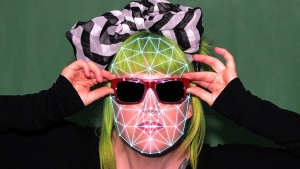
From the Reflectacles Kickstarter

So after writing the Dark Web Trope Editing Rant in September, my paranoia is running higher. Just a little.

Did you know that there is a whole Fashion subset to avoid the surveillance cameras everywhere?

Here are some Fashion Statements to say something about the person wearing them, either tin-hat-paranoia or they-really-are-out-to-get-you. The accessories could make for some exciting additions to a near future sci-fi or a contemporary thriller.

  1. Makeup and Hair – Asymmetrical is the key. Bright splotches of color hair. Cover or obscure the eye with spikes and decorations. Squares with high differentiation of coloring – black and white. Jewels applied randomly to the face, especially the nose and cheekbones. Gorgeous and disturbing to a species hard-programmed for symmetry. The machines also freak out a little. (See cvdazzle for examples.)
  2. Pattern Recognition Disruption Scarfs – Put on a lacy scarf with dots or mini-faces. For example, the HyperFace scarf has 1,200 facial shapes to blow the surveillance camera software to bits.
  3. Health masks – Those face masks people are wearing to prevent transmission of disease. They may be keeping other transmissions and invasions at bay. Popular among protesters around the world, especially when holding a gathering near suppressive government buildings.
  4. RFID Blocking Wallets – With the credit cards being RFID chipped now, pick up a wallet to keep someone from reading accessing the credit just by talking down the street beside you.
  5. Metallic Fabric Jackets (with or without hoodies) – But the RFID and microchips go beyond just the wallet, dogs are chipped, medical history may be on chips soon, and some medical machines already are microchipped and can be programmed for injections. Pick up a metallic jacket to keep criminals from scanning the microchips … or reprogramming them.
  6. IR Privacy Eyewear – Full infrared (IR) protection on the sunglasses prevent surveillance cameras from getting eyeshape, one of the most important aspects of facial recognition. A bonus is manufacturing the frames to be extra reflective – this makes the wearer more visible at night when crossing the street while also completely screwing with the camera’s ability to see the person’s face.
  7. Antiflash Clothing – Prismatic metallic ink which interferes when paparazzi beat on a celebrity with flashbulbs. Suddenly their greatest tool of humiliation destroys the very picture they are trying to take. Also great for those days when a politician, or ordinary citizens caught up in a mess, takes a walk of shame before proof of innocence or guilt is established. Also useful for the next company party with the open bar; no pictures, no proof.
  8. Infrared Ballcaps – The brim of the cap shines an IR light on the face, making it too bright for surveillance cameras to see. Perfect for those late night run to Walmart, and you don’t want to get dolled up in an anti-surveillance fashion statement.

Bibliography

Bacchi, Umberto and Suliman, Adela. “Face masks to decoy t-shirts: The rise of anti-surveillance fashion”. Reuters. 2019 September 26. https://www.reuters.com/article/us-britain-tech-fashion-feature/face-masks-to-decoy-t-shirts-the-rise-of-anti-surveillance-fashion-idUSKBN1WB0HT – Last viewed 11/13/2019.

CV Dazzle. “Camouflage from face detection.” cvdazzle. 2017 August 22. https://cvdazzle.com/ – Last viewed 11/13/2019.

Dobush, Grace. “Privacy by design: How fashion combats surveillance”. The Christian Science Monitor. 2017 January 27. https://www.csmonitor.com/World/Passcode/Security-culture/2017/0127/Privacy-by-design-How-fashion-combats-surveillance – Last viewed 11/13/2019.

Hern, Alex. “The fashion line designed to trick surveillance cameras”. 2019 August 14. https://www.theguardian.com/world/2019/aug/13/the-fashion-line-designed-to-trick-surveillance-cameras – Last viewed 11/13/2019.

Hu, Jane C. “When Will TJ Maxx Sell Anti-Surveillance Fashion?” Slate. 2019 August 15. https://slate.com/technology/2019/08/facial-recognition-surveillance-fashion-hong-kong.html – Last viewed 11/13/2019.

Jacobs, Bel. “How what you wear can help you avoid surveillance.” BBC. 2017 March 20. https://www.bbc.com/culture/article/20170320-how-what-you-wear-can-help-you-avoid-surveillance – Last viewed 11/13/2019.

Reflectables. “IRpair & Phantom – Privacy Eyewear.” Kickstarter. 2019 November. https://www.kickstarter.com/projects/reflectacles/irpair-and-phantom-privacy-eyewear – Last viewed 11/13/2019.


Book Review: A Time & Shadows Mystery Series

Book Cover from Amazon

The Day Before: Time & Shadows Mystery (Book 1) by Liana Brooks
Convergence Point: A Time & Shadows Mystery (Book 2) by Liana Brooks
Decoherence: A Time & Shadows Mystery (Book 3) by Liana Brooks

SERIES REVIEW

Any long-term readers of my blog know one of my favorite authors is Liana Brooks. I read everything she writes, I attend book launches long-distance, I stalk … um … follow her on Facebook. Why does she have to be a West Coast writer – forever 3,000 miles away? I adore her writing so much I’ll even read a series on time travel if she writes it, my least favorite sci-fi variation. And, you know what?, I loved it. She actually came up with a mechanism I liked – giving agency to the characters.

That is my normal problem with time travel.

Option A: You can’t change time. Characters have no agency; when they go back in time, they get blocked at every turn trying to make changes. The only option available is an emotional journey and I’m not into soul-searching for it’s own sake after the first version of this time travel option. I get it – the character goes from angry, to frustrated, to acceptance, and returns home a changed person. Great the first read, not the fortieth.

Option B: You can change time, but then you can’t return to your original point because your future timeline has disconnected because of your actions. The character becomes lost in the sea of infinite timelines, a Dutchman never again making home port. In this option the characters appears to agency, but they don’t. Because, really, that previous timeline the character wanted change is still out there, moving forward without them. Sure they have created a “happy” timeline, but it doesn’t erase the other line.

Ms. Brook twisted the option B with a dash of energy-wave-cycle science, crashing together a theory where agency exists for characters between the cycles. And she mashed it up with a murder mystery and political thriller.

Did I mention she is one of my favorite authors?

See the book blurbs and my individual book reviews below.

Book Cover from Amazon

The Day Before: Time & Shadows Mystery (Book 2) by Liana Brooks

BOOK BLURB ON AMAZON

A body is found in the Alabama wilderness. The question is:

Is it a human corpse … or is it just a piece of discarded property?

Agent Samantha Rose has been exiled to a backwater assignment for the Commonwealth Bureau of Investigation, a death knell for her career. But then Sam catches a break—a murder—that could give her the boost she needs to get her life back on track. There’s a snag, though: the body is a clone, and technically that means it’s not a homicide. And yet, something about the body raises questions, not only for her, but for coroner Linsey Mackenzie.

The more they dig, the more they realize nothing about this case is what it seems … and for Sam, nothing about Mac is what it seems, either.

This case might be the way out for her, but that way could be in a bodybag.

A thrilling new mystery from Liana Brooks, The Day Before will have you looking over your shoulder and questioning what it means to be human.


MY REVIEW

Wow, I knew Ms. Brooks could write – her superhero romance is fantastic – but wow.

A police procedural with sci-fi time-travel mix. The procedural is set in the near future – about 50 years from now. 25-ish years ago half of humanity was lost to a plague and the survivors joined nations and moved forward, so Samantha, the main character, works for the North American government. Ms. Brooks has done an excellent job of creating a new culture from the fallout, plus a pretty interesting scientific possibility for time travel.

I highly recommend reading the chapter teasers. The stuff at the start of chapters 8, 13, and 23 give the motivation for Iteration 1 and lays the groundwork for the series.

Full Disclosure: Received free from author as part of an on-line book launch. No mention of review in the transaction. Attended launch because loved her other books.


Book Cover from Amazon

Convergence Point: A Time & Shadows Mystery (Book 1) by Liana Brooks

BOOK BLURB ON AMAZON

Agent Samantha Rose has already died once…and knows the exact date she’ll die again.

Having taken down a terrorist organization bent on traveling through time to overthrow the government, Sam figured she was done dealing with the unbelievable. Finally out of backwater Alabama, she’s the senior agent in a Florida district, and her life is back on track.

Until a scientist is found dead. And then an eco-terrorist. And then a clone of herself…again.

As the pieces start to fall together, they paint a picture that seems to defy everything they know about time and physics. But the bodies are all too real, and by partnering up with Agent MacKenzie once more, they might just figure out what’s going on. And when.


MY REVIEW

Is it possible for Convergence Point to be even better than The Day Before of the Time and Shadows series? Yes, I believe it is.

First off, we get a little more romance this time. Not center stage, but nicely worked into the story. Second the mystery-procedural investigation and as much legwork and slow reveal as the last time. The on-edge feeling continues throughout the book of who may die next. Police officers call in, warrants are retrieved – you really feel like these are officers doing their jobs. Too many books have officers breaking the law to bring criminals in – this one makes you feel that these are real officers who really believe, obey, and enforce the law.

I do dislike how men still treat women poorly – I had hoped 50 years in the future to see better of humanity. But after a plague wipes out half the population and women become breeding machines in some areas of the planet, I expect some backsliding would occur from our “enlightened times”.

I should note there were a couple places where characters seemed to act out of character. Not always sure the change was because of an Iteration crossing over.

But the reason why this is amazing is the worldbuilding. As my other reviews indicate, I LOVE good worldbuilding. Ms. Brooks brings to the table several layers to the clone world – including Sam having to deal with other Iteration versions of herself dying in this one. The initial fallout from the Yellow Plague – both the crumbling of nations and the rebuilding. And, of course, time travel.

Ms. Brooks, with the Time and Shadows, has come up with a comprise to time travel which returns agency to the time-travel stories, plus gives one of the best motivations for murder I have ever seen. What would you do, who would you kill, to keep your reality alive instead of collapsing into a dream? For creating a viable, to me at least, time-travel-multiverse thread I have to give Ms. Brooks five stars!


Book Cover from Amazon

Decoherence: A Time & Shadows Mystery (Book 3) by Liana Brooks

BOOK BLURB ON AMAZON

Samantha Rose and Linsey MacKenzie have established an idyllic life of married bliss in Australia, away from the Commonwealth Bureau of Investigation, away from mysterious corpses, and—most of all—away from Dr. Emir’s multiverse machine.

But Sam is a detective at heart, and even on the other side of the world, she can’t help wonder if a series of unsolved killings she reads about are related—not just to each other, but to the only unsolved case of her short career.

She knows Jane Doe’s true name, but Sam never discovered who killed the woman found in an empty Alabama field in spring of 2069. She doesn’t even know which version of herself she buried under a plain headstone.

When Mac suddenly disappears, Sam realizes she is going to once more be caught up in a silent war she still doesn’t fully understand. Every step she takes to save Mac puts the world she knows at risk, and moves her one step closer to becoming the girl in the grave.


MY REVIEW

I want to sit down and create a timeline … line?, woven cloth matrix folded in parts, wibbly-wobbly time knot … anyway, I would like to try to create a iteration and people tracking tool to follow this story through the three books of the series. I am totally going to do this sometime – likely in three or four years. If I come back to books (and I will with this series), it usually takes me around half a decade.

This is not a stand-alone book. Read books one and two before reading book three.

The third of the series science fiction world-building isn’t as strong as the first two, which isn’t surprising since by this time the world has been defined. The romance established in the second book has been solidified by the third. The police procedural isn’t quite as clear cut to follow as the first two books as the world(s) spiral toward decoherence. 

So the story didn’t knock my socks off as much as the first two – on the other hand, I still can’t find my shoes.

Geeking Science: EmDrive

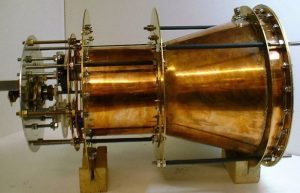
Image (c) SPR Ltd. / www.emdrive.com

Breaking Science – EmDrive

The engineers are trying to break science again. They do this periodically just to keep scientists honest. The newest thing hairbrain idea is the EmDrive (officially a “radio frequency (RF) resonant cavity thruster”).

Engineers (practical application) have been driving Scientists (theory modelists) to distraction since the beginning of time.


STORYTIME: The Scientist and the Engineer

“Hey, Scientist Uke, I got fire by rubbing two sticks together,” reported Engineer Bob.

“That isn’t how fire comes.” The scientist explained the world-model everyone knew to be true. “It comes from the sky from the gods as an element. Wood is a different element from a different god that is destroyed by the fire gods. It is the way the world works.”

“Well, I rubbed two sticks together using that bow thing I put together last month, and I got fire from wood.”

The scientist scrunched his Neanderthal brow. “Prove it. Recreate your experiment.”

“Don’t know what an experiment is, Uke, but see…” Bob used the bow string to rapidly rotate a stick and create fire.

“Oh hey, guys.” Average hunter-gatherer, Ted, who brings in a lot of food and keeps everyone alive entered the clearing. “Hey, fire. I got stuff to cook!”

“No, don’t use it.” The scientist-priest-overthinker tried to stop the average guy from cooking a few roots and a squirrel. “That isn’t normal fire. The wrong god was used to create it.”

Ted took a couple of bites. “Tastes just fine.”

“You sure you are okay.” The scientist watched Ted for reactions.

“Yep. Works just like normal fire.”

Bob smiled. “We can now make fire anywhere and not wait for a god to strike.”

“Cool beans. That could be useful.” Ted wandered off leaving some of the extra food behind for the big thinkers. They do a lot to make his life easier – the engineer had invented the bow and the scientist figured out how to leave enough roots behind so they can eat them year after year.

Uke looked at Bob, frowning. “You are going to make me figure this out, aren’t you?”

“If you want.” Bob responded. “Not sure why you need to figure it out though. What good is a structure of the universe?”

“Well, if we know what wood gods can create fire and when they can create fire, we can make it in the winter and summer. We know fire likes the fall, but is really hard to make in the winter and spring.”

“You think that the fire might be different later?”

“Well, when everything has been claimed by the rain gods, fire doesn’t start.”

“True.” Bob slung his bow across his back. “Tell you what, I will see if I can make fire next time it rains.”

“Yes, that is a good experiment.” Uke watched his friend walk away before dancing. “I get to figure out something new.”

***

Thousands of years later.

“What do you think?” The engineer, Bob, pointed at the large stone cathedral with no columns holding up the ceiling.

The scientist, Uke, blinked. “That should fall. Only caves can be open. Natural openings held by god’s hands”

“Yeah, well, I had been using arches to hold open doorways and thought, why not?”

Ted and his daughter, Tish, came up with a couple loaves of bread in a basket, “Cool beans, that is a big space. Can I use it to store grain?”

“I just built you a grinding wheel, why do you need a big place for grain?” Bob looked at the farmer-food provider.

“Well, with the grinding wheel, I can grind grain a lot faster, so I need more grain. A big open area would be great.”

Ted scratched the back of his head. “Yeah, well. I got this to work some of the time, but not all of the time. A couple of them have fallen. I was hoping Uke could figure it out.”

“I told you it couldn’t be done.” The scientist scrunched his brow. “Why did you do it?”

“What did you say?” Bob studied Uke for a moment. “I think I heard something wrong.”

“I told you it couldn’t be done.”

“Yeah, that is what I thought you said. ‘See if you can do it.’ Well, I did, but it works part of the time.”

“No, I said it couldn’t be done.”

The engineer shook his head. “I see lips moving, but the words are strange. Anyway, I need to see if I can make something for Ted here. I think I will call it a silo. You figure out the arch thing, okay?” He grabbed a loaf from Ted to better think and build.

Uke took the second loaf of bread offered by Ted and asked the everyday man, “Why does he always take ‘it can’t be done’ as a challenge to do it?”

Tish, a dreamer, spoke up. “I don’t know. Mom says it to dad and he reacts the same way. Maybe you should study human actions too.”

“Humans are created in god’s image, they don’t bend to scientific study.”

“Didn’t you tell me that the world is god’s creation? If we can study the world using the scientific method, and it was made by god, we should be able to study humans, made by god, the same way, right?”

The scientist blinked at the young questioner. “You may be right.” Uke went off and studied arches and humans, breaking up science into a variety of topics including the humanities.

***

Hundreds of years later.

“So, Uke.” Bob came up behind his scientist friend. “I made something in 1989. I call it an EmDrive.”

Uke jumped out of his skin. “Don’t do that!”

“Do what?” The engineer held up a big copper engine. “It works with microwaves bouncing around and provides propulsion without propellant.”

Uke rolled his eyes. “Why are you always doing this to me? I taught you the Conservation of Momentum. To move ahead, you got to have something pushing out the back.”

“Well, you told me you wanted to go to the stars, but it took too much propellant, so I am trying to figure out a way without the stuff.” Ted shot back.

“Well, fine. Just make a unicorn while you are at it.”

“No need for a unicorn, we got horses.” The engineer pointed out logically. “Anyway, I need you to look at the engine.” He handed it to the scientist. “It works.”

“It what?” The scientist stared down at the engine. “It can’t work. That would break quantum laws, and well, everything. I would need to rework everything.” He frowned, trying to hide the giddiness bubbling inside.

“Well, near as I can tell, it works.”

“Tell you what, let run this by Dr. White. He breaks everything. If he can’t break it, you might got something.” The scientist rotated the shiny object. “We will need to test it in vacuum because that is where we want to use it. You know outer space has a vacuum, right?”

“Yeah, I know, I just didn’t have the money to make a vacuum yet.” Bob groused.

Dr. White got back to the scientific community at the 50th AIAA/ASME/SAE/ASEE Joint Propulsion Conference in 2014. “I couldn’t break it, not even with vacuum.” (See Rodal, et al. in the Bibliography)

“But!”

The engineer shook his head. There was always a catch.

“I got these eleven other possible things to look at.”

Uke, the scientist, shook his head. “I need Ted to give me money to run the tests.”

Ted, who was recovering from a long recession didn’t have much money and was getting annoyed by scientists with stuff like Climate Change, antivax  and other fake news, rocked back on his heels. “Before I give you money to figure out if it can’t work, tell me what I get out of it. Especially with you telling me it can’t work before you even begin testing.”

“Well, if it works, it will save money and effort getting to the stars. It will drop satellite weight to a third. It can make low Earth orbit stations like the International Space Station last longer as they can self-boost. If we get our act together, we can get to the moon in four days, Mars in less than four months, and Alpha Centauri in just shy of a century. It would be awesome because we wouldn’t need to calculate slingshots, and we could go anywhere in space without a lot of preplanning.”

“Yawn.” Ted waved a hand in front of his face. “You already said it can’t work. So let’s save a lot of time and money and just not worry about it, okay?”

“Hoverboards.” The engineer said.

“No, it can’t—“

Bob slapped a hand over Uke’s mouth, interrupting him.

“Hoverboards?” Ted perked up.

“Yep, hoverboards. We will need mature the technology and then miniaturize it, but hoverboards.” The engineer assured the money-man who provided food, shelter, and manufacturing to the engineer and scientist so long as the inventions were useful, or at least interesting to people.

“Cool beans, here is enough to feed about thirty people for a few years. You work on that.” Ted walked away after writing the check. “Oh, and I want to be able to get to Alpha Centauri in fifty years or less. If I send something there, I want to hear back before I die. Just saying.”

After Ted was safely out of the space exploration room, the engineer removed his hand from Uke’s face. Immediately the scientist hissed, “It can’t do hoverboards.”

“Actually I can make it work with miniaturization and maturity of technology.” Bob smiled at Uke. “Trust me.”

“But—“

“I told you I could make computers smaller than a building, right?”

“It took several decades, but yes.”

“So get me the theory to work with. Prove this actually works, and I can get us hoverboards to make Ted happy, and you and I can continue to figure out new things to keep everyone looking up and out.”

“What if it doesn’t work?”

“Well, we are on, what, the third round of proofs?” The engineer shrugged. “I need to know what doesn’t work before I can figure out what does. It took me a while to get the lightbulb working. I will get us profusion in a small package somehow.”

Trish ran into the room, “Lasers!”

Bob and Uke turned to the new kid who constantly shouted out crazy ideas from science fiction and fantasy. “What?”

“I can levitate stuff with LIGHT!” Trish ran in circles around the room, showing off her new trick. (See Tangermann in the Bibliography) “You know light is an energy and a MATTER, right. So cool. You can use it to shove stuff. I might be able to push things to space really, really fast.”

“Like Alpha Centauri in less than fifty years?” asked the scientist.

Trish, the dreamer where money and science meet, jumped up and down. “Twenty!” (See Shankland in the Bibliography)

Uke and Bob looked at each other.

Uke said, “The science is actually sound and proven, we just need something that works.”

“Kid, we need to talk.” Bob started taking Trish from the room.

Uke yelled after him, “Keep working on that EmDrive too. The laser will only send small things to space. I want humans to get to Alpha Centauri as well.”

END STORYTIME


The EmDrive is nasty in that if it works, it will break a lot of scientific theories. Which in turn is kind-of fun, because having to figure out how things work. In the meantime, scientists and engineers are enthralled with inventing tests and test machinery to figure out why it works even a little in the first place. 

If the EmDrive works, it would be totally awesome!

And the laser drive already works, which is totally awesome!

Space, here we come!


Bibliography

Drake, Nadia. “NASA’s ‘Impossible Space Engine Tests-Here Are the Results.” NationalGeographic.com. 2018 May 22.  (Last viewed 2019 March 24 … seems removed as of 11/17/2022.)

Hambling, David. “Why DARPA Is Betting a Million Bucks on an ‘Impossible’ Space Drive.” PopularMechanics.com. 2018 November 2. https://www.popularmechanics.com/space/rockets/a24219132/darpa-emdrive/ (Last viewed 2019 March 24.)

PBS Space Time. “The EM Drive: Fact or Fantasy.” 2017 January 11. https://www.youtube.com/watch?v=hqoo_4wSkdg&t=603s (Last viewed 2019 March 24.)

Rodal, Jose, Jeremiah Mullikin and Noel Muson. Subedited by Chris Gebhardt. “Evaluating NASA’s Futuristic EM Drive. 2015 April 29. https://www.nasaspaceflight.com/2015/04/evaluating-nasas-futuristic-em-drive/ (Last viewed 2019 March 24.)

Shankland, Stephen. “Are we alone? Tiny spacescraft will head to Alpha Centauri to find out.” Cnet.com. 2018 August 27. https://www.cnet.com/news/sending-tiny-spacecraft-to-alpha-centauri/ (Last viewed 2019 March 24.)

Tangermann, Victor. “Researchers Found a Way to Levitate Objects Using Only Light.” Futurism.com. 2019 March 19. https://futurism.com/levitation-light-propulsion-spacecraft (Last viewed 2019 March 24.)

Wikipedia. “RF resonant cavity thruster.” https://en.wikipedia.org/wiki/RF_resonant_cavity_thruster (Last viewed 2019 March 24.)