Writing Exercise: Let’s Do This (Part One)

Image found with multiple postings on the Interweb

Who all has made New Year’s Resolutions promising to “finish that book” or just to “write more”? Okay, I see more than one hand up. The question is: How do you write more? How do you become the writer you want to be?

First rule of a writer is write, second rule is write more, third rule is write regularly, and fourth is writing something to completion.

To do this professionally means producing words with consistency and commitment, the question is how best to deliver yourself for BIC (butt in chair) HOK (hand on keyboard). Especially while working a day job, meeting family commitments, and (maybe) having enough social life to maintain the requirements for sanity.

Each month for the next three months, I will introduce two methods, and the writing challenge will be testing one of the two to see if it works for you. For January, let’s do a quick trip back to National Novel Writing Month (NaNo) for two tools for your writing chest.

First. Word Sprints. The National Novel Writing Month gold standard.

Five minute, fifteen minutes, or thirty minute typing or scribing crunches. Getting words on paper as fast as possible. This technique is used by many to destroy a writer’s block. Can’t write, then stop thinking about writing and just do it. Get words out, in any order. Don’t edit. Don’t worry. Just open the tap and get the water flowing, however rusty it is. People swear by word sprint.

So you don’t have to watch the time while typing, go to your phone’s alarm clock function. Many of them have a countdown alarm. Set it to the length you will be sprinting, click start to make sure it is actually counting down, flip it over so you can’t see the countdown, and GO.

Second. Every.Single.Day.

Just sit down at the keyboard or in your favorite chair, and do it. If nothing happens after five minutes, get up and walk away. But what matters is you tried. Day-in and day-out. You sat in the chair at some point with the intent to write. Commitment made.

WRITING EXERCISE: Try one of the two techniques.

(A) Every.Single.Day – for one week try the E.S.D. method. BICHOK.

(B) Word Sprint – For either one week, or for three weekends in January/February, do word sprints. Choose a length of time to work with and just type away or scribble in a notebook until the time is up.

Evaluate. Did you ENJOY the technique you tried? Did you feel COMMITTED while working on it? Did you PRODUCE a good product? (note – good product is a first draft you can edit later, not a finished product worthy of publication)

***

My Attempts

Every.Single.Day – I started the year with the intent to write E.S.D. Then a work convention happened the second week and I didn’t have time for three days. This always happens. I usually have too many irons in the fire and suddenly I miss a day, then a month. The simple goal of E.S.D. doesn’t make me happy; while writing is work, it shouldn’t be a toil. 

Word Sprints – I tried them once, but instead of swearing by them like some NaNo writers, I swear at them. I cannot shut off my inner editor enough and writing just to write doesn’t work for me, not even to break a writer’s block. Going outside and mowing the lawn and weeding the garden is ten times a better use of my time. But what doesn’t work for me, might work for you so try it out.


Writing Exercise: 50-Word Prompts 2018

WRITING EXERCISE

I participated in a 50-word prompt day in 2013. A visual and a text prompt alternated every hour for twelve hours. Creatively, it was great fun. I published the results in 2017 on 2/19/17, 2/26/17, 3/19/17, and 3/26/17.

For Christmas, I thought I would keep the Writing Exercise short and sweet. Write two 50-word flashes – aim for 50 words, give or take five extra words. Write them directly in comments below so you don’t think about them too much. 

TEXT PROMPT FOR 50-WORD FLASH: Performance

VISUAL PROMPT FOR 50-WORD FLASH

Photo by Charles Gaudreault on Unsplash

My attempts

TEXT PROMPT: Performance

Responding to the standing ovation, I look left down the line of actors as we stand linked hand-and-hand. We bow in unison, and the clapping grows louder. The marquee steps in front, and the house shakes, a physical force as the shouts hit us. Next time, I’ll be center stage. (first published 3/21/2022; words 50)

VISUAL PROMPT

The rest of the volunteers stopped arguing about the treatment when Devil Dog showed his abs. Four days ago Dutch had been one of them, now he stood alongside their “advisors”. While the others focused on his abs, Elisa studied the scars barely visible along the edges of the clothing. (first published 3/21/2022; words 50)

Series: 50-word Prompts

  1. Prompts 1& 5 (2/19/2017)
  2. Prompts 6 & 12 (2/26/2017)
  3. Prompts 7, 8, 10, 11 (3/19/2017)
  4. Prompts (The Mouse Roars) (3/26/2017)
  5. 50-word prompts 2018 (12/25/2018)
  6. 50-word prompts 2019 (8/27/2019)
  7. 50-word prompts 2020 (12/22/2020)
  8. 50-word prompts 2021 (12/28/2021)
  9. 50-word prompts 2022 (12/17/2022)
  10. 50-word prompts 2023 (12/26/2023)
  11. 50-word prompts 2024 (12/24/2024)
  12. 50-word prompts 2025 (12/25/2025)

Writing Exercise: Unreliable Narrator

Photo by Andrey Metelev on Unsplash

I’ve talked a lot about Point of View (POV) characters, using cameras to help visualize the effects. Today is about the shaky camera – an unreliable narrator.

The main character doesn’t providing all the information, may be misinterpreting the information, or may be lying. Examples of why a POV character might do this include:  physical limitations, inability to see because of a blindfold; age with a child’s understanding; pride, not willing to share family secrets (with the unreliable vibes coming from avoiding topics like the door upstairs); mental limitations, such as bigotry preventing them from understanding others. The list is long.

The true challenge of writing unreliable narrators is providing enough clues to the reader so they question the narrator’s NARRATIVE but do not question the validity of the STORY.

Basically the author balances shaky and solid within the manuscript like a rope bridge. Your turn to try this.

WRITING EXERCISE: Write a scene (around 100 to 250 words) with an unreliable narrator.

My attempt

I wrote Half-Empty (1/8/2017) with Gwyn being an unreliable narrator in two ways. First, her self-image and connection to her actions is skewed after a poor upbringing and a series of gas-lighting relationships. Second, her understanding of her childhood friend has holes the size of elephants though she is unaware of them. But, both of these issues should come through clearly in the narrative.

Other Cool Blogs: Wired January 31, 2011

Photo by Quino Al on Unsplash

Happy Thanksgiving. 

Just a month until Christmas, and tomorrow is the first day celebrating all things materialistic. Instead of running out Black Friday to get the best deal on this year’s hot toy, you might want to look into these tried and true toys of the past. Wired did a review of “The 5 Best Toys of All Time” back in 2011, and everything on the list can be had for a dollar or less.

My personal favorite as an adult is String (see embroidery), but #5 with the optional Water add-on never gets old (see mosaics and gardening). In fact, Water really should be listed as a toy as well, but remember Water needs supervision even more than String.

See all five here: https://www.wired.com/2011/01/the-5-best-toys-of-all-time/

WRITING EXERCISE: Send an hour playing with one of the toys by yourself, with other adults, or with a child or children. You can call it “crafting,” “bathing,” or “woodwork” if “playing” doesn’t sound right to you. Accessories, like power tools, are allowed. Write up a flash, fiction or non-fiction, based on that time. (Toys: Stick, Dirt, Cardboard Tube, Water, Box, String)

Other Cool Blogs: Liana Brooks June 26, 2016

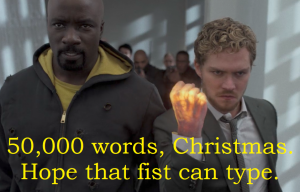
50,000 words, Christmas. Hope that fist can type.

Writing meme created by Erin Penn

The Good Guys

Way back in 2014 Liana Brooks created a National Novel Writing Month (NaNoWritMo) boot camp. When she migrated over to her new blog in 2016, the boot camp disappeared including Day 3: The Antagonist, which is perhaps the best ever explanation on how to create several levels of bad guys in a book. I contacted her, and she immediately dropped the material in her new blog, because she is awesome like that.

From her boot camp I have previously made posts about the Antagonist and Establishing a Baseline. As NaNoWritMo rears its head again, I thought to dip once more into the well of goodness and touch on Day 4: The Protagonist.

She has five exercises to help a writer define a hero. Not every manuscript needs every exercise, but someone thinking about writing a novel next month might want to try out one or two to level up their hero.

Exercise 1: Weaknesses; Exercise 2: Strengths; Exercise 3: Backstory (specific to strengths and weaknesses); Exercise 4: Personality; Exercise 5: One Thing

Of the suggested exercises, I found exercise 4 and 5 the most useful over the years. Knowing the characters Meyers-Briggs personality helps me come up with a decision-making process different from my own. Sometimes I post to my list asking for someone with the appropriate personality to contact me so I can run choices by them.

And “The One Thing” part is just pure gold. If you would like to see it, go here: http://www.lianabrooks.com/nanowrimo-boot-camp-day-4-the-protagonist/

WRITING EXERCISE: Choose one of the five Protagonist exercises suggested by Ms. Brooks, and implement it for your present Work-in-progress (WIP). If you are participating in NaNo next month, consider that your WIP.