Everything from a comma instead of a hyphen costing the American government the modern equivalent of $40 million dollars during the Civil War to changing a medical term from Patient O (as in Oh, for Outside the area being examined) to Patient Zero.
Image courtesy of Sira Anamwong at FreeDigitalPhotos.net
Drafts are the self-editing phase of writing. If you participated in NaNoWritMo in November, my fearless author friends, you now have a ROUGH draft. This is NOT a final draft, not even close. What you have is the foundation to build your novel. Bet you thought those 50,000 words were the novel. Nope – average sellable novel on the low end is 70,000 for romance, mystery, horror, and urban fantasy; and 100,000 for science fiction and fantasy.
If you are like most, you worked NaNo without an outline. Time to put that together. A previous blog post covers the benefits of outlining here. Now you have your basic story flow, and the beginnings of a synopsis for later trying to sell the product.
Looking at the outline, combined with the Rough Draft, the Macro/Content Draft begins. Are there things missing – characters dropped, action slowing down when it shouldn’t, a plot line needing beefing up? Make notes on the outline of the fixes needed and take your Rough Draft to Macro/Content Draft. When done, an increase in word count should have occurred.
Update the outline, maybe start a Bible if a series is expected. What are the major characters and locations? Heights, clothing, props, eye color, etc. With the Book Bible beside you, go over the Macro/Content Draft and update it to a Micro/Line Draft. Check for consistency of character in dialogue and actions, verify permanency of props – do they appear before they are first used, and see if any “tell” can be flipped over to “show”.
It’s okay to do one or more passes for each concentration. For example, Macro pass one adds the scenes you thought you wrote, but never got around to, while Macro pass two you rewrite the Point-of-view character because you realize the story is really about the “side-kick” and not the leader.
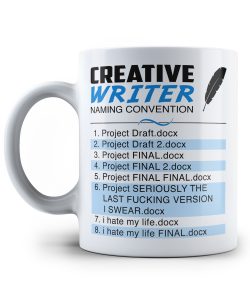
(Mug can be bought at GearBubble and other locations)
Once you have reached the “I hate my life FINAL.docx” phase, time for the proofreading to start. I recommend using an on-line proofreader such as prowritingaid or grammarly. As mentioned in a previous blog, it’s hard to proofread your own work.
All done.
You have gone from Rough Draft to … BetaReaderDraft. You’ve lined up those beta readers, right? Beta reader blog post is here.
Image courtesy of lekkyjustdoit at FreeDigitalPhotos.net
Kill, kill the passive.
Especially the “dead” words. Words which when removed make no change in the meaning of the sentence. All they do is slow things down. The worst offender is “that”.
“That” is a pronoun and sometimes has a purpose for being. But most times, no, nope, nada, zilch, deader than a doornail buried in a graveyard.
EDITING EXERCISE: For your present work-in-progress (WIP), search on the word “that” and highlight all instances. Read each sentence where the word appears with and without “that” included. Do you need it for meaning? For dialogue, natural speaking flow may require it, but elsewhere, unless actively used – kill, kill the passive and the dead words.
Previous Editing Rants and other posts on passivity include:
Commas. Way back in February 2016, Beginnings as side note included “Actually it was ‘I sat down, and hired me.'” … but that is a different editing rant entirely.
Here is that rant.
***
Many times I’ve mentioned my love of the Oxford, or serial, comma. The Oxford comma deals with lists. Lists of two do not need a comma to clearly point out each option, but lists of three do need the addition.
Example with no serial comma needed: I love ice cream and chocolate.
How the serial comma works
Serial comma needed: I had a choice of ice cream, chocolate, or cookie dough.
Without the serial comma: I had a choice of ice cream, chocolate or cookie dough.
Without the serial comma, it seems that the choice was two types of ice cream, with a serial comma the choice is between three types of deserts.
***
Now the comma has an additional duty in pausing the eye to notice groups of words and options beyond the Oxford comma. I’m not going to go into all that independent, dependent clause, conjunction, fused sentence, comma splice stuff English teachers love so much. I’m just going to cover the most simple way to see how a comma should be used with conjunctions.
First, as a writer, you going to need to know some basic vocabulary describing words.
Verb – action
Noun – person, place, or thing
Conjunction – joins things, especially, but not limited to “and, but, or, nor, yet, so, for”
If you don’t know what these are, watch the following School House Rock youtube videos:
Got the basic vocab now?
Moving on.
The simplest of sentences have a Subject (noun), Verb, and a little bit of something more to complete the thought. A conjoined sentence has two complete simple sentences connected by a conjunction.
Example: I love ice cream, and I adore chocolate.
When two complete thoughts are presented (in English-teacher-speak two independent clauses), they are connected with a comma.
On the other hand, phrases are not complete thoughts. The most common usage are two phrases using the same subject.
Example: I love ice cream and adore chocolate.
50% or more of my comma proofreading while editing is either marking an Oxford comma (nearly every publishing house prefers them for clarity) or correcting a conjunction phrase/clause connection.
If you are a writer and working on your second (or sixth) draft, review the conjunction sentences. If a subject is used by the phrases either side of the conjunction and is only in the first phrase, then no comma is needed. If a subject noun appears either side of the conjunction, then two independent clauses appear and a comma is needed.
***
Where the Oxford comma meets the conjunction comma.
So what happens when several phrases appear in a list, then the Oxford comma rules.
Example:
I went to the store, I bought cookie dough ice cream, and I forgot my change when I left the store. Afterward, I returned home, and I chowed down on the ice cream.
I went to the store, bought cookie dough ice cream, and forgot my change when I left the store. Afterward, I returned home and chowed down on the ice cream.
As you can see, when three clauses or phrases were used, the Oxford comma was needed for the list, but when only two clauses or phrases were used, only the conjunction comma rule needs to be applied. Since the second example did not have the subject after the “and”, no comma was used.
***
Think you got it? Then try these from some of my edits in 2014:
He turned on his heel and stormed out of the computer research lab, slamming the door behind him. (okay)
He was surprised, but ecstatically happy. (remove comma)
His head pounded and his shoulder burned like the fires of hell. (add comma before “and”)
***
Back to the original rant: ‘I sat down, and hired me.’
Since there is no second subject, the “I” applies to both the “sat down” and “hired me” phrases, so the comma needs to be removed. Afterward, the point-of-view character hired himself which is just wrong.