Other Cool Blogs: Escape (Liana Brooks) (X is for X-scape)

Photo by Eriks Cistovs on Unsplash

Do you have a Bug-Out Bag for when disaster strikes? Or a “stay-in-place” for three days – the things in the backpack are the same either way usually.

My area is hurricane season (June to November with the focus August to October). Further North could be a snow or ice event. Out West fires. Recently for Hawaii, volcanoes. Also on the list are man-made issues with nuclear plants and riots. Recently in North Carolina, some eejit decided to disable the electric grid for Moore County by shooting it up right before a cold snap in early December, leaving forty-five thousand people without power for nearly a week in border-line freezing temperatures. Christmas shopping was shelved for survival spending – the entire county businesses had a devastating hit right before their biggest money making of the year, and all those people expecting overtime instead scrambled to find a shelter not filled to capacity.

Anyway, Liana Brooks put together a basic checklist for a 72-Hour Kit (basically the three days it takes relief organizations to mobilize). Whether shelter-in-place or getting the heck-out-of-Dodge, X-scape is the key (okay, not the perfect X for A-to-Z, but still important).

72-Hour Checklist” by Liana Brooks (9/11/2018) – (spelled out URL: http://www.lianabrooks.com/72-hour-checklist/?fbclid=IwAR3aoCd6fjz3n29BWrJwv65oTBEQRluS3Wpvs3BOkgRiZhEk5VQrH6zkhL4) – Last viewed 12/13/2022 – note that the site is HTTP, not HTTPS (secure).)

Other helpful sites and lists:

(Bug Out Bag Builder . com)

WRITING EXERCISE: Okay, not really writing this time, but still essential. Make your WUSH kit (Wake Up, Stuff’s Happening) for by your bed. As a writer, I really like the suggestion by the Bug Out Bag Builder to keep your USB backup drive there. Yes, I will still be freaked out about losing my computer to a fire, but I won’t have lost everything.

This is the minimal kit – just grab and go to escape a fire or other house disaster. Store it by your night stand or under the bed, so you can wake and get outside in seconds. This go-bag is small; it should sling over the shoulder like a purse to keep the arms free to grab the children and pets.

May you never need it and may you have it if you do need it.

A) Wallet and Cell Phone – either store them in the bag at night or set things up so they are easily sweep into the bag in an emergency. Store an extra phone charger for your phone in the bag.

B) Keys – one for the house and one for the car. These are the extra keys and should live in the bag. Don’t waste time looking for keys – these should be there.

C) USB backup drive – As a writer/creative, you should be backing up your computer at least monthly. Store the backup in the WUSH bag. Digital copies of the following should be in a fire: Driver’s License, Passport, Marriage License and Birth Certificates, Social Security Cards, Deed for House and Car, Insurance Polices for House and Car, Health insurance info, Credit cards (front and back – so you can call the issuer if they get destroyed).

Bonus storage for family photos, phone numbers (in case the phone is lost), and other things you don’t want to live without.

(Set a calendar alert on your phone or computer to remind you to backup the computer once a month.)

Store the backup drive in a ziplock bag in case of wet.

D) Physical copies of: Passport (if you don’t carry it daily), Marriage License and Birth Certificates, Social Security Cards, Deed for House and Car, Insurance Polices for House and Car, Health Insurance info, Physical print off of copies of both sides credit cards and driver’s license (so you don’t have to find a computer for the USB backup), blank checks (if you have them), printoff of phone numbers and addresses of family, friends, and neighbors emergency contacts.

Plus some extra cash. A mix of small and large bills, enough to get a single meal and pay for overnight stay in a hotel.

E) Medications and prescription glasses – Remember to rotate the prescription medications. Keep three days in the WUSH bag, the full bug-out kit should have another four days for a total of seven days between them. For the glasses, when you get a new pair, the old pair goes in the bag. They won’t be the best, but at least the old glasses are better than nothing.

F) Flashlight – because 50% of the time, disaster will strike during night hours.

G) Food – Just one or two snack bars, especially if you have kids. Not much though, so you don’t attract ants to your bedroom.

H) Small first aid kit – a couple Band-Aids, nail clippers, and some tweezers will do. One mensuration pad (doubles as a big bandage). Don’t go nuts, this is a small kit.

Now that you have the WUSH, set aside time to put together a full go-bag as well. Remember to rotate stock in both regularly – maybe set a calendar reminder like that USB backup.


Writing Exercise: V is for Voice

Photo by João Marinho on Unsplash

Find your voice. In writing, in singing, in the world. Candence, rhythm, volume, smoothness, word choices – these are your own and no one else’s. Claim them.

Your Voice might change between blog posts and novels, talking to adults in a professional environment and children on the playground, singing blues or rock. But still, at the core, it’s your Voice.

It takes time to find your Voice. Understanding. Writing a lot of words or singing a lot of different songs. My voice has children and playfulness, short phrases haphazardly put together, and then weird asides of scientific thought.

If when people say, “I heard you read when I read your novel.” your speaking and writing voice are the same and it’s coming through (yay!). But sometimes the speaking and writing voice are completely different. As is genre changing things up and your different characters might have different personal voices (wait, no MIGHT – they SHOULD have different voices).

Kalayna Price has a wonderful blog posting “On Voice and Timing” in Magical Words (10/1/2011). URL: http://www.magicalwords.net/kalayna-price/on-voice-and-timing/

WRITING EXERCISE: Think about your writing voice and write down what you know about it. Is it short and sweet or long and detailed? Political or fluffy or introspective or…? What writing strengths do you have – dialog, action, characters, etc.?

Now, write one paragraph with a voice aimed at Fantasy (your choice of Urban, High, Sword & Sorcery, etc.) and a second one for  “real life” type genres (Murder Mystery, Thriller, Horror Contemporary, Disaster, Romance Contemporary, etc.). Have the scenes in the paragraph be similar number of characters and situation. How did the Genre Voice change the paragraph … and what things remained the same between the two scenes that could be your underlying voice and how does that match up to your initial thoughts about your voice?

Writing Exercise: Conflicting Wants

Anyone still have their New Year resolution in place to lose weight, or has the joy of fat, sugar, and salt won the year, yet again? One of the basic conflicting wants – eat healthy & be healthy vs joy of eating and joy in life.
Your characters have these conflicts too. Two mutually exclusive, yet base level things. Defining these wants can really help bring a character to life.
Edmund Schubert made an amazing Magical Word post on May 28, 2011, “What Else Does Your Character Want?”
We are going to do his challenge as a writing exercise, so be sure to read the whole thing. Don’t look at the comments yet, but after the exercise, go over them to help you think about this. Again, the URL is:
WRITING EXERCISE: Take a major character from one of your present WIP (work-in-progress) and define two conflicting “wants” the character has, and tell us in the comments below how those wants impact your story.
My Attempt: I’m presently working on expanding the Quest for True Love. The unnamed main character loves gaming and wants to win the game, especially having defined the goal “To find my true love.” BUT they also want to escape the game and get back to the real world. 

Writing Exercise: Study how others do dialogue

Photo by Tamara Gak on Unsplash

Struggling with dialog? On a recent edit, the author constantly had people exchange looks – stares – and glances, while the speaking portion of the exchanges were in a rather formalistic structured dialog. The words of the dialog itself were great; the presentation needed work. I came up with the following writing exercise for the author to study dialog produced by others.

WRITING EXERCISE

Let’s look at other authors and see how they approach glances between characters in dialog, looking at / describing buildings and scenes, and other pauses of action while characters consider what is happening.

Pick three authors you enjoy reading and pick out a description of scene (three pages) and a dialog (three pages) for each. One should be in the genre you are working (say thriller) and one should be NOT be in the genre (not thriller, maybe romance instead), and one an author you sound similar too (if you have one in mind otherwise your choice). Total of 18 pages.

Make copies of the pages or print them out as your are going to mark them up a lot.

Highlight or mark the sections where they are describing a building or room. Do the characters look around? How does the “camera” sweep the area?

For the dialog, how does the “camera” switch between characters? Are they named each time? Where are the dialog tags? Are they firm – “she said”, “he asked”? Or implied “she turned around while pacing.” “he put down the tea cup”? How is the scene description put into the dialog … does the scene description and character description all hit at the beginning of the scene and then does all the dialog happen? Or is the narrative scattered throughout? How is the dialog broken up? Is it always (dialog tag) then (dialog) or (dialog) then (dialog tag) or always (dialog) (dialog tag) (rest of dialog)? How often is the dialog tag/dialog format changed up? How many dialog exchanges are there before a narrative break? Are there sections with just dialog/quoted material with no narrative or dialog tags at all?

Write a short paragraph on what you learned, mark the date, and staple everything together to keep for a year as a reminder.

Other Cool Blogs: Medium – Murray Blehart

Photo by K. Mitch Hodge on Unsplash

How much is too much?

Murry Blehart asked this question back in December in his blog “Is There Such a Thing as Too Many Stories in the Queue?” (Medium, 12/13/2022). (The link written out is: https://mjblehart.medium.com/is-there-such-a-thing-as-too-many-stories-in-the-queue-266e53926f29)

He gives a comforting answer of find your own path and be aware of your joys and limitations (his blog on medium is about mindfulness).

Do I have too many jobs? At present count, now that the political job four-year term is over (and related supporting political job), I’m down to ONLY seven gigs. 

Do I have too many stories? (Looking over the blog, with flash ideas in the hundreds.)

Do I have too many projects? (Looking around the room at the to-be-done piles.)

Yes, and yet, no.

The jobs are needed to pay the bills and that loss of income from the political jobs – small though it is – hurts and I’m trying to figure out a way to make it up. But the keeping track of them and switching between them sucks up executive decision-making energy better used for creative vitality. I have fun with them, but I could have fun with other things too.

The stories just keep coming and I have no more control over them than the weeds in the yard – write them or pull them, the project is not a project but a process. (Project in business-speak has an completion-date, Process is on-going tasks like cleaning the home, making meals, or a manufacturing line. Individual tasks within a process many be completed, but the task will be there again tomorrow because most things in life is about flow. Life is a river, not a port.)

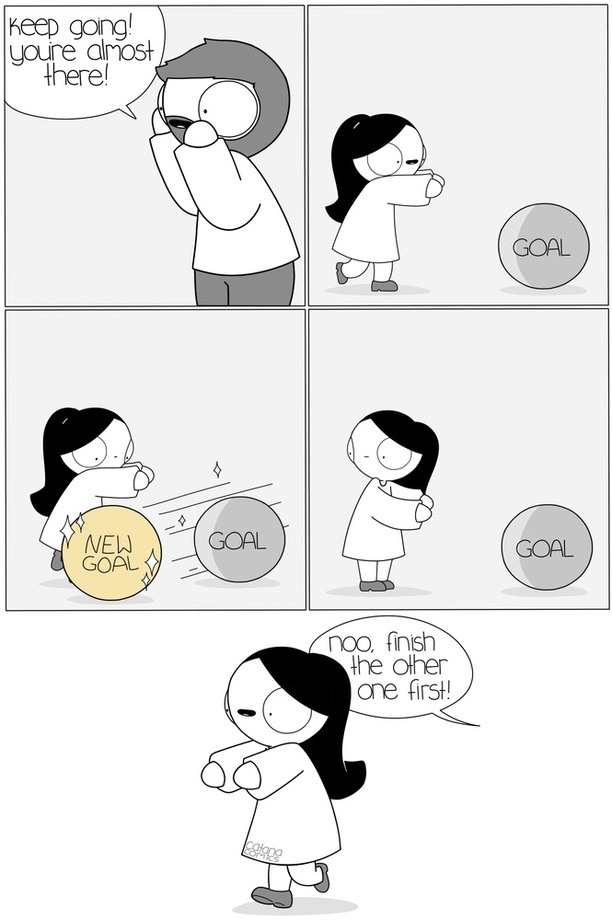
Projects? Well, I also try to keep the new shinnies down but…

Find more Catana Comics at: https://catanacomics.com/ (and many other web locations and in book stores)

WRITING EXERCISE: Take a moment and think mindfully. Are your “stories-in-queue” (or pictures to be drawn, or embroidery to be done, or tasks) bringing your joy or burdens? Is it too much? If too much, think what to trim to bring it under control. If not, celebrate the Joy and take a moment on your queue.