Writing Exercise: Study how others do dialogue

Photo by Tamara Gak on Unsplash

Struggling with dialog? On a recent edit, the author constantly had people exchange looks – stares – and glances, while the speaking portion of the exchanges were in a rather formalistic structured dialog. The words of the dialog itself were great; the presentation needed work. I came up with the following writing exercise for the author to study dialog produced by others.

WRITING EXERCISE

Let’s look at other authors and see how they approach glances between characters in dialog, looking at / describing buildings and scenes, and other pauses of action while characters consider what is happening.

Pick three authors you enjoy reading and pick out a description of scene (three pages) and a dialog (three pages) for each. One should be in the genre you are working (say thriller) and one should be NOT be in the genre (not thriller, maybe romance instead), and one an author you sound similar too (if you have one in mind otherwise your choice). Total of 18 pages.

Make copies of the pages or print them out as your are going to mark them up a lot.

Highlight or mark the sections where they are describing a building or room. Do the characters look around? How does the “camera” sweep the area?

For the dialog, how does the “camera” switch between characters? Are they named each time? Where are the dialog tags? Are they firm – “she said”, “he asked”? Or implied “she turned around while pacing.” “he put down the tea cup”? How is the scene description put into the dialog … does the scene description and character description all hit at the beginning of the scene and then does all the dialog happen? Or is the narrative scattered throughout? How is the dialog broken up? Is it always (dialog tag) then (dialog) or (dialog) then (dialog tag) or always (dialog) (dialog tag) (rest of dialog)? How often is the dialog tag/dialog format changed up? How many dialog exchanges are there before a narrative break? Are there sections with just dialog/quoted material with no narrative or dialog tags at all?

Write a short paragraph on what you learned, mark the date, and staple everything together to keep for a year as a reminder.
Other Cool Blogs: Medium – Murray Blehart

Photo by K. Mitch Hodge on Unsplash

How much is too much?

Murry Blehart asked this question back in December in his blog “Is There Such a Thing as Too Many Stories in the Queue?” (Medium, 12/13/2022). (The link written out is:

He gives a comforting answer of find your own path and be aware of your joys and limitations (his blog on medium is about mindfulness).

Do I have too many jobs? At present count, now that the political job four-year term is over (and related supporting political job), I’m down to ONLY seven gigs. 

Do I have too many stories? (Looking over the blog, with flash ideas in the hundreds.)

Do I have too many projects? (Looking around the room at the to-be-done piles.)

Yes, and yet, no.

The jobs are needed to pay the bills and that loss of income from the political jobs – small though it is – hurts and I’m trying to figure out a way to make it up. But the keeping track of them and switching between them sucks up executive decision-making energy better used for creative vitality. I have fun with them, but I could have fun with other things too.

The stories just keep coming and I have no more control over them than the weeds in the yard – write them or pull them, the project is not a project but a process. (Project in business-speak has an completion-date, Process is on-going tasks like cleaning the home, making meals, or a manufacturing line. Individual tasks within a process many be completed, but the task will be there again tomorrow because most things in life is about flow. Life is a river, not a port.)

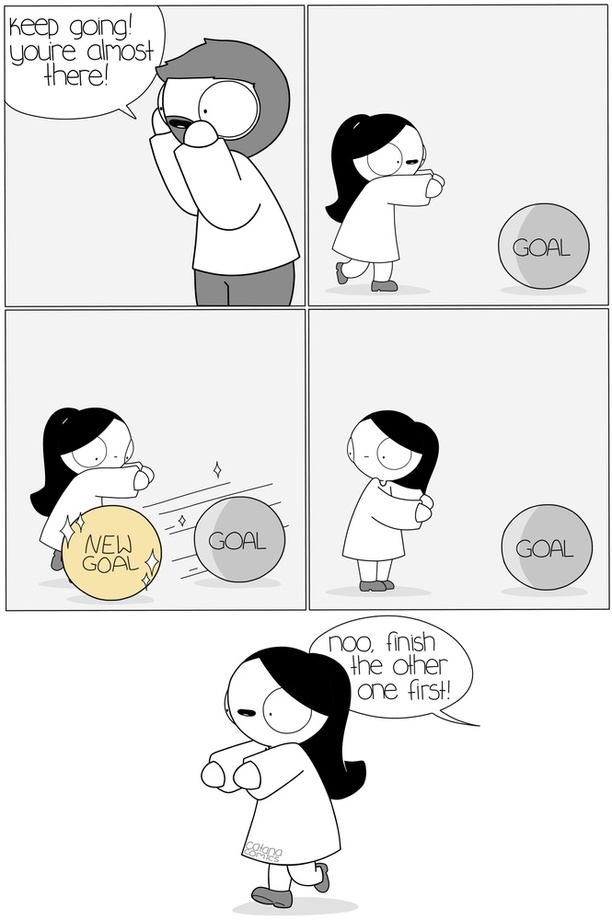
Projects? Well, I also try to keep the new shinnies down but…

Find more Catana Comics at: https://catanacomics.com/ (and many other web locations and in book stores)

WRITING EXERCISE: Take a moment and think mindfully. Are your “stories-in-queue” (or pictures to be drawn, or embroidery to be done, or tasks) bringing your joy or burdens? Is it too much? If too much, think what to trim to bring it under control. If not, celebrate the Joy and take a moment on your queue.

Other Blogs: David B. Coe, Author of Fantasy

Photo by Alexander Grey on Unsplash

January brings a host of resolutions and resolves – the biggest combo is work better and clean stuff. Strangely the work better often comes from cleaning stuff. Having room to work without the mental fatigue of seeing other tasks and duties can make a huge difference in attitude.

David B. Coe describe this dilemma and solution in his Professional Wednesday: Tending to Our Work Space (May 18, 2022). (The direct link is: https://www.davidbcoe.com/2022/05/18/professional-wednesday-tending-to-our-work-space/ – last viewed 12/12/2022)

Between package season for my post office job and tax season for my other day-job, my desk is buried in paperwork and project lists and I don’t know when I will get through it all. There are tasks years old that I still mean to get to someday. My honey-do list to myself.

When I did the yard hole-fill-in last year (see lawn leveling), I got rejuvenated. A task weighing me down was released to the ether. Hope raised and danced the jig for a time.

WRITING EXERCISE

Take two hours (or whatever the project needs) and clean one thing you’ve been meaning to clean. This isn’t a procrastination from writing, but an energy building project. Clean something bothering in the line of sight of your desk. Squeaky wheel – WD-40. Leaky pen – throw it out and replace. One stack of papers that keeps shifting – actually clear it. If it drains energy instead of putting a smile on your face when sitting at your writing desk, fix it.

Just one thing today.

Maybe you need to have one hour of your writing week set aside to maintaining your HAPPY work space. Think about it. If the mess is draining your writing, making it hard to start or to maintain, then something needs doing. Maybe an all out attack like Mr. Coe did over several days (he is a full-time writer, so take that into account on his ability to focus), maybe a happy tree fix once a week.

Comment below on what you did to make your writing space more pleasant to work in this week.

From the Internet hivemind


Writing Exercise: Inciting Incident Part 2

Amazon Cover

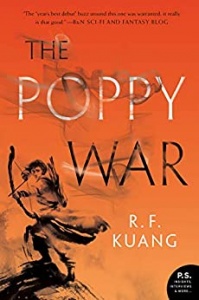
My book club this month read “The Poppy War”, a grimdark fantasy novel based on Chinese history.

Its inciting incident leaped out to me and made me think about the 5/24/2022 Writing Exercise on inciting incidents. deconstructing it in my mind.

WRITING EXERCISE: Using a novel you are reading or recently read, take apart its inciting incident. (The manuscript used needs to be at least novella length and the first of the series, to give the inciting incident a reason for being.) Comment below what book you chose and why. Review the previous writing exercise for details about inciting incidents.

My attempt

As I said, The Poppy War inciting incident stood out to me … because it had so little to do with the rest of the story. It could have been removed from the book and virtually nothing would have changed … except it is the pebble that starts the avalanche. 

Quick review on what an inciting incident needs:

(One) Early in the book – check. Aside from the opening flash forward, the marriage proposal starts the book.

(Two) Disrupts the status quo – This is where the marriage proposal becomes important. While life truly is horrible for our protagonist, she is well used to it at this point. She works the shop, protects her little brother as best she can, and knows how to manipulate her adoptive mother enough to avoid the worst of the abuse. Being married even to someone in the same village, will change everything in her life, and not for the better as far as she can see. Especially at 14, to a twice divorced older male. Big disruption.

(Three) Not under the protagonist’s control – And this is where the inciting incident of the marriage proposal is different from her waiting for answers on the test she took. Rin chose to start studying for the Keju test, she arranged for her professor, she took control of her life to take the test. Even while waiting for the answer to the test, everything related to it was under her control. But the marriage proposal, nothing was under her control. Her adoptive mother wants it, the marriage maker didn’t even consult her, her possible intended never talked to her. 

Similar to the inciting incident in Harry Potter is receiving the letter. Nothing in his life ever prepared him for this. But the Sorting Hat, while seemingly not under the children’s control does listen to them and is influenced by Harry’s wish not to be Slytherin. In the Wizard of Oz, the inciting incident is the tornado. 

(Four) Forces a difficult choice – Rin chooses to take the Keju, and then further, chooses to leave home. While the leaving everything she knows behind is as disruptive to the status quo as the marriage, the difference is the protagonist chooses this “Call to Adventure”.

Oh, wow. I figured why the inciting incident bothers me so much. Usually the Inciting Incident for fantasy is a “call to adventure” – something that leads the person into the magical world. But in Rin’s case, she isn’t so much responding to a call as avoiding something unpleasant. The inciting incident so mundane, it doesn’t match the normal expected Call to Adventure or other Fantasy magic. In fact, the inciting incident is so hateful to her she twice uses it to whip herself down a path when things get rough. Anything was better than going back.

In conclusion, the inciting incident of The Poppy War stuck out like a sore thumb, different from normal fantasy and not really fitting in to the rest of the book, and yet it meets all the classic needs of the Inciting Incident – including and especially the fact the marriage proposal wasn’t under her control.

Inciting Incident Series

  1. Writing Exercise: Inciting Incident (5/24/2022)
  2. Writing Exercise: Inciting Incident Part 2 (1/24/2023)
  3. Writing Exercise: Inciting Incident Part 3 (7/1/2027)

My Strategy Plan for 2022 – a review

Photo by Scott Blake on Unsplash

Time for the last post of the 2022, and it’s the perfect time to do a review of the strategic plan I started back in March and see what tweaks are needed for 2023.

First off, success, though not a great success. I got a lot more done this year than the previous two years of the pandemic. And I’ve done some maneuvering in my day-job life this past month that I hope will drive me to do even better next year. Small steps in this marathon.

Goals were:

  1. Increase sellable words volume. — Did not happen, but I think it will happen in 2023
  2. Get blog up-to-date by December 2022 (adjusted to a more reasonable production of update complete by March 31, 2023). — Went from 257 blogs behind to only 72. Note that for 2023, another 157 blogs will be needed (72 + 157 = 229 … still ahead of where I started!)
  3. Produce novels regularly, setting up a production line by December 2022. — Did not happen, but I think it will happen by December 2023.
  4. Stay healthy. — No new injuries! Doc wants me to get on a better diet, so more work is needed.

Ditto the goals for next year. And release the Water Rabbits!