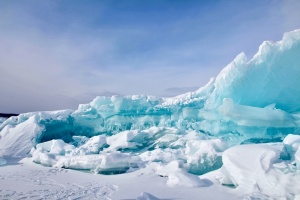
History is written in many different ways. It’s written down in books. It’s written in graveyards. It’s written in tree rings. And it’s written in the ice.
Tree rings gave a mystery to scientists, showing poor summer grown for about a decade in mid-500s. Written records indicates nearly 18 months with the sun hidden behind clouds in some areas, killing two years of harvest. Searching the ice shows volcanic eruptions about that time.
Using new technology of ultraprecise analysis of ice from a Swiss glacier, a team of scientists narrowed it down to a volcano in Iceland erupting in early 536, with followup eruptions in 540 and 547. Scientist understand the link between volcano eruptions causing dust and debris in the atmosphere dropping temperatures because the sun is blocked, resulting in harvest failures and famine. With the one-two-three hit of eruptions, the starvation marked humanity with malnutrition, leaving it open for a plague. The Justinian Plague ravaged the Roman Empire, killing one-third to one-half of the eastern population, likely contributing to the Empires eventual fall.
Volcanos -> light/cold -> harvest & food failure -> plague -> population loss -> war and political upheaval.
Everything is connected. Tread lightly. Mother Earth writes history in ice and it’s been a while since she replenished her scribal parchment.
Did you know that cats treat their humans as overgrown kittens? Like most animals, they use vocalizations and behavior usually restricted to their offspring, not to other adult creatures. Cats not only bring us dead animals because they question our hunting ability, while taking advantage of our ability and willingness to feed them, but they dump mostly dead animals on us in the hopes we will learn to kill them like a good growing kitten. Sadly few of us “grow up” under the cat definition.
We, on the other hand, deal with these self-domesticated creatures in our lives similar to the young of our species as well. Their vocal range matches our hearing range in the frequency most often used when tired or in need of help. When the cat speaks, we listen, because a human saying something in the same frequency needs to be heard. High and light. Like children – and we talk back to them the same way.
Acquired from the internet hivemind – Lucid Energy
Humans have been using water to create energy for a long time. Waterwheels, mills, and hydro-electric dams as just a few of the tools used to feed the hunger for energy through the constant flow of water of the Earth’s water system.
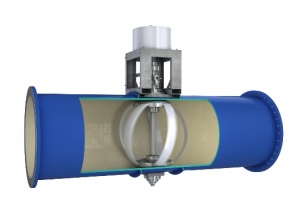
An interesting variation has come up for hydro-electric power. Water flowing through the BIG pipes of a city, going downhill, operates the turbine within the pipe producing electricity to help with other parts of the water system and feed into the city grid.
Limitations. First, the flow over the turbine needs to be just water, so this needs to be in the clean water system, not the sewer system or the storm water system. Otherwise the debris will get caught in the turbine. Therefore the water is flowing from the water cleaning plants TO the houses and plants.
Second, the flow needs to be going downhill, not pumped uphill. Otherwise the energy produced by the turbine is used for the pump – an overall loss.
Third, the amount of turbines will never be enough to power a city, not like a full dam. This is a micro-solution, a support system, not a replacement.
Pluses. No need to worry about drought, sun, or wind. This is city water and needs a constant flow to feed the city’s needs.
Second plus, tapping into something that is already there. Nothing needs to be dammed. No environmental impact. No harm of other species – keeping fishes from going upstream or flooding habitats. The pipes are already built.
Third plus, micro-solutions provide a multi-tier reaction plan, allowing for flexibility throughout the year and in different weathers.
Portland is just one of the many cities around the world testing out the viability of this technology.
Find out more here:
Lempriere, Molly. “Can a city’s water infrastructure produce hydropower?” power-technology.com. 2018 October 15. https://www.power-technology.com/features/city-water-infrastructure-hydropower/ (last viewed 3/29/2022; note as of 4/26/2024 the link no longer works)
Schwartz, Rafi. “Portland Now Generates Electricity From Turbines Installed in City Water Pipes.” earthmaven.io. 2019 March 21. (last viewed 3/29/2022)
Image courtesy of renjith krishnan at FreeDigitalPhotos.net
Ever look at a beaded drop of water and go, that’s really weird? You can touch it, and it will rock back and forth and not move. And falling into water HURTS. Yet swimming is fun. Why is the matter-state between gas and solid so strange?
I mean – how is this even possible?
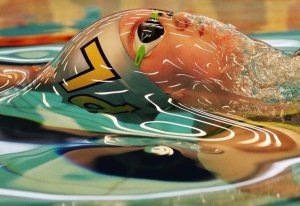
Bow Wave because of Water Properties – “Perfect shot” by Brian Taffy
Seems that the EDGE of water has different properties than the large mass of it, nano-size rules kick in – how molecules and atoms are structured. Studying this difference of properties become really important for anything that requires water to be moved at the small level.
Things like medicine.
We used to think water acted like water all the way up and down the scale. It doesn’t. Not even close. For example, water is a pretty good solvent. We use water wash things up because it interacts with things easily, lifting materials. It has a “dielectric constant” of 80. Dielectric constant being the polarizability of the atoms – meaning can it stick to things and stuff like that. Think how drenched you get in the rain.
At the three atom deep level, the dielectric constant is 2 – it goes from clinging to everything to teflon level – sticking only to itself. (Lowe 2018)
Water tension. Where you can touch a water bead and it doesn’t get absorbed into the skin or cling to your finger.
Applied to medicine at the protein cell level – like the construction blocks of our meat suits – you are working at the three atom level, not immersing in a bathtub. Without the understanding of how water works on the extremely small scale, figuring out how to care for our “bags of mostly water” takes on a level of difficulty leading to a lot of guess work. How do you get medicine from outside a cell into a cell? Should it be a water-soluble medicine or will a different delivery system work better?
Properties at the molecular level impacts other things as well. Water with gas in an average glass creates bubbles that float up and burst. Soda rocks!
Get a narrow enough glass, like a tube, and the bubbles stop moving. Time to call a plumber. That teflon-type “film” on the top of the water surrounds the bubble of gas, making it hard to move. Virtually stationary. (Ecole 2019)
We know how that plays out in the house. It’s called sewer backing up.
How will it play out in a spaceship with no gravity creating an up and down? How much worse will the tubing issues become for moving water around if an air bubble forms and doesn’t move? Scientists need to investigate how small the tubing can go to avoid the immobile gas bubble level.
And you thought quantum physics could be left to the physicists.
Chemistry, biology, medical science, space travel. Geeking science, dude!
Bibliography
Ecole Polytechnique Federale de Lausanne. “Student solves a 100-year-old physics enigma.” phys.org. 2019 December 2. – Last viewed 12/12/2019.
‘Oumuamua. It came from outer space. Deep outer space. It was just the first.
‘Oumuamua (properly spelled with the leading ‘ – Hawaiian word) was the first confirmed interstellar object we humans have noticed, and what a delightful dozy it was. All kinds of anomalies – and if you remember my post from 2018 (Dyson or Dust) scientists love anomalies.
When the chunk of rock managed to be noticed, it was already saying Aloha the second time on its way out. But all eyes immediately turned to it once it had been spotted on October 19. 2017. The comet had been shooting through the system for a century (because astronomy distances – it moved really fast, but takes forever), but until it got close enough to the sun to reflect light, seeing it was like finding a needle in a haystack. Then scientists had to move fast before its small size got it lost in the dark again.
The last recording of it came from Hubble (still the best eyes in the sky) on January 2, 2018. ‘Oumuamua will be chugging through the Oort cloud through at least 2196, though because of it’s strange inclination, when it will leave that mass of material is unknown.
First, let’s talk about it’s shape. Long and thin, flipping end over end, like a forgotten missile from a forgotten war. (So many sci-fi ideas from this piece of space flotsam.) Most space debris ends up round overtime – like rocks rolled by a river – between striking other material and gravity, space is full of marbles ready to be knocked together on a god’s playground.
But not the needle-shaped interstellar visitor. How did it gain that shape? Why didn’t the heat of circling the sun take off more of the long edges?
Guy Ottewell illustration of ‘Oumuamua’s Orbit
Second, the trajectory through the elliptical plane. While doing its end-over-end tumble (which didn’t help with the imaging), it traveled retrograde to the paths of the planets at a 33 degree angle. Most comets, if they are going to survive any length of time in the system, are off the typical plane. Otherwise Jupiter and its little gas siblings would sweep the visitor from the sky in short order.
Most short orbit comets (regular visitors from the Kuiper Belt) are within 30 degrees of normal and travels along the same orbit as the planets, although there are retrograde exceptions like Halley’s Comet.
The odd trajectory provided proof that the rock Wasn’t From Around Here.
Third, reflection is weird. Astronomers have a bunch of filters, which give them a lot of information. They tried infrared imaging and the object didn’t show up, like at all. (Shielding anyone?) Actual reflection is 10% rather than 3% of most comets; whatever it’s made from isn’t from Around Here. Not typical space material.
Fourth, and here is a really fun fact. It picked up speed and changed trajectory as it flew away from the sun.
Comets don’t do this. They pick up speed falling toward the sun, allowing them to break free of the gravity and keep to their elliptical orbit. But to speed up while moving away from the monster gravity well? And change where it is going?
Are we sure this is not an alien probe?
Scientists, because aliens are ALWAYS the last option, speculate that the asteroid experienced outgassing vents on the side facing the sun but because of the small size and distance, our telescopes couldn’t pick it up. This combined with the tumble changed the trajectory.
Because, yeah, something with an odd-shape will lose its materials in a manner which won’t break it in half, apply speed increase while flipping end over end, and remain needle shape. Let’s go with invisible vents.
Scientists assure us this happens with other comets. The speed increase, at least. They have seen it before with some comets. All of whom eject large amounts of dust and gas when warmed by the Sun; basically an explosion on one side sends the comet careening away from the star. Problem was ‘Oumuamua didn’t do the dust-ejection thing at all.
Those studying the speed-increase and trajectory-change phenomenon have come with six possible explanations, and the comet outgassing seemed ‘most likely’. (Kiesman 2018)
I’ll go with bad programming on some alien’s part. They matched the speed, but maybe they don’t see in the same range as us and didn’t include the visible part where it was visible to us. Our scientists looked for three different types of gases, one easy and typical and two less easy. Nothing.
Fifth, where did it come from? Coryn Bailer-Jones of the Max Planck Institute for Astronomy in Heidelberg, Germany, backtracked the path to four possible candidates. Guess what? None of the answers match up to our present understanding of expelling materials during the planet-creation process. ‘Oumuamua is traveling too fast, like a factor of ten high. Another anomaly.
But, you know, if you are going to send out a space probe to nearby planets or stars, a good space agency would slingshot the probe around stars and planets to increase speed and change direction to get aim a probe at another place to investigate. Once into space, maybe the needle unfolds to send its gather data home on its way to the next system?
But, as with WTF? star mentioned in the “Dyson or Dust”, only one example does not a database make.
Did I mention ‘Oumuamua was the first?
Guess what happened in 2019?
An amateur astronomer named Gennady Borisov spotted another comet and bounced it through the international database to see what it could be. It didn’t match anything, so boy-o got it named after him – the Borisov comet. Continued observation came back with an interesting piece of data – the orbit wasn’t elliptical. Not by a longshot. Under one is required for comets to stay in-system – even an Oort cloud comet with a million year orbit, this baby had a three trajectory.
Another interstellar object, and this one over twice as big as ‘Oumuamua and spotted on the way in. Lots of time for observation. First spotted on August 30, Borisov wouldn’t do-si-do around the sun until December 8, 2019.
After the craziness of ‘Oumuamua, scientists were hot to have another interstellar object to observe.
Borisov reflects like normal, has a round shape, the material analysis possible at distant is coming back typical to a rock from Sol’s local real estate.
So now we have one rock that is exactly like what we expected and one which is nothing like we expected. Which is the anomaly for what’s out in the Big Black?
Did our alien observers get better with their camouflage?
Only time will tell. As we continue to upgrade our telescopes and raise our awareness of Near-Earth-Objects, Humanity will figure this out.
Me. I’m impatient. I want to know the answers now. But we aren’t in the Big Black yet, so we have to wait and watch patiently for the next rock to come to us. To wash ashore from the Endless into our Solar System.
****
UPDATE – 6/28/2020
From the Planetary Society Downlink 6/5/2020
The first interstellar object ever detected passing through our solar system, ‘Oumuamua, may have been an iceberg made entirely out of hydrogen, scientists say in a paper submitted to The Astrophysical Journal. ‘Oumuamua mysteriously accelerated as it left the solar system, but not in a way that matched our understanding of comets venting dust and gas. Models show a hydrogen iceberg fits the data, meaning ‘Oumuamua could have formed in a dense cloud of hydrogen and helium where stars are born, known as a giant molecular cloud. A well-known example of such a cloud is the Horsehead Nebula in Orion. (The Planetary Society, Mission Briefings, third paragraph)
***
So not aliens, maybe (article is out for peer review). On the other hand, one of the questions for space exploration has been how to get a hold of hydrogen while in deep space.
NASA Jet Propulsion Laboratory California Institute of Technology. “First Interstellar Asteroid Wows Scientists.” 2017 November 20. – Video last viewed 12/6/2019.
Seligman, Darryl and Gregory Laughlin. “Evidence that 1I/2017 U1 (‘Oumuamua) was composed of molecular hydrogen ice”. 2020 May 28. https://arxiv.org/pdf/2005.12932.pdf – last viewed 6/28/2020.
Strobel, Nick. “Comet Orbits — Oort Cloud and Kuiper Belt.” Astronomynotes.com (personal website). Last updated 2019 May 26. https://www.astronomynotes.com/solfluf/s8.htm – last viewed 12/6/2019.