Geeking Science: SETI

Radio Telescope Stock Art

Image Courtesy of njaj at FreeDigitalPhotos.net

Anybody out there?

At ConCarolinas 2016 I had the pleasure of being on five science panels. I did a TON of research to make certain I was ready to roll on the panels and I think everyone, audience and panelists, had a really good time. For “50 Years of SEIT, Where is Everyone?” I shared a panel with Stephen Euinn Cobb, Dr. Ben Davis, and DL Leonine. (SEIT – Search for Extra-terrestrial Intelligent Life)

The blurb for the panel read

“A formal search for extraterrestrial intelligence has been in place for 50 years without meaningful result. Are we alone in the universe? And if we aren’t alone, then why haven’t we heard from anyone else?”

After finding over 1,000 new planets in 2016 alone and having proof of 21 earth-ish size planets in the life zone as we understand it, the questions are legitimate. [(NASA’S Kepler]

What the panelists decided is we are looking in the wrong places for the last 50 years. When we initially started looking radio waves were the BOMB. Everything ran to radio and we knew, WE KNEW, any advance civilization would have an ever-increasing radio footprint spreading out from its home planet. Communication between the native planet and space stations would be by radio. Tons and tons of radio waves would be going out into space randomly once a civilization reached its industrial age and so long as the civilization continued to exist this situation would continue.

The assumption has proven false.

Less than 50 years since we started looking and Earth’s the use of powerful radio waves peaked, then started falling. We have gone wireless, which does mean radio waves – but we have dropped the strength drastically. Most waves don’t make it 100 miles let alone out of the atmosphere. All they have to do is get to the nearest cell tower and go underground. We narrow-focus everything sent to space to save energy, so little leaks beyond Earth’s slowly quieting electronic footprint.

Also in the mix, if we use Earthlings as an example of what might be happening to other sentients, is how far radio waves travel before disappearing in the background noise of space. Which is “not far”. Twenty light years out, and unless the neighbors (only 110 stars in 53 systems, don’t know how many planets, yet) directed a focused radio at us, we would hear nothing. [How far] [Nearest Stars]

I know I published about LIGO in June where we hear the merging of black holes at the edge of the universe from over a billion years ago, but that phenomenon was a 7 millisecond long and used up (converted from mass direct to energy) the equivalent mass of three suns. Somehow I don’t see anyone doing this energy output on a sustained basis. We got lucky because we were listening for the gravity waves during a time when the results of the activity crossed our sphere in space. We started listening in 2002 (14 years ago). [Gravitational Waves]

Maybe we will get lucky again. This time with SEIT. Of course to have the luck work the following will need to happen:

  1. We LISTEN.
  2. We listen in a variety of mediums beyond radio waves.
  3. We narrow the search to where we think life might be. (This does mean life needs to match our expectations, but the sky is HUGE. We need limits to create a cost-effective search.)
  4. The civilization needs to have sent out the message at a particular time in the past and it needs to arrive at our point in space, both physically and temporarily since Earth moves through space, while we are listening.

I think we will eventually hear something. Maybe not this century and 150 years is an exhausting long time to listen for a maybe chance of a whisper. Is the search worth it?

Depends on what else we find looking for extra-terrestrial intellect life. So far we discovered pulsars and gathered a ton of data we are now using to look for planets. Scientists don’t waste data.

I think the most important aspect of SEIT is hope. Hope we might have friends someday when we finish outgrowing our home planet. 


Bibliography

“Gravitational Waves Detected 100 Years After Einstein’s Prediction.” 2016 February 11. Downloaded 6/28/2016 from https://www.ligo.caltech.edu/news/ligo20160211.

“How Far Have Our Radio Signals Traveled From Earth?” July 26, 2011. Downloaded 6/28/2016 from http://zidbits.com/2011/07/how-far-have-radio-signals-traveled-from-earth/.

“NASA’s Kepler Mission Announces Largest Collection of Planets Ever Discovered.” NASA news release 16-51, May 10, 2016. Downloaded 6/28/2016 from https://www.nasa.gov/press-release/nasas-kepler-mission-announces-largest-collection-of-planets-ever-discovered.

“The Nearest Stars to Earth (Infographic).” Tate, Karl. December 19, 2012. Downloaded 6/28/2016 from http://www.space.com/18964-the-nearest-stars-to-earth-infographic.html

Other Cool Blogs: LIGO and A Capella Science

A little departure from my standard pointing to other writing blogs where good writing/editing/publishing advice is provided, I thought I would touch base on a video-blog I love. Because to write good science fiction, one needs to know about science fact. 

A Capella Science was started by a Canadian physics student, Tim Blais, while he was earning his masters, a mash-up of his love of music and physics to blow off steam between research projects. The A Capella Science channel became an unexpected hit after the release of Bohemian Gravity. Like 3 million crazy – who knew string theory had such a catchy beat?

His following continued to develop with each new release, some of them parodies of popular music set to science themes and some original pieces of his own creation. Whether the musical Wicked parody where Newton and Einstein sing a duet about Defining Gravity through time or the original Nerds: A Manifesto, Mr. Blais hits the science and culture of science out of the park again and again.

I highly recommend subscribing to his youtube channel and if you have a dollar or two to spare become his patreon: here. It is stuff like this that makes science accessible and interesting to teenagers and adults; it encourages people to go into technology and biology. And if you are a teacher of physics, biology, chemistry, or music, see if you can work some of these videos into your lessons. 

Geeking Science: 3D Printer Tech

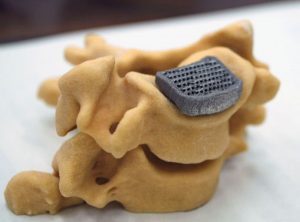
3-D Printed Artifical Bone

Artificial bone made using a 3D printer
Copied from 
http://www.3ders.org/articles/20130813-japanese-patients-successfully-received-3d-printed-bone-transplants.html

New type of blog entry. Don’t know how often I will write a “Geeking Science” blog, but I hope you enjoy them.

***

So, you may ask, what is Source-Replicator technology and why do I think it is a “near future” science fiction.

3D printing technology will be the next major game changer. Just like wireless communication has affected nearly everything we do – TV remotes, cell phones, computer wi-fi, the wireless keyboard and mouse, eBooks, pre-pay toll booths, RFID inventory, GPS car directions – once printing technology matures the applications will be countless. And it is very nearly mature.

Experiments and actual use of the technology is happening in the automotive, dental, medical, fashion, food, and many other industries. Open source 3D printing is available for several items.

Where most manufacturing is about removing stuff you don’t need – trimming wood or metal down until you have the object’s shape, 3D printing is about additive manufacturing. You only use the materials you need to make the item.

In automotive, computer modeling has replaced many of the physical modules they used to build. They still need to make a few modules, usually sculptures, to do real world tests. Now a flick of the button releases the prototype, saving weeks in the development cycle.

What makes this a game changer is ANYTHING which can be crafted can be “printed”. Pizza for Mars () in development.  Need to replace compressed spinal bones (a common back aliment), already done in Japan with printed bone transplants (http://www.3ders.org/articles/20130813-japanese-patients-successfully-received-3d-printed-bone-transplants.html). Well bone is easy, but how about more complicated items forever on the transplant wait list? How about a working liver? A “printed” one has been successfully placed into a mouse (https://www.popsci.com/science/article/2013-07/how-3-d-printing-body-parts-will-revolutionize-medicine/). Oh, and rejection? The base is from the patient’s own cells. Bioprinting skin grafts for burn victims, new heart valves to replaced damaged ones, even replacement ears – all happening RIGHT NOW!

That printer for skin grafts – they are making it portable. As in, be able to take into the field for disasters and third world hospitals.

Imagine wearing clothes made for you. Not just off the shelf, but going into a store, getting laser measured and a pair of jeans comes out ten minutes later fitted for your bootie. No more compromising a dress either too tight on top or too loose on bottom.  The next generation will look back and laugh, going – didn’t they know how to wear clothes? Like the present generation, when we talk about a car stalling out and walking to the nearest gas station – why didn’t you just call on your cell, mom?

How about getting a car repaired? Have to wait until the mechanic order parts? No more. The wait is maybe 30 minutes if the material needed for the part isn’t too specialized like a platinum plug.

This is very real, and very now. In the 80’s we laughed at the large cell phones, even as we saw their potential. We did not realize all the things that would change with the wireless technology.

I don’t know what all will change with the 3D printing technology, but the writing on the wall has started. Industries will vanish, while new ones form. Medical will continue to evolve, making us healthier, longer – and for less expense – and all the implications of long-life impacting social security, job opportunities, and  recreational freedom.

I labeled flashes of “Pickup Line” and “Keep Trucking” as science fiction. They were actually intellectual exercises figuring out how our lives may change in the near future.

We live in amazing times.