Geeking Science: Sweden Solar System

Model of Sedna in Luleå, part of the Sweden Solar System – 10/17/2009 by Dag Lindgren
https://commons.wikimedia.org/wiki/File:Sweden_Solar_System_-_Sedna_2.JPG

Someone in Sweden seriously wanted to win the class diorama in a shoebox science project.

In 1998, Sweden started a Solar System project where the Sun, planets, and various other features of the Solar System (including the termination shockwave) plays out in a scale of 1 to 20 million. The rocky planets are close to the sun, all located in and around Stockholm. The balance stretches the length of the country.

The models are owned and maintained by their makers, and is coordinated by the Swedish Astronomical Society. (Sweden Solar System) At present count in 2022, there are 25 parts to the model.

How did I not know this existed before now?!? I now have something for my bucket travel list.

Bibliography

Hargreaves, Andy. “Sweden Solar System.” YouTube. January 2, 2017. https://www.youtube.com/watch?v=IQBjKCG-BKo – last viewed 12/20/2022.

Sweden Solar System. “The Sweden Solar System.” (undated). – last viewed 12/20/2022.

wikivoyage. “Sweden Solar System.” (undated) https://en.wikivoyage.org/wiki/Sweden_Solar_System#:~:text=Sweden%20Solar%20System%20is%20the,are%20scattered%20across%20northern%20Sweden. – last viewed 12/20/2022.

Geeking Science: Anumeric

Photo by Susan Holt Simpson on Unsplash

Did you know some languages do not have numbers? Few, some, or many is all humans needed for the longest time. Eventually one-two-three became useful. Then, likely, five to ten, and, taking off the shoes, got you to twenty.

English even hints at the importance of the most basic numbers – one through ten – being easy-to-pronounce and short-to-spell. Eleven and twelve continue the uniqueness. After that, everything is duplicates – the teens, twenties and so forth. One through ten came first, and came first a long time in the language world before even eleven and twelve, let alone “high” numbers like fifteen.

Would numbers be different for other species? 

Caleb Everett discusses in “‘Anumeric’ people: What happens when a language has no words for numbers?” (published 25 April 2017) cultures in humanity where number do not exist or exist on a minimal level.

How fun would this be to bring to a sci-fi worldbuilding? Read the article – the one line about how minutes and seconds coming from Mesopotamia gives me so many ideas.

Geeking Science: One Gender Research

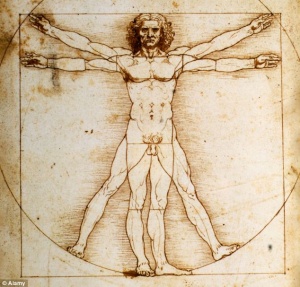
Uomo Vitruviano Vitruvian Man 1492 Leonardo Da Vinci.


Taking medicine or having surgery can be problematic for women. Pain impacts healing, hormones cycles react with immunity building from vaccinations, life cycle changes alter heart health. AND NONE OF IT HAS BEEN STUDIED!!! Not really.

Because it is “too complicated”.

Half of humanity, and the differences everyone says exists between men and women medically, have never been really studied. 

Testing of drugs, longitudinal studies of human health, EVEN ANIMAL TESTING. Male subjects only need apply.

“For much of documented history, women have been excluded from medical and science knowledge production, so essentially we’ve ended up with a healthcare system, among other things in society, that has been made by men for men,” Dr Kate Young, a public health researcher at Monash University in Australia

Want to test diets? The 1982 Multiple Risk Factor Intervention Trial, seeing if dietary change and exercise can prevent heart disease – only men subjects, all 13,000 participants were male.

And why animal testing on only male subjects? Well, the female subjects just added too much extra data to track. Too much complication.

Never mind over half of humanity taking the drugs after they are through going through the (male only) animal trials and (male only) human trials are female. It’s too much work. And the few times they do include women, they forget to break out the gender separate.

Is it any wonder the drugs are not as effective?

We need to do better.

Short and quick in article format:

Jackson, Gabrielle. “The female problem: how male bias in medical trials ruined women’s health.” The Guardian. 2019 Nov 13. https://www.theguardian.com/lifeandstyle/2019/nov/13/the-female-problem-male-bias-in-medical-trials?fbclid=IwAR2SYwQzIMZze958gnL2-Zu7nxYFF04iA5aUeHtqULBzhHCoyrFc5ayivLU (last viewed 4/5/2022)

Full book format:

Jackson, Gabrielle. “Pain and Prejudice: How the Medical System Ignores Women – And What We Can do About It” (Amazon link)

Geeking Science: Plant Trees

Photo by Eyoel Kahssay on Unsplash

Planting trees is essential for reversing climate change.

I mentioned my “duh” moment of the important of trees back in 2018 (Geeking Science: Trees and Oxygen). Because trees are MUCH taller than everything humanity replaces them with, the VOLUME of tree oxygen production is much higher than crops or grass.

Trees also STORE a lot of carbon, much more than grass. A study shows that trees planted in a manner that doesn’t impact human cities or agriculture can still store two-thirds of the carbon humanity needs to pull out of the atmosphere to mitigate the worse aspects of climate change. (Good News Network, 2019)

You may wonder if planting trees will really make a difference. Seems possible based on what happened in the 1500s when within a single century the indigenous population of the Americas was reduced by 90% from 60 million to 6 million. All that farmland used by the Inca, Sioux, Cree, etc. became reclaimed by the forest. Antarctic ice core studies show a reduction in carbon by 7 to 10 part per million because of that. While the Little Ice Age started before the 1500s, its onset spurred by volcanic eruptions, the temperatures reached their all-time lows during century where nearly all farmland in America disappeared. (Geggel, 2019)

Now this particular study of agriculture losses in the Americas impacting carbon levels is still in the “lots of questions” stage of scientific investigation. Until at least two or three other studies are needed to support or refute the postulate; a grain of salt needs to be taken with these “facts.” They are not facts per se, just theories, and not widely accepted ones as yet. But they have enough heft, they do warrant further study.

Trees also have other benefits, especially when added to an urban area. They reduce pollutants. Make life prettier and reduce noise. Decreases stress and family violence. Connect eco-spheres isolated within the urban setting. Control storm water, holding water in their leaves and roots to reduce flooding issues. And, most importantly (and easiest to prove), reduce urban heat island effects – reducing heat-related illness and death, air conditioning costs, and road maintenance.  All this on top of controlling carbon levels which MAY help mitigate climate change. (Grants Pass Oregon)

I’m willing to take climate change as a BONUS, and make Urban Forests into reality just for all the other benefits.

Acquired from the internet hive brain (Copyright © 2014 CartoonArts International)

Bibliography

Geggel, Laura. “European Slaughters of Indigenous Americans May Have Cooled the Planet. LiveScience. 2019 February 8. https://www.livescience.com/64723-great-dying-little-ice-age.html (last viewed 4/10/2022)

Good News Network. “For First Time Ever, Scientists Identify How Many Trees to Plant and Where to Plant Them to Stop Climate Crisis.” 2019 July 7. https://www.goodnewsnetwork.org/how-many-trees-to-plant-to-stop-climate-crisis/ (last viewed 4/10/2022)

Grants Pass Oregon. “Appendix A: Benefits of Trees in Urban Areas.” https://www.grantspassoregon.gov/DocumentCenter/View/1626/Chapter-3-Appendix-A-PDF (last viewed 4/10/2022)


Geeking Science: Reading in Bed

Photo by Nicole Wolf on Unsplash

Click bait –

The Dangers of Reading in Bed!

Fire erupts!

Dangerous Solitude!

Unhealthy immoral practices!

Selfishness!

If headlines from the 17th and 18th century read like modern clickbait, and, really, headlines always have, titles like the above would have flagged the new and crazy practice of reading ALONE IN BED. Find out more in The Atlantic May 19, 2017 post by Nika Mavrody in “The Dangers of Reading in Bed”.

The article is a well-researched and sociology-leaning article about what happens when technology changes society. Books became more common, and more people had private space and time. First the society shifted to having more books available with the printing press. But still expensive. Then they became less expensive, but the reading skill was limited. Displacing storytelling, public reading evolved as the norm. Someone who could read would read aloud to a group. Interactive reading with questions, noise, and  interruptions.

Around about the same time, sleeping changed from shared sleep space in the one-room houses, to rooms dedicated to sleeping – with real doors to close other people out. Real readers now had the opportunity to read in private without interruption. They grabbed it with both hands.

This group of people, the private reader, crossed all lines of society.

The combination major change with reading and sleeping habits upset the society standard, and people were chastised for changing.

Sound familiar?

Like all of human history?

Again, find out more about this deviant practice here: https://www.theatlantic.com/technology/archive/2017/05/reading-in-bed/527388/