Geeking Science: Learning through Paper vs. Tech

Photo by @felipepelaquim on Unsplash

I’m cleaning out old emails, e-newsletters, e-magazines, saved bookmarks, and saved facebook posts off my computer. What a backlog – hundreds of articles and posts and emails I meant to get to “some day”. That “some day” has been over half a year now to process all of the mountain of information. I quickly skim through them, turn some of the more interesting ones into blogs (getting me caught up on my backlog of blogs from the Pandemic), and move on.

Then I hit two articles which made me pause – one is how reading from paper vs a screen produces different learning results, and the other is how notetaking on paper vs. screen produces different learning results.

Technology is a great equalizer, giving those with limited funds access to books and education not previously available. School systems no longer need to devote a budget to books, just tablets and wi-fi, giving teachers options in their instructional process.

Technology is also great for the environment. All that paper no longer needs to be printed, moved, stored, restored after children fingers touch it, and eventually, desposed. And for those of us who never have enough bookshelves, all that time saved culling them annually gives more time reading.

If you can find books on your Kindle. (Could it be LESS user friendly on keeping track of the to-be-read pile vs. the finished-but-want-again vs. the done-and-out?)

Basically buried by books either paper or electronically.

But what happens when learning?

Well, if reading from a screen, students read faster and grabbed the general topics fine. But the meat-and-potatoes of the topic, not so much. Unless the topic was only a page long – then comprehension was the same from paper and screen. (Alexander and Singer) Personally, I’ve noticed the same when reading novels – the ability to jump around in paper – to interact with the story – just doesn’t work on the screen. It’s a front-to-back read, nonstop. When reading novels on paper, I can put the book down and think for a moment, explore in my mind, but somehow with a computer or tablet screen, that dip against the chest and stare-off-into-the-distance of the story doesn’t happen.

The take-away is for most things, screen in fine. Skimming newspaper articles, flipping through magazines which you are not going to return to, getting general information, all this is great for computer and tablets. But if it is something you need to LEARN, lecture and paper is the way to go. Prepping for an anatomy exam to become a doctor, paper books. Prepping for your own operation so you have a clue what the doctor is going to do, screen should be fine. Figure out the level you need to learn the topic and choose the appropriate tools.

How about note-taking? The writing end of things – what we are more interested in as authors.

If note-taking on a computer, it is in-the-ears-and-out-the-fingers verbatim. No processing occurring. I know the truth of this from the times I did transcription – sometimes the people I was transcribing for asked me what I thought and I was like, I don’t have a clue, I’ll need to read it after I’m done.

But if note-taking on paper, the student can’t write as fast as the professor talks, so they have to process and shorten for notes. That processing requires thinking and lecture material sinks in when choosing what needs to be remembered. (npr)

Note-taking on paper is better than just listening without note-taking because of that interaction to record the material … so long as it isn’t a transcription (word-for-word, like using short-hand). (Note, this particular opinion is personal and is not covered in the Bibliography, but a quick google-search backs it up. It’s a topic for another day.)

The study that npr reviewed included testing to see how much people retained immediately after. Then they did a second test, allowing time to study the notes then come back. And even with the much more verbose notes from the computer typing, the paper note-taking produced better comprehension.

But let’s also be truthful on how college works. The students are BURIED under reading and lectures. I know when I did the classes, I always meant to go back and rewrite the notes to get a better understanding. Never had the time. So verbatim notes, those aren’t going to be read; the student would have been better off just listening in class, no matter how much the teacher wants to see all those students taking notes.

The best purpose of notes is the encoding and higher-level thinking during the note-taking, which means writing, not typing or recording.

Even if the student never touches those notes, writing them was important.

Part of this year’s decluttering for me will include throwing out all those notes from college, once I’m done digging myself from the electronic mountain. I need to stop being buried under electronics and papers and actually process the materials I saved for “one day”. Like these two articles.

Bibliography

Alexander, Patricia A. and Singer, Lauren M. “A new study shows that students learn way more effectively from print textbooks than screens.” Insider. October 15, 2017. https://www.businessinsider.com/students-learning-education-print-textbooks-screens-study-2017-10 – last viewed 1/3/2023.

npr. “Attention, Students: Put Your Laptops Away.” April 17, 2016. https://www.npr.org/2016/04/17/474525392/attention-students-put-your-laptops-away – last viewed 1/3/2023.

Geeking Science: Capturing Bubbles in CGI and other Black Matters

Black Panther: Wakanda Forever Movie Poster from Internet Hive Mind

Photography has been a white person game for a long time. The film for photos and film was optimized for light skin. When computer special effects came around, CGI illumination of skin likewise concentrated on the melatonin levels found in the layers of Caucasian skin. CGI hair mimicked either clumped animal hair or straight Caucasian hair.

Time for change.

Quick background – really, lighting for film concentrated on making white people to look good. It’s hard to make someone look good when the tools aren’t even on your side. For example

“Shirley cards” used by film-makers to calibrate skin tones and light, only featured Caucasian models until well into the 70s (and only changed because of complaints from photographers trying to advertise chocolate or wood furniture).  (Latif, 2022)

During the creation of Shrek, animators discovered skin looked more real when created with layers of reflection.

If you shine a laser pointer on a wall you’ll see just a small spot of light. But shine it on your hand and you’ll see a blob of red light because the light is spread around,” said Stephen Marschner, a professor of computer graphics at Cornell University in Ithaca, N.Y.  (Onion, 2005)

To get skin to look real, the CGI character models needed layers to the outer shell replicating light interaction with skin. The programmers in the early oughts (00s) tapped research in the medical community studying skin for cancer and to find the difference between young and old skin to create their algorithms. (Secondary Rabbit Hole: The medical community used light refraction to study the difference between old and young skin, by analyzing “the skin between the thumb and the first finger of 400 Caucasian women ranging in age from 10 to 70.” (Onion) – and some of the discoveries are really cool and will impact makeup and health for decades to come. Note the studies used to create the algorithms were from Caucasian subjects.)

Change was needed when Wakanda Forever wanted to do underwater scenes with people of color, both Mexico-born and African heritage. Not only did they need to redo algorithms to account for different melatonin amounts in different levels of the CGI character model layers, but also deal with the underwater light diffusion.

Then the Wakanda Forever programmers had to start all over with the CGI algorithms for hair. Aquaman came first, and those movie makers said that the CGI effects for hair were tough. (Failes, 2018) Unlike Aquaman, Wakanda Forever did a lot of wet shooting and discovered something. Curly and kinky hair captures air – bubbles happen. Not only does kinky hair flow different underwater, but if reproducing people who recently went underwater, air bubbles need to be taken into account.

The science of filmmaking is worth geeking about, especially as inclusion and representation pushes technology boundaries, even in the CGI algorithms. If you are interested in photograph or filmmaking or CGI animation, I highly recommend diving down this rabbit hole.

Also check out a third rabbit hole on the hair styles for Wakanda Forever (Cummings, 2022)).

Bibliography

Alter, Ethan. “How the ‘Wakanda Forever’ visual effects team evolved the way Black skin and hair are digitally replicated onscreen.” aol.com. 12/21/2022. https://www.aol.com/entertainment/wakanda-forever-visual-effects-team-213304735.html – last viewed 12/27/2022.

Cummings, Faith. “The Story Behind the Stunning Array of Hair Looks in Black Panther: Wakanda Forever.” Vogue. 11/21/2022. https://www.vogue.com/article/black-panther-wakanda-forever-hair-camille-friend – last viewed 12/27/2022.

Failes, Ian. “In ‘Aquaman,’ Underwater CG Hair Was Surprisingly One of the Toughest Effect.” Cartoon Brew. 12/30/2018. – last viewed 12/27/2022.

Latif, Nadia. “It’s lit! How film finally learned to light black skin.” The Guardian. 9/21/2017. https://www.theguardian.com/film/2017/sep/21/its-lit-how-film-finally-learned-how-to-light-black-skin – last viewed 12/27/2022.

Onion, Amanda. “Shrek Animators, Dermatologists Share Beauty Secret.” ABCnews. 4/4/2005. https://abcnews.go.com/Technology/Health/story?id=609818&page=1 – last viewed 12/27/2022.

Geeking Science: COVID More than Once

Three and a half years into the pandemic, now also endemic, first shot and a couple boosters (thank you universe for human ingenuity to quickly identify and create a vaccine), COVID-19 aspects continue to prove its Novel aspect.
Normally I love Novels … but not so much in medicine as novel there means new and unprecedented. Or, really, “we don’t know what the f* is going to happen until it happens.” The brains are trying so hard, and studying so much, but the mutations and the reinfections are do a fan dance reveal, hiding all the good stuff from the scientists.
Especially for long-term COVID.
Remember at the beginning we thought COVID-19 was the typical respiratory disease with its coughing and pneumonia like reactions. The big worry was the cytokine storm killing people. Took a little time to figure out how best to care for people to prevent the storm.
But COVID was hiding what it really was when hanging out in the blood-rich lungs. Now we know it is a vasculature disease – anywhere blood flows, COVID goes. And what it really likes to damage during its house parties is the itsy-bitsy blood vessels carrying oxygen from the lungs to the brain, hence Brain Fog being one of the worst hits of this disease.
A … study from Washington University School of Medicine in St. Louis and the Veterans Affairs St. Louis Health Care system shows the health consequences of reinfection. The researchers found that repeat SARS-CoV-2 infections contribute significant additional risk of adverse health conditions in multiple organ systems. (Sauerwein. 2022)
Unlike glorious chicken-pox, which is pretty much a one and done, COVID can be caught more than once, and each round contributes to the damage making acute COVID more likely, long-term COVID more likely, and all the other hosts of issues. Thanks to the vast database of the Veterans Affairs, cases could be studied from initial infection through further courses of care, and a lot of reveals came out.
The small scars riddled throughout the blood system increases heart attacks and strokes.
(P)eople with repeat infections were 3½ times more likely to develop lung problems, three times more likely to suffer heart conditions and 1.6 times more likely to experience brain conditions than patients who had been infected with the virus once. (Sauerwein, 2022)
The bottom line is, COVID isn’t done and we need to avoid catching it still.
Stay safe and stay well folks. Be cautious with our new normal.
Bibliography
AdventHealth. “COVID-19: Transitioning from Pandemic to Endemic.” August 24, 2022. https://www.adventhealth.com/blog/covid-19-transitioning-pandemic-endemic – last viewed 12/23/2022.
Martinez-Salazar, B. Holwerda, M. Studle, C. Piragyte, I. Mercader, N. Engelhardt, B. Rieben, R. and Doring, Y. “COVID-19 and the Vasculature: Current Aspects and Long-Term Consequences.” Frontiers in Cell and Development Biology. February 15, 2022. https://www.frontiersin.org/articles/10.3389/fcell.2022.824851/full – last viewed 12/23/2022.
Sauerwein, Kristina. “Repeat COVID-19 infections increase risk of organ failure, death.” Washington University School of Medicine in St. Louis. November 10, 2022. https://medicine.wustl.edu/news/repeat-covid-19-infections-increase-risk-of-organ-failure-death/ – last viewed 12/23/2022.

Geeking Science: R is for Reef and Real Estate Race

Artist’s illustration of Orbital Reef, a private space station project involving Blue Origin, Sierra Space, and a number of other partners. (Image credit: Sierra Space/Blue Origin)

The International Space Station (ISS) first launched component settled in orbit in 1998 with residents moving in November 2000. “The station has been continuously occupied for 22 years … having surpassed the previous record of 9 years and 357 days held by the Mir space station.” (Wikipedia, International Space Station). The International part of the title has proven well-used with the support of five space agencies: NASA (United States), Roscosmos (Russia), JAXA (Japan), ESA (Europe) and CSA (Canada).

The original plan for decommission was a mere 15 years (2015), but it has been extended several times. Even so, the extensions can’t continue forever. The wear and tear of long-term use, the leaks and holes, are adding up. (Inverse) Also in the mix in the Russia’s shenanigans in Ukraine, and the world hitting them with sanctions. The aggressor might pull out their funding early, previously planned to continue to 2024, in protest of getting called on the carpet for their actions.

2031 is becoming the hard-fast de-orbit date, with 2030 being when the shop will close up for the safety of all involved and the lights will be turned off.

The ISS will join all the Salyut stations (seven from 1971-1991 USSR), Skylab (1973-1979 USA), Mir (1986-2001 Russia), and the two Tiangong (2011-2019 China) in retirement. Once the station lands in Point Nemo, only Tiangong 3 will remain in orbit (2021-present, China).

Unless something changes. And boy-o-boy, are changes in the plans.

Several countries are thinking of creating their own stations.

But the first in line to deliver might be Amazon.

Well, Blue Origin (wholly owned by Jeff Brazos) (Cuofano 2022).

Blue Origin and Sierra Nevada Corporation plan to create a space station for commercial space activities and space tourism. The news brief for the plans released in October 2021, and the plans have been continuing apace, including approval by NASA.

The title for the planned station is Orbital Reef.

Some of the conversations on building Orbital Reef include using the ISS as a jumping point. Basically a port to work from.

Russia has been lifting new modules up for a Russian Orbital Service Station (ROSS) – official launch date of 2025. America and the international community of the ISS (without Russia), likewise, are working on Axiom Station and Lunar Gateway for science activities and as part of the Artemis program for lunar landings and human missions to Mars. All these government space stations, as well as several commercial ventures, are hoped to be online before 2030. The Orbital Reef is the most ambitious with a crew size of 10; most of the others are aiming for 4.

NASA’s Commercial Low-Earth Orbit Development (CLDP) program aims at getting AT LEAST one commercial outpost up and running before the ISS lights go out. Orbital Reef, Starlab (by NanoRacks) and an unnamed concept (by Northrop Grumman) all have received grants after the initial plans have been reviewed and approved by NASA. (Wall)

I’m highly entertained by Orbital Reef being referred to a “turn-key” location, where a (space) business park can be scaled to serve markets. Like one can just go to a relator and state your needs, and they hand you the key to a building.

The large crew of ten for Orbital Reef is aimed at supporting the renters, including a possible space hotel. “We sell only the utilities and services you need to sustain your business: power, cooling, high-bandwidth communication, information and physical security, robotic services, technician attention, stowage, and logistics.” More can be found on this sci-fi, soon to be science fact, location at .

Planning on filming a commercial that needs microgravity? They got you covered. Need microgravity to create the next microchip? Think Orbital Reef.

Key to the dream of the Orbital Reef is Dream Chaser, a pint-sized reusable space plane. Sierra Space hopes to demonstrate viability in a February 2023 launch aboard the ULA Vulcan Centaur booster rocket.

Tons of prep-work and moving parts are in play for 2023 with 2024 being the year of heavy lifting into orbit as things get off the production line. Be interesting to see who wins the low-Earth orbit real estate race.

Bibliography

Clark, Stephen. “Blue Origin and Sierra Space team up for commercial space station.” Spaceflight Now. October 25, 2021. – last viewed 12/21/2022.

Foust, Jeff. “Orbital Reef passes NASA review.” SpaceNews. August 22, 2022. https://spacenews.com/orbital-reef-passes-nasa-review/ – last viewed 12/21/2022.

Cuofano, Gennaro. “Who owns Blue Origin?” FourWeekMBA. September 30, 2022. https://fourweekmba.com/who-owns-blue-origin/ – last viewed 12/21/2022.

Inverse. “NASA Plans to Obliterate the International Space Station – Here’s How.” (undated). https://www.inverse.com/science/nasa-kill-iss – last viewed 12/21/2022.

Kirk, Benny. “Space Shuttle vs Dream Chaser: Can This Pint Sized Space Plane Really Replace an Icon?” autoevolution. October 21, 2022. – last viewed 12/21/2022.

Orbital Reef. (website, undated). – last viewed 12/21/2022.

The Planetary Society. “Missing Briefings: Blue Origin wants to build its own space station.” The Downlink. October 29, 2021. (email newsletter)

Shields, Ken (of Sierra Space Corp). “Orbital Reef: A Space Station for a New Economy of Space.” IEEE-CNSV Consultants’ Network of Silicon Valley. March 8, 2022. – last viewed 12/21/2022.

Wall, Mike. “Blue Origin’s private Orbital Reef space station passes key design review.” Space.com. August 24, 2022. https://www.space.com/blue-origin-orbital-reef-system-definition-review – last viewed 12/21/2022.

Wikipedia. “International Space Station.” (undated) https://en.wikipedia.org/wiki/International_Space_Station – last viewed 12/21/2022.

Wikipedia. “List of space stations.” (undated). https://en.wikipedia.org/wiki/List_of_space_stations – last viewed 12/21/2022.

Wikipedia. “Orbital Reef.” (undated) https://en.wikipedia.org/wiki/Orbital_Reef – last viewed 12/21/2022.

Geeking Science: Dust to Dust

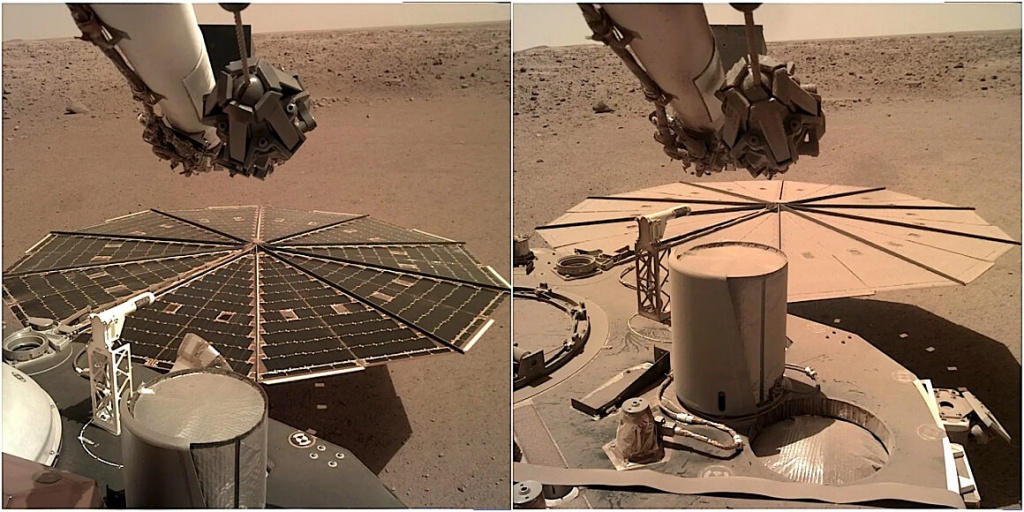
Image credit: NASA/JPL-Caltech.

On the left is a selfie from the InSight lander in December 2018, on the right is one from June 2021. (The Planetary Society)

Martian dust finally claimed the InSight on December 18, 2022, when it stopped responding to communication. (NASA, 2022) Originally planned for a 2018-2020 lifespan, the lander, like so many of it’s Martian relatives, push onward, doubling the mission time.

The primary mission was a seismometer to track Marsquakes. No one was sure if anything would be detected at all before sending the testing equipment, and the risk proved worthwhile, resulting in over 1,300 seismic event with the biggest one on May 2022 (during the bonus time mission) of a magnitude of 5, with vibrations continuing through the planet for at least six hours. (NASA, undated) Those seismic events have given a look at the Mars interior – proving it has a crust, mantle, and core with the crust thinner than expected. In addition the quakes indicate, Mars is still very much a living planet with a molten core.

In 2021, a magnitude 4 Marsquake ended up being attributed to a meteoroid strike. The Mars Reconnaissance Orbiter found the impact site … with churned up water ice previously buried underground. (Treisman)

Thank you InSight for your long service. Dust to dust.

Bibliography

Foust, Jeff. “NASA confirms impending end for InSight.” SpaceNews. May 18, 2022. https://spacenews.com/nasa-confirms-impending-end-for-insight/ – last viewed 12/20/2022.

Malik, Tariq. “This may be the last Mars photo from NASA’s InSight lander before it dies on the Red Planet.” Space.com. December 20, 2022. https://www.space.com/mars-insight-lander-possible-final-photo – last viewed 12/20/2022.

NASA. “InSight Mission News – Mission Updates.” December 19, 2022. https://mars.nasa.gov/insight/news-and-events/status/#:~:text=12%2C%202022-,As%20of%20Dec.,range%20from%200.6%2D0.7). – last viewed 12/20/2022.

NASA. “InSight Top Science Results: Detected First Quake on Another Planet.” (undated). https://mars.nasa.gov/insight/mission/science/results/ – last viewed 12/20/2022

The Planetary Society. “Space Snapshot.” The Downlink. May 27, 2022. (email newsletter)

Treisman, Rachel. “Goodnight, sweet spacecraft: NASA’s InSight lander may have just signed off from Mars.” npr.org. December 20, 2022. https://www.npr.org/2022/12/20/1144402999/nasa-insight-mars-lander – last viewed 12/20/2022.