Geeking Science: Mirror Mirror, who is the fastest of them all

NASA – John Hopkins Applied Physics Laboratory Patch for the Parker Solar Probe

Back in 2017 I wrote about how Fast things can go in space in a Geeking Science: Fast, Faster, Fastest (5/18/2017), and discussed the expectation of the Parker Solar Probe expected to be the fastest man-made thing Out There – maybe hitting 0.0671% the speed of light. I figured it is time to check in on the results; it has been six years … six very long years here on Earth.

The PSP launched on August 12, 2018, with its first close swingby the sun on November 5 of the same year. Since then it’s been flying an oval between the Sun and Venus’ orbit has been using Vensus’ gravity, when it is in that part of space at the same time as the probe, each lap to aim the probe closer and closer to the sun during the perihelion turn. “A Mission to Touch the Sun” isn’t just a slogan. They are using the probe to explore the sun’s corona, taking measurements and imagery. One part so scientists and meteorologists can better predict solar storms affecting technology on earth, one part to better understand solar wind as humanity continues to develop solar sail technology, and a whole bunch of other parts, because nearest star!

PSP has completed seventeen flybys and will accomplish the eighteenth on December 29, just before the new year flips. Each sling shot around the sun picks up speed – with the adjusted top speed (now that it has been running for a while) to be be hit sometime in 2025 to be 0.0641% of the speed of light. A little slower than originally hoped but still super fast at 430,000 miles per hour.

Each sling shot around Venus (only seven due to the Evening Star planet moving through its orbit), tightens the orbit to bring it closer to the sun’s atmosphere. The downside is the Venus gravity corrections do slow the probe down. With its most recent pass of the sun (the 17th), the probe hit 394,736 mph – or 0.0589% the speed of light. The fastest thing that humanity has ever put up there.

When will another man-made creation break this record? Don’t know.

But humanity will need to do so, because visiting other stars needs to be faster than this. At the top speed of 0.0641%, if somehow we made it instantaneous and constant, from here to Proxima Centauri would take over seven thousand years … even to reach Eris, a dwarf planet in the Orts cloud, 13 light hours from Earth, would take over two  and a half years. The real tech available now, without the constant orbits dropping into the Sol’s gravity field, is more like ten times that at twenty-five years.

Still the achievement of fastest is amazing. And the study of the star of the solar system is crucial. If Cosmic-Ray energy or heliosphere perimeters excite you, be sure to check out the PSP website “publication” section. Many of the papers drawing from the data collected by this can-do hot-stuff probe are available there.

Bibliography

Website: https://parkersolarprobe.jhuapl.edu/The-Mission/ – last viewed 11/16/2023

“For the Record: Parker Solar Probe Sets Distance, Speed Marks on 17th Swing by the Sun.” Nasa Parker Solar Probe. 28 September 2023. (https://parkersolarprobe.jhuapl.edu/News-Center/Show-Article.php?articleID=193 – last viewed 11/16/2023)

Witze, Alexandra. “Astromers Find the Farthest-Out Solar System Object Ever Seen.” Scientific American. 10 November 2015. (https://www.scientificamerican.com/article/astronomers-find-the-farthest-out-solar-system-object-ever-seen/ – last viewed 11/16/2023)

Geeking Science: Period

Photo by Forest Simon on Unsplash

The thing that takes up most of humanity’s time is food – food preparation (planting, growing, harvesting, transportation, finding, shopping, preparing, cooking, eating, cleaning up). It takes a lot of effort to keep our bodies in the calories to keep them moving. Thanks to modern technology, food preparation has been concentrated to specializations like farmer, grocers, and cooks, leaving time for other things and other specializations. But outside of sleeping, food still eats up a lot of our time.

Sleeping (preparation, recovery, doing) takes up about a third of humanity’s time.

Food took nearly the entire non-sleeping time for most of humanity, except for raising the next generation, until recently.

You know what also impacts a significant amount of time for humanity? We never really talk about it. It is considered in most cultures even more taboo than defecation. In fact, I think it is hands down the most public “secret” of humanity. Period.

That’s right, menstruation.  Strung together, it takes up around 7 years of a ovulating person’s life. Let’s say an average of THREE YEARS per human on the planet – that is about 4% of everyone’s times … or close to 10% of the ovulating person’s lifespan. Thank goodness the five or so days only happens once a month.

Hey, don’t turn away. This is Geeking Science, sociology style. Did you know that Menstruation is stigmatized all over the world? (unicef.org) With about half of all females at reproductive age – ONE QUARTER OF THE ENTIRE PLANET – to have it be a “secret” is beyond stupid, it’s dangerous.

It impacts female’s ability to attend school. When access to running water, or pads, or cleaning facilities is limited, teen girls often say home. Humanity is leaking skills when education and knowledge isn’t passed on, especially to those raising the next generation.

It impacts women’s ability to maintain jobs when health care isn’t available. Lord knows, my cycle had me cramping so bad I vomited every month for decades. Until I figured out just how to get the sugar levels AND the pain levels under control for the first three days, my natural cycle devastated my ability to function on the job. I didn’t have much in sick leave outside of managing my period. I can’t imagine what it would have been like without access running water, easy food, pain killers, and a job that allowed sick leave.

It impacts political decisions, dangerously so, when those making the decision are working without all the facts they need because of stigma and nearly willful ignorance.

We need to break the barriers of shame and misunderstanding.

***

UNICEF issued Nine Key Facts on Menstruation because:

“At UNICEF, we envision a world where every girl can learn, play, and safeguard her own health without experiencing stress, shame, or unnecessary barriers to information or supplies during menstruation,” said Sanjay Wijesekera UNICEF Chief of Water, Sanitation and Hygiene. “Meeting the hygiene needs of all adolescent girls is a fundamental issue of human rights, dignity, and public health.”

(One) TIME – On average a woman menstruates for about 7 years during their lifetime

(Two) EMOTIONS and EMOTIONAL SUPPORT – The first period can be met with either celebration, fear or concern. For every girl, this signifies an important transition to womanhood – a time when they would benefit from the support of family and friends.

(Three) UNDERSTANDING – Many girls do not have complete and accurate understanding of menstruation as a normal biological process. Educating girls before their first period — and, importantly, boys — on menstruation, builds their confidence, contributes to social solidarity and encourages healthy habits. Such information should be provided at home and at school.

(Four) HEALTH – Poor menstrual hygiene can pose physical health risks and has been linked to reproductive and urinary tract infections. Many girls and women have limited options for affordable menstrual materials. Providing access to private facilities with water and safer low-cost menstrual materials could reduce urogenital diseases.

(Five) SPECIAL NEEDS – Girls and women with disabilities and special needs face additional challenges with menstrual hygiene and are affected disproportionately with lack of access to toilets with water and materials to manage their period.

(Six) EMERGENCIES – Many women and girls do not have access to materials to manage their menstruation, especially in times of emergency — natural disasters and conflicts. In emergencies, UNICEF provides dignity kits to women and girls, which include sanitary pads, a flashlight and whistle for personal safety when using the toilet.

(Seven) SANITATION – Globally, 2.3 billion people lack basic sanitation services and in Least Developed Countries only 27 per cent of the population has a handwashing facility with water and soap at home. Managing periods at home is a major challenge for women and adolescent girls who lack these basic facilities at home.

(Eight) EDUCATION – About half of the schools in low-income countries lack adequate drinking water, sanitation and hygiene crucial for girls and female teachers to manage their period. Inadequate facilities can affect girls’ experience at school, causing them to miss school during their period. All schools should provide running water, safe and clean toilets for adolescent girls. (And like many things specifically created to benefit one group of people, benefits all – Running water is necessary to the general health and safety of all students and teachers.)

(Nine) TABOOS – UNICEF is working with local communities, schools and governments to research and provide information about menstruation, promote positive hygiene habits and break down taboos. UNICEF also provides adequate facilities and supplies, including toilets, soap, and water to schools in some of the poorest regions.

***

Can you imagine living in a culture without heat, but because of taboos, you have to sleep alone while menstruating? The cramping can affect the body’s ability to control heat, making both the cold and cramping even worse.

I’m glad UNICEF is making it a priority to provide “dignity kits” during emergencies. Displaced women do not need to worry about the mess while escaping wildfires, earthquakes, and mudslides. Cleaning and disposal of the blood-rich sanitary protection materials is essential to reduce infections and disease, especially in situations such as natural emergencies. And knowledge of how long one can use a pad or tampon is necessary to avoid toxic shock syndrome (Cleveland Clinic), both in young girls, and those taking care of injured women during an evacuation needs to be shared far and wide.

With a quarter of humanity experiencing “the cycle”, education, materials, and sanitation measures are necessary. It’s not a “special” or “secret” thing. It’s a biological fact as much as sleeping and eating.

Bibliography

Cleveland Clinic – health essentials. “What Happens if You Leave a Tampon in Too Long?” 9 September 2022. https://health.clevelandclinic.org/what-happens-if-you-leave-a-tampon-in-too-long/ – last viewed 8 November 2023.

House, Sarah, Therese Mahon and Sue Cavill. “Menstrual hygiene matters: A resource for improving menstrual hygiene around the world.” – last viewed 8 November 2023 (this is a 354-page PDF.) (Note: PDF seems to be down as of 4/28/2024)

natracare. “15 Period questions teenage boys want answered.” https://www.natracare.com/blog/15-period-questions-teenage-boys-have/ – last viewed 8 November 2023.

UNICEF.org. “FAST FACTS: Nine things you didn’t know about menstruation.” 25 May 2018. – last viewed 8 November 2023.

 

Geeking Science: Just the Facts

“Just the facts” is not enough to convince people, even if every “rational” person you know believes them. Between confirmation bias and tribal communities, facts attacking a worldview can be as scary as weapons waved in the face – especially if the person sharing the facts is screaming them. Historically, isolating from the tribe with a new idea could mean death from the elements and world, so preference is given to close community over being able to say “I told you so.”

While the below video isn’t a scientific study, I found it a useful reminder that not everyone thinks like me.

Autism spectrum means my ties to community are really, really loose. I know I need a tribe, but, unlike most, it is a “fact” in my head not an emotionally deep understanding – so other facts can offset it. I vote against a group; I can stand and be that single voice. I think that is why autism variations have been perpetuated genetically, the ability to move against the tribe has saved the tribe enough that the universe marked it as a “good” mutation. Which, when all the spears are pointed at you because you spoke up, doesn’t mean as much for the individual. I got a lot of pinholes over the years and cried a river of tears.

The hint at the end is very useful: make sure when trying to change a person’s worldview, to first present a “we share a tribe” position first.

Remember this as we enter another COVID-Flu season. Remember this as we enter another Presidential election season in the United States. Remember this for the Ukraine-Russia conflict. Remember this for the Hamas-Israel government actions.

Remember we are all one tribe. One planet. One humanity.

Geeking Science: Drone Ingenuity

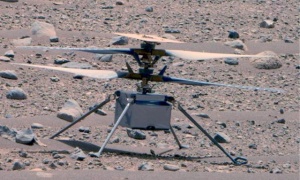
NASA’s Ingenuity Mars helicopter, photographed by the agency’s Perseverance rover on April 16, 2023. The rover captured this enhanced-color image using its Mastcam-Z instrument.

The drone is still at it, through dust and desire, Ingenuity – the Mars Helicopter – keeps going. Over fifty flights on another world, greatly adding to the scope of the rover missions with ariel reconnaissance. The first five missions were planned, the other forty plus (and still growing) flights are bonus. Over 90 minutes of airtime. Two years.

The machine was specially made for Mars thin atmosphere with blades that spin 10 times faster than what we need on Earth. (Mathewson)

What does this mean? Get ready to Geek OUT!!! Drones FLEETS flying Mars (not just satellites). Instead of the inch by precious inch of our rovers, we will have meters of flight, and maybe, one day, kilometers. Also RETRIEVAL of samples. The next group going to Mars will be picking up the rover soil samples, take them to a rocket to return the samples to earth. (Second video below)

And now that we have had proof of concept, other planets are being looked at too. If it got atmosphere, we will figure out how to fly it.

Except for Venus. That place is stoopid crazy hot.


Bibliography

Mathewson, Samantha. “Perseverance Mars rover snaps amazing shot of dusty Ingenuity helicopter (photo).” yahoo!news. 21 April 2023. https://news.yahoo.com/perseverance-mars-rover-snaps-amazing-130035119.html – last viewed 5/7/2023.

Nasa Jet Propulsion Laboratory. “Ingenuity Mars Helicopter Celebrates 50 Flights.” youtube.com. (youtube has stopped giving dates). See embed above – last viewed 5/7/2023.

Nasa Jet Propulsion Laboratory. “Ingenuity Helicopter Inspires Future Flights on Mars (Mars Report – April 2023)”. youtube.com (youtube has stopped giving dates). See embed above – last viewed 5/7/2023.

Nasa.gov “Nasa Science – Mars Helicopter Tech Demo.” (undated) – https://mars.nasa.gov/technology/helicopter/# – last viewed 5/7/2023.

Wall, Mike. “Mars helicopter Ingenuity aces 40th Red Planet flight.” space.com. 20 January 2023. https://www.space.com/mars-helicopter-ingenuity-40th-flight – last viewed 5/7/2023.


Geeking Science: The DNA of Political Science

Twisted science happens when politics drives the results. Makes the truth go to the dark side.

But what is a scientist to do when their funding comes from a corporation, person, or political organization?

Fiddle with the statistics, of course. Because if you fiddle enough, maybe, you get the results your benefactor/captor wants.

The most recent example of this comes from Florida and is related to COVID, where the Florida Surgeon General released an analysis claiming “an increased risk of cardiac-related death among men 18-39” who take the COVID vaccine. To get that result, six different statistical analysis were run, with a lot of relevant information dropped between drafts, until the Florida governor and his Surgeon General got a result of “vaccination bad”. Your Local Epidemiologist released an article on 27 April 2023 on the “Evolution of Florida vaccine analysis.” It’s fascinating and frightening.

A stark reminder that while trusting Science is a good thing, reviewing the behind-the-scenes politics may also be required. From “herbal remedies” to “diet science” to “four out of five…,” truth gets twisted from the basic research. If, indeed, the research was even done according to the scientific peer-review method.

Fear, funding, and freedom all impact what science can reveal.

Bibliography

CDC.gov. “Flu Season.” Centers for Disease Control and Prevention. (undated) . – last viewed 4/27/2023.

Chitty Chitty Bang Bang. “The Roses of Success”. (1968)

Jetelina, Katelyn and Kristen Panthagani, MD, PhD. “Evolution of Florida vaccine analysis.” Your Local Epidemiologist. (April, 27, 2023) https://yourlocalepidemiologist.substack.com/p/evolution-of-florida-vaccine-analysis?utm_medium=email&fbclid=IwAR03IJq0RbPPvDKL_DQu6CQqR7o1xnbWa8GgYZy4BtnPo-syRwwTIoPFoKA – last viewed 4/27/2023.

Megan Ciafre. “Sith Lord Transformation”. (2023)

Nickelback. “She Keep Me Up.” (2015) – the words and music for “twisted trickster” sound bite