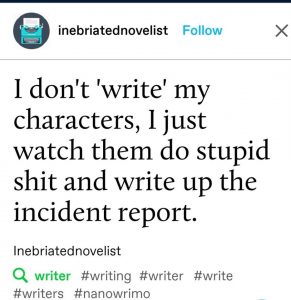
Image acquired from the Internet Hive Mind
Original source is on Tumblr:
Image acquired from the Internet Hive Mind
Original source is on Tumblr:

Image courtesy of ddpavumba at FreeDigitalPhotos.net
This rant is based on a book I picked up while free on Kindle, and I am still annoyed at the time it took to read this.
It had absolutely no transitions. The characters suddenly transported from room to room.
Don’t want to deal with the woman being pregnant – put her to sleep with drugs (oh, but for the birth, the medical-center can’t give painkillers?). Skip to the next scene, skip to the next emotional highlight, skip, skip, skip to the end. The whole thing felt like it was on fast forward.
No transitions and as boring as fast forwarding through a TV show.
While walking through doors, climbing into cars, and traveling between places is also boring, transitions are needed to let the reader know locations changed, time passed, and emotions may have calmed (or ramped up). Keep the transitions short. No need to bury the reader in the mundane, especially if writing a flash or short story, but do include an “end scene” moment and a “begin scene” moment which tie the two scenes together.
In An Infidelity of Hearts (11/24/2019), I have two scene transitions to execute.
The first between the table and the cage – which is done with a combination of the woman announcing she was leaving and draining her drink and a sharp scene break with “***” and she is suddenly at the cage. If I had closed the scene after she laid her cards down, winning the trick, but before she announced she was cashing out, that jump would have been too abrupt. See how it reads when I remove the transitional words between the scenes.
Smiling at the professional, she laid down her cards one-by-one. Nine, ten, page, jack, and finally queen high. All of the same suit, as red as her gown. Nicknamed an Infidelity of Hearts on this planet, as the king had been replaced by the jack and page in the queen’s chambers, spread before her.
***
The cage transferred her winnings back to the account where the money started, after Carin told them which tips to give to the tables she had worked that night.
The second transition is between leaving the club and waking up captured. It is a mashup transition, serving several purposes: a fast forward over the boring (walking alone and waiting to be jumped), providing backstory (why she actually was there), and entering the next scene (where she woke up).
I could have done the table to cage to walk to waking up without transitions, but that hurky-jerky story would not have been a pleasant read.
WRITING EXERCISE: Look at your present work-in-progress (WIP) and examine one of your transition moments. Why do you need it and what happens when you remove it? Is it a long transition, and does it serve more than one purpose?

Image courtesy of Stuart Miles at FreeDigitalPhotos.net
Oh, good grief.
Why do I have a prologue for a short story? No – oh, no – why are there prologues for three short stories in this collection someone is trying to sell my publisher – and the fourth short story has a flashback? Do you not understand how short stories work? …. What prologues are for?
I get it. Fantasies have prologues, but not.every.single.time. Especially in a short format where laser focus is needed. Just because (fill in the blank, famous-and-now-dead high fantasy author) used prologues back in their day, does not mean you get to use them now.
Well, this one is an easy decision. My publisher hates prologues. Unless there is a great reason to have it – and I have seen them used properly once in a hundred uses – the submission is a reject. Only six more to read today. (Yes, I want to accept submissions, but I have two slots this year and a hundred submissions. Bad prologues go into the “no” pile.)
For the most part, what I was seeing are prologues used as a big info backstory dumps for lazy writers who can’t figure out how to integrate backstory into the narration (I’ve touched on how to do backstory integration elsewhere). That said, if done right, providing a hint to the story which raises questions instead of just answering questions which haven’t been asked yet, prologues are useful. One example I read was a beautiful pre-story explaining something that affected every decision the point-of-view (POV) character made, but she did not know how this childhood event changed her as a person. The reader sees it, but the POV character doesn’t know and cannot know and therefore cannot share it in the primary narration.
Another good use of prologues is in murder mysteries where you meet the victim and witness the event of the murder before the detective character shows up. In both this case and the previous case, the camera through which we are witlessness the main story does not have access to the information. Also in both cases, the prologue was written like part of the story – action-oriented. In the info dump case, the long history of everything which went before on the fantasy world told by a historian is BORING, and often irrelevant to the story. I love worldbuilding, but not reading it dry. I didn’t like dates and places in history class when I was in school, and I don’t like them now. I do love history though and have been part of a recreation hands-on group for years.
So don’t do info dumps – not for prologues and certainly not in short stories. You might need to write them up during the first draft, but remove them and set them aside during the second draft.
I’ll close with an exchange I had with some editors.
***
Erin Penn: I’ve never realized just how bad prolog-itis is until I started reading slush.
Editor One: LOL
Editor Two: It is an epidemic.
Erin Penn: Affecting over 50% of the population.
Editor Two: We need a vaccine.
Editor Three: It’s particularly virulent in fantasy authors…
Editor Four: And like most bugbears of writing, the infestation of bad ones ruin the possibility for a really good one. Because it is possible to have a good prologue, but almost nobody does.
People want to dump all that exposition in early so they don’t have to worry about it any more – they want the Star Wars opening crawl through space. The thing is, if they can just restrain themselves, they DON’T have to worry about it. If the story matches the exposition, the exposition will come out as the story unfolds.
Erin Penn: Stealing for a some-day blog post!
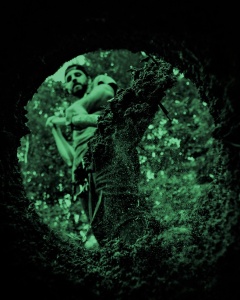
Photo by Daniel Lincoln on Unsplash – Adjusted by Erin Penn
Have you ever read a story out of order? Sometimes authors lead with the end of the story and the mystery is how the person ended up in that situation. “Dude, where’s my car?” and “The Hangover” are just two recent movie examples where people wake up after a night of debauchery wondering what happened to them and have to backtrack the night.
For writing, often a writer will drop readers in the middle of the action and in the second chapter backtracks a couple hours or days and fill in the backstory once the reader is hooked.
Today’s writing exercise is to create an out-of-order flash. Normally, this would be frowned on because the flash medium is too short for backstory and timeline confusion. But breaking the rules to learn a new skill is okay.
Often when setting up a story in this manner, the first action is set in present tense and the remembrance portion is written in past tense. When the action catches up to present, the verb tense returns to present tense.
Example starts: “I stopped digging when the hole was deep enough.” “Blood is not my color, but at least it was washing out.” “The hangover wasn’t bad until I moved my head into the sunlight. When I opened my eyes, I realized it wasn’t sunlight.”
Remember the mystery is how the person got from a “normal” state to their present craziness when writing timelines out of order. This focus keeps the reader on the hook until the end.
WRITING EXERCISE: Write out three things that will happen in a flash in time order, and then write the flash with #3 as the first piece of information presented.
***
My Attempt
Flash Title: Too Big
I stopped digging the hole when it was deep enough. Mud covered me from head to toe which covered the blood. I hoped the mess would wash out, but burning everything remained an option. I had a stack of wood under a lean-to close to the house from clearing underbrush this summer which would provide a good firestarter. I didn’t want to run around starkers at home, but I’ve done that before chasing kids when I was younger and fitter and the young escape artists were slippery from their baths. Somehow the clothes would be taken care of before I went inside.
I wasn’t tracking evidence inside my home.
I guess I should start at the beginning.
Yesterday was normal. Wake up, take the kids to school, drop the spouse off at work, run errands, do the laundry at home – walking the dog between loads and picking up after the kids and setting up for dinner and paying bills and the hindered of other tasks needed to keep a house of six people alive. I work weekends while Samantha works weekdays, that way someone is always home with the kids. It does mean the two of us don’t spend time together much, but considering number five is on the way, we do spend enough time together for some things.
Then I got a call from school. Mardi had gone missing with two other children off the playground. I don’t remember getting to the school, but the time between me hanging up the phone and signing in at the office was four minutes. The school is five miles away.
She was still missing when I got there, police were arriving behind me. One of them may have been following me for speeding. Don’t know, don’t really care, but I didn’t get a ticket for it. The two other missing kids were eleven year-old girls, dark hair, dark skin, just like my Mardi. She takes after her mother but has my high cheekbones and narrow nose from my Native American ancestors. The two other girls were also mixed races.
The police didn’t like that pattern at all.
Well, long-story short, since this story should be about 500 words. The police have the bodies of the human traffickers. Well, the low-level guys.
Their boss is too big to fail.
The clothes burned fine once they caught fire, and Sam hosed me down once I got out of the backwoods. Not my woods, mind, the woods owned by the guy too big to fail. One of my buds who wasn’t able to help me today already is calling in an anonymous tip about a suspected body being ditched.
Too-Big-to-Fail is going to have a bad day tomorrow. Worse than mine was today.
(words 459, first published 02/25/2020,
