Editing Rant: Homeschool Plotting

Photo by Tong Nguyen van on Unsplash

Several of my sisters homeschool their children and one with several in her brood texted me about a writing issue she was having. Below is the whole exchange, spelling and grammar errors corrected for clarity.


“How do you tell your authors that they need a plot? (or at least a conflict/dilemma and resolution)”

“Since we (Falstaff books where I edit) are action adventure genres, conflict is fairly integral.

Age of the offender?

Mostly I focus on beginning middle end. What is the BME of the character development, and what is the BME of the action development? You aren’t saying something is missing so much as asking for them to define it for you and they then know where to beef it up. By asking for both, you hide where you think the problem is and make them find it. I do this with newer authors when they ask me to quickly look at their stuff. Those under contract would not have gotten the contract if they are missing plot.”

“K is 12. For language arts she was to write a story. I thought the conflict was going to be the last part of her outline, but it wasn’t. She wants it to be a different part, but does not want to make the protagonist work for the solution, nor to express distress beforehand, nor satisfaction with the resolution.”

“So the question is where is the change, or why is there no change? Mom went grocery shopping and brought back food, is a change in the house. She didn’t bring back food is a different story and also interesting.

Sounds like you also want to see both a climax and a resolution. The solution and the reactions to the solution. That one I do need to talk to authors about. The emotional need of the reader to be released from a story …. otherwise known as why people hate cliffhangers.

A question to ask her, maybe, is why is the main character interesting? How is the reader identifying with her? Do you want to show thinking, feeling, action, or reaction to have the reader know her? What character have you read or watched recently that drew you in? Why? What did they do or feel? Were they satisfied with the story resolution? How do you know?

Just realized she is still mostly a concrete thinker. Asking her to think like a reader or the character is likely at the edge of her abstract thinking. A good learning experience, but an additional layer to the lesson.”


Yes, I am that wordy texting on my phone. Sister didn’t get back to me about how things turned out with K and her plots. I remember the fights I had with creative writing at that age. Abstract thinking, figuring out how the reader sees the words is tough. And I have seen adult writers not wanting to make a protagonist work for a solution. Torturing your characters – these parts of you being put on paper – is tough, especially when they look up from the page with distress. Be interesting to see where K is after a couple more years of brain rewiring from concrete to abstract.

Editing Rant: Repair the Pants

Image courtesy of ladywriter55 at FreeDigitalPhotos.net

What the…?

Okay folks, it is great to be a pantser. Break free of the constraints of outlining and worldbuilding. Just write things out and get it on paper. Fresh, new, exciting.

Then edit that draft!

Just read a story where the author was obviously a pantser. The action was constant, the plotting – not so much. The reveal of what the human female was and her ongoing issues felt very “slidey”; things were added during the pantsing writing and not fully integrated during subsequent editing passes.

Oh, let’s have her not just be human. First meeting of ex – helpful and healthy – oh, but wait … won’t it be better if he was poison as she starts a new relationship. Great additions, really help the story pop – but created an unevenness in the presentation, a feeling of being tacked on instead of full integration. 

Image courtesy of the internet Hivemind

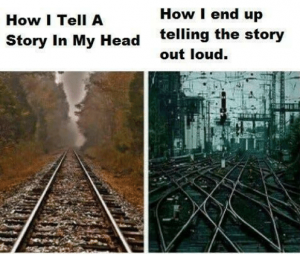
I understand that draft stage is boring. You know the story now. But this is the difference between telling a haphazard story among friends and creating a coherent manuscript.

Pants it all you want – just remember the tradeoff. With plotters, they do a lot of the prep work before hand. This is the exciting part to them. Writing it out is hard. For pantsers, writing out is fun, it is the draft work that is the chore. One way or the other, details and sorting things out for a full well-written document worthy of publication requires effort.

Go back and repair those pants.

Other Cool Blogs: Magical Words 2/24/2010

Image courtesy of winnond at FreeDigitalPhotos.net

The magic advice so often given: Write what you know. And its immediate corollary: Write what you love.

Of course there is always just the simple all hopeful authors need: Write.

Blake Charlton provided a new one to the mix: Write what scares you.

Think on that. We are not just talking horror, but all genres. Write what scares you. This is “Write what you know,” because what you know is emotions – the need to get into the reader’s head and make them feel with their heart. Exploring what scares you can do that. Scared of demagoguery, or racism, or trusting people only to be betrayed, or a big rock falling out of the sky and changing everything? Bring it to the keyboard.

This is part of the human condition. Don’t use fear for fear’s sake but face it, explore it, and figure out how to conquer it or live with it. One of my recent flashes, Thebe Loses Day Job, lightly touches on the fear we all have in exploring something new taking away what we know. Will the new job provide enough income to pay the bills? What will happen if the new job doesn’t work out? Yes, these fears are presented within an erotica storyline, but that is part of what makes people enter the story. Something just about moist, mushy, and manic is okay. But something which pounds a pain center while being moist, takes things to the next level.

Write what scares you.

See the whole blog here (and be sure to look at the comments): http://www.magicalwords.net/specialgueststars/todays-special-guest-blake-charlton/

Other Cool Blogs: Magical Words March 23, 2009

Image courtesy of FreeDigitalPhotos.net

Chapter Breaks – Stepping Stones in a Story

“Why Divide Your Book Into Chapters?” was asked of the Magical Word crew in 2009, and David B. Coe responded giving insight into how books are structured.

The most direct answer is seeing all those words strung together without any breaks exhausts a reader before they even start.

The working answer is writers get exhausted thinking about writing all those words at once. For plotters, outlines and chapters can walk hand-in-hand.

The more subtle answer is dividing the work up provides clues and prompts to a reader’s mind which can be exploited by authors. 

Breaking down the basics from the post:

  1. Maintaining narrative flow: POV changes, jumps in time
  2. Escalating narrative tension: changing narrative threads, critical beats/cliffhangers
  3. Keeping readers interested: provides breaks to take care of business, gives chunks to think about as a unit
  4. (From Comments) Selling points: editors ask for a chapter, being able to offer the first chapter for free
  5. (From Comments) Editing for word count: helps visualize word count
  6. (From Comments) Voice: length of chapter can affect the narrative voice, helps focus
  7. (From Comments) Serialization: offering the story via podcast, magazine, etc requires breaking things into narrative chunks but remaining true to a complete novel.

If you would like to read the full post and related comments, go here: http://www.magicalwords.net/david-b-coe/why-divide-your-book-into-chapters/

Other Cool Blogs: Magical Words July 8, 2013

Image courtesy of nunawwoofy at FreeDigitalPhotos.net

Dark Night of the Soul

Today is March 1st and my first day off (other than a snow day) since tax season started. Tax season started on January 2nd and goes until April 17th due to the 15th being on the weekend. One hundred and six days. Today is day 59, a bit past the half-way point. Things are calmer. The introduction long past where we remind people of our locations, followed by the initial rush the weeks immediately before and after January 31st when the W-2s go out. 

I’m in a lull. In a book, everything that went wrong in the first half has been sorted out. The character thinks they can accomplish everything. They got the tools, the relationships, and the skills. Things are beginning to look up.

Thing is, I know March 25th is coming fast. Why March 25? People start feeling the pressure of April – how did a quarter of the year go by already? – they ask. The final rush hits. More accurately builds. Every day more people show. Every single day. More and more and more.

My Dark Night of Soul for tax season begins on March 25, though despair doesn’t start taking huge bites until April 6. Bites from my sanity to which I will apply stitches the week following the end of tax season locked in my house with my to-be-read pile, my comfy chair, some blankets, and chocolate.

My tools? By April 8th overloaded, broken down. Printers and scanners giving their all for the final seven days with no hope of repair. My relationships? The procrastinators. People who owe heart-rending amounts; decisions on eating and heat have to be made. People who hate taxes. People who are looking over their tax documents for the first time. In all cases we will find essential stuff missing and have no time to get it. My skills? Overwhelmed, exhausted, I struggle – the final two days I start counting hours, eyeing the line which is only growing. No way am I going to satisfy everyone. No way am I going to be able to do what I consider the level of care required, a service level I offered with a smile just a few short weeks ago around March 1st. (Hint: If you get taxes done by professionals, or do them yourself but may need to call technical support, the next two weeks are the best time to complete the task.)

In Dark Night of Soul for writing, you take everything you had built up for your character and destroy it bit by bit, leap by leap. Flood them emotionally, physically; make the task – internal and external – impossible.

The consummate Carrie Ryan explained the situation far better than me in “The Dark Night of the Soul” back in 2013. Crushing your character’s hopes and dreams are explained in intense detail.

WRITING EXERCISE: Think about your life and a Dark Night of Soul point. The level should be the first book of a series, so leave room for things to be worse in future books. You don’t have to visit your darkest emotional moments; an external (outside focus) can work just as well. Stuff like raining on prom night in a rented outfit, a white shirt becoming see-through in the rain right before a job interview, or annual tax season exhaustion. List every step of the loss – friends, tools, skills.

If you were writing this scene for a comedy, what else would you take away? Spend no more than an hour on this, preferably during daylight, and then put away the paperwork, save the file, and go outside and enjoy the sun.

READING EXERCISE: For your present read-in-progress, record what the character has at the midpoint. What skills and relationships have they developed? What are they confident about. During the Dark Night of Soul times, how had each of the midpoint positives been undercut?

***

An example of a second book level, keeping up with the tax season theme, is when congress passes their tax bills right before going on Christmas break so corporate is still reprogramming things when the first people show up to get their taxes done, and then when Congress returns in the new year they pass a retro-active bill related to charity donations. Once congress completes their thing, the States finally pass their tax season bills in the middle of February so the tax professionals need to call people back into the office who thought their taxes were done to correct state issues. Those are bad years.

Book three level, the final book of the series, would be like the first three days of the year I opened an office I never been in. I didn’t know where anything was stored, the woman who I was told to contact with questions was in the hospital for the first two days of the season (hence me opening her office), overnight Microsoft had released a 90-part (I kid you not) update which took over 2 hours to load (and I couldn’t run our security procedures without it), and fifteen people waiting for the system to reboot including people with young children. I ate my packed LUNCH at 9 pm that night. I cried some when I got home – from relief, exhaustion, stress, need to sleep, need to get up early, I don’t know. And was back in the office at 6 am to take care of one couple who had to leave with their baby, but needed to go to work early the following day – now that day. The tools I had were broken, the relationships unavailable, and the knowledge not pertinent to the office I was in. Yes, I was successful enough I am still in the business. Yes, the next year the only office I opened was one I was intimately familiar with.

Give me the book one Dark Night of Soul level over the book three level any day.