A Facebook friend share with me a picture with the following words: Just learned that 80% of organ donors are women and 70% of receivers are men and now I think I might remove myself from the donor program because WTAF (what the ACTUAL fuck).
This is a truly troubling set of statistics if true, as women are 51% of the population and men are 49% (Census – 2010, 50.9% female) and donors and recipients should match the population…or should they?
Time for a statistical dive into organ donations!
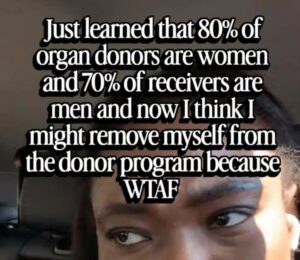
First question, is the meme even true? Some meme are just pieces of information created – like if I said, memes accurately quote scientific articles 35% of the time…I just made it up, but it sounds true.
First hit on the google search: “The 2021 report from the National Organ and Tissue Transplant Organisation (NOTTO) reveals a troubling gender disparity in organ donation: 80% of organ recipients were men, while 75% of organ donors were women.” (Anagha) Now, Organisation (with an “s”) indicates this isn’t an American group – this report is from a national-level group answering to the Ministry of Health and Family Welfare in New Delhi, India. The numbers also don’t align with the original meme, but seeing how things work in another country can be helpful with a look into America. This statistic is interesting: In India, 27.7% of all living donor transplants are spouses, but 87% of the spouses doing the donation are the wives. (Anagha)
Even in Switzerland, for living kidney donors, 22% are women donating to their partners but only 8% are male. In the US and Germany, the ratio in both countries is wives donate to partners twice as often as husband to their wives for kidney donations. If you look at the Switzerland numbers, they could also be easily described as two-to-one ratio as well.
I’m not finding information with either the original numbers of the meme, nor information from America, but that still doesn’t mean the mean isn’t true, especially when reviewing how common this disparity is in around the world.
Second step, what are the statistics we need to look at? This isn’t just one statistic being presented, it is two: gender differences in donors and gender differences in receivers. More men than women receive, and more women than men give. Do men need the medical treatment more than women? Are women in a better position to donate than men? These two statistics need to be broken apart if they are to be studied properly.
I think figuring out the recipients will be simpler, so let’s start there.
Third, breaking out the first of the statistics, why do men receive more organ donations than women?
Well, what are the organ donations that people need? We get a hint that Kidney is going to be a be a big one based on the first hit which had statistics from four different countries on the rate of living donations for kidneys. Everyone hears about heart and lung donations, but over 85% of the people waiting for a donations are waiting for a kidney donation – and that is one of the few donations which can have a living donor! Still matches need to be made. The list of organs waiting on donation as of July 30, 2026 in order of amount: Kidney (84.8%), Liver (7.8%), Heart (3.6%), Kidney & Pancreas (2%), Lung (0.8%), Pancreas (0.7%), Heart & Lung (0.03%), plus “other” (0.1%). (HRSA)
So the biggest category on the waiting list BY FAR is Kidney. Do men have a higher rate of kidney disease than women? Because if they do, the 70% of receivers could be explained by a simple rate of disease impact. According to the NIH, the National Institute for Diabetes and Digestive and Kidney Diseases, 1 in 7 US adults have chronic kidney disease, with the chronic version being slightly more common in women (14%) then men (12%). (NIH)
Oh, that is a problem, if more women then men have kidney disease. Reading deeper, I found a VERY important statistic: For end-stage kidney disease where 68% are on dialysis, men are 1.6 times more likely than women to be in end-stage. I hate when they don’t give us equivalent statistics to work with; it is like they are deliberately hiding data. But if this is the case, the split between men and women in end-stage is about 60-40, I think, if I am interpreting their number right. (NIH)
That is HUGE! With 70% of the organ donation recipients male, and 85% of all organ donation kidney, and 60% of the kidney needs male – that explains at least some of the discrepancy right there. If a similar carries over the statistic applying to all the organ needs, then the natural split of organ recipients should be 60% male to 40% female, not the natural 50-50 one would expect by population or the 70-30 which is actually happening.
More details – 46% of those in end-stage kidney disease AND put on the waiting list receive a transplant within five years. Children (under 17) are the most likely at 85% – again, kidney can be done by living donors so family members are move likely to get tested for a donation when a child is involved. Most of the children donations are likely (no indication though is given, so this is a guess) from the adults around them. Females on the list are 47% likely to get a transplant while men are 45% likely to get a transplant. (NIH)
That is interesting; no indication is given about number of males versus number of females on the transplant list but statistically once on the list there is about an equal chance of getting the needed donation.
So it is looking like the bias is not getting the surgery, it is getting on the list in the first place. Which is likely a combination of referral for treatment and then consideration of the extremity of the disease, both of which the medical community has shown as measurable statistical deviation against women. In fact the Sowinski conference report states “Women may be less likely to be perceived as transplant candidates and are referred less often.” Complicating that also is “Women may have family and other obligations that prevent completion of the evaluation process.” So they are less likely to be referred for treatment, less likely to follow the testing requirements, and less likely to be approved for transplants.
But does this statistic cross to other donations?
A little search, I found an article about sex differences in heart transplants by Chung et al. Only 25% of the candidates for heart transplant are women, with a matching overall number in recipients. Again, it looks like if a person can get on the waiting list, they get the help they need regardless of gender. The challenge is getting on the list. The challenges women face in the heart, again is diagnosis, testing, and referral.
Solution to Recipient Problem: The problem isn’t the transplant waitlist, but the system to get on the waitlist. The medical community is working on being more aware of the male bias baked into the system. More testing and studies need to be done for women, doctors need to be aware of the bias they bring to the door, and accommodations need to be made for the different social roles women usually serve, such as primary caregiver to children and elderly adults. The medical community knows of these issues and are working on it. The 70%-30% recipient of transplantation is just one of the many symptoms. Hopefully time will reduce this problem; but this is one of the statistics to use as a rubric of success in reduction and eventual elimination of gender bias within the medical institution.
Fourth, the second statistical question, why do women donate more than men? And how can that be fixed to?
First, indication of why there is a difference is that statistic of 85% of children get a kidney donation. The statistic of donation does not break out living donations versus deceased donations. Here is a matching interesting statistic – women do 33% of their donations between the ages of the 35 and 49 (Ruzicka). One in three of their donations, living and deceased, happen after the major child-bearing years but before their children are fully grown. The mother already gave her body to her child, giving up a kidney to keep them alive (if compatible) is a natural consequence.
In fact, over 60% of the donations for women happen during the child-caretaking years. Men on the other hand donate as children (22%) or 18-34 (22%); around age 30 is when the ratio of men to women changes. More men than women are born, but overall, there are more women than men. This is because before age 30, males die at a higher rate than women by accident (trauma) and disease. Men donating more at the earlier ages likely aren’t living donations but deceased donations.
Yee shares that while the vast majority of living organ donors are women, only 40% of the deceased donors are women.
So when women are alive to be pressured into donating for family and spouses, they do so, whereas men donate after dying from trauma. This can be a problem, especially in the heart and lung situation where size can impact who can receive the donation. In addition, some transplants do seem to have some minor gender benefits for like-to-like matches, so having men being the deceased donors by a 60-40 ratio reduces some of the donation effectivity for women – decreasing their chances of receiving a donation.
Solution to the donation problem: One, get men and women to sign up for deceased organ donation, and make sure the family is aware of the person’s wishes. 10% of all families refuse to consider organ donation, and the majority of the rejections were for females who passed. (Yee) Organ donations discussions need to happen in advance of the emergency.
Two, men need to participate in the living donation for the kidney and the partial liver at the rates women do. That is really where the discrepancy in donation is happening. Not on the slab, but in the home. Don’t pressure the females; everyone in the family should be tested.
It isn’t that the women are doing too much, it is men aren’t doing enough. And it can be done while living.
IN CONCLUSION
Organ donation and organ transplantation are a complicated multifactorial situation impacted by multiple society and culture circumstances. A simple meme giving two stats hardly covers the consideration the conversation deserves. Remember this when facing other 15-second meme lore drops.
Also, if you haven’t signed up for organ donation, do so, and let your family know your wishes.
Bibliography
Anagha BP. “Gender disparity in organ donations: She gives, He received.” Change in Content. 2024 October 14. Last viewed 8/16/2026. https://www.changeincontent.com/gender-disparity-in-organ-donation/
Census. “Quick Facts.” www.census.gov. page for April 1, 2010 data. Last viewed 8/16/2026. https://www.census.gov/quickfacts/fact/table/US/LFE046224
Chung, Alice; Heidi Hartman & Ersillia M. DeFilippis. “Sex Differences in Cardiac Transplantation.” Springer Nature Lin. 2023 December 07. Last viewed 8/16/2026. https://link.springer.com/article/10.1007/s11883-023-01169-0
HRSA – Health Resources & Services Administration. “Organ Donation Statistics.” Last viewed 8/16/2026. https://www.organdonor.gov/learn/organ-donation-statistics
NIH – National Institute of Diabetes and Digestive and Kidney Diseases. “Kidney Disease Statistics for the United States.” Last viewed 8/16/2026. https://www.niddk.nih.gov/health-information/health-statistics/kidney-disease
Ruzicka, Emilla. “Who is most likely to donate organs in the US?” Northwell Health. 2023 April 24. Last viewed 8/16/2026. https://www.northwell.edu/news/the-latest/how-the-demographics-of-organ-donors-differ-by-state
Sowinski, Deirdre, et al. (It’s over ten names, look it up) “Addressing sex-based disparities in solid organ transplantation in the United States – a conference report.” American Journal of TRANSPLANATION. Volume 23, Issue 3. 2023 March. Last viewed 8/16/2026. https://www.amjtransplant.org/article/S1600-6135(22)24785-6/fulltext
Yee, Erika, et.al. (Erika Yee, BS; Seyedeh Maryam Hosseini, MD; Bianca Duarte, BS; Shannon M. Knapp, PhD; Molly Carnes, MD, MS; Bessie Young, MD, MPH; Nancy K. Sweitzer, MD, PhD; and Khadijah Breathett, MD, MS) “Sex Disparities in Organ Donation: Finding an Equitable Donor Pool.” Journal of the American Heart Association. 2021 September 24. Last viewed 8/16/2026. https://www.ahajournals.org/doi/10.1161/JAHA.121.020820

 Not everything can be explored with rovers and flying drones. EELS offers a third option. The drill design allows the thirteen foot long robot to cross loose soil and even go into crevasses. Things the hard-working Mars and Moon rovers get bogged down in. With the AI-decision protocols (yes, this nightmare fueled design has state-of-the-art AI built in, and not just for making art on social media), the robot can figure out how to get from here-to-there using its corkscrew apparatus. The AI will allow the explorer to operate on Saturn’s moon Enceladus and other distant surfaces without constant checking back in with ground control. Mars is bad enough with distances between four and twenty light minutes in one direction; Saturn (and her moons) start at seventy-one minutes one direction and could be as much as eighty-eight minutes depending on the Earth-Saturn relative positions in orbit around Sol.