Today humans managed to get off the planet again.
And with Style!
Today humans managed to get off the planet again.
And with Style!

Image courtesy of Nasa: Jeanette Epps
The most valuable commodity in the world is human intellect. We can’t dig it up, refine it, and put it on the market in a quick just-in-time product stream. Intellect, in all its forms, requires discovery, shaping, honing, and continued usage. Whether a person excels in spacial, verbal, social, political, mathematical, educational, technological, or musical aspects of understanding the world, each individual must be given a safe, welcoming environment to sharpen the intellect to its fullest. Doing otherwise is burning scare resources and delaying advancement.
STEM (Science, Technology, Engineering, Math) has been throwing away millions of IQ points a year with their neglect, nay, their criminal abuse of women, especially women of color. In a field where “nerdy geeks” rule, women have been kicked out of the treehouse. Half of humanity actively discouraged from participation, and people wonder why we don’t have flying cars and we aren’t living on Mars?
July 2017 released study created from interviewing 474 astronomers and planetary scientist revealed Doctorate level women scared to attend conferences or participate in field research. Let me repeat that – women our society has trained to be the best, invested over 20 years of education, because of PREVIOUS EXPERIENCE cannot attend intellectual exchanges or go to isolated locations with their co-workers because they fear for their physical and mental health. Really, WTF? (See “Women of Color Face a Staggering Amount of Harassment in Astronomy“)
Last year #MeToo had a month of buzz on Facebook and social media as woman after woman spoke about her personal experiences. I include some of my experiences along that line in “Blog: Made Me Look“. Shortly after the month of #MeToo, the celebrity circle suffered a “witch hunt” (as some called it) of improper sexual behavior accusations. Most women I know just blinked and muttered “about time.” The long-standing joke of “sleeping on the casting bed” had its covers pulled back.
Sexual harassment costs society brains, women who choose not to go into fields where only men live. Women cautiously refusing life in the military, avoiding writing because of backlash, staying home from conferences instead of sharing papers.
Maybe a part of your brain is whispering “good”, maybe another part of you has cancer which a woman who could have discovered a life-saving cure in your lifetime never entered the field after threats were made in her pre-med classes.
Yes, someone is likely to figure it out. After all, science is just a study of the world and discovering how it works. Eventually a solution can be found. Depending on how many people are looking, “eventually” can be minutes or decades away.
Pushing half the people out of the STEM treehouse is beyond stupid.
A quick perspective of how making the scientific community hostile to women and people of color affect research: ORCID – A non-profit research organization with 1 million registered scientists is 33% women. The number of women in the organization would need to MORE THAN DOUBLE to achieve parity of gender.**
You can’t get those numbers overnight.
Not even in astronomy.
So how do we help those that can’t help themselves? Provide inspiration.
People emulate what they see in fiction. Having Uhura on the Enterprise bridge inspired hundreds, thousands of people – women and people of color.
Writers can provide a face for people to see in fields they never thought to try. Make people question how the world should work. Point them in a direction.
WRITING EXERCISE: Write a STEM flash with a woman of color as a positive protagonist. Be sure she has the strongest agency in the story and not a front for a different member of the cast.
READING EXERCISE: Find a biography or autobiography of a woman or person of color who had been in space and read it.
Wikipedia has the following astronaut lists
Women: https://en.wikipedia.org/wiki/List_of_female_astronauts (include US, Soviet, Chinese, Korea, Italy, India, and more)
African-American: https://en.wikipedia.org/wiki/List_of_African-American_astronauts
Asian: https://en.wikipedia.org/wiki/List_of_Asian_astronauts
Hispanics: https://en.wikipedia.org/wiki/List_of_Hispanic_astronauts
And you can go here to find the Arab, Jewish, and Muslim lists as well as by country splits: https://en.wikipedia.org/wiki/Lists_of_astronauts
***
** Statistics calculation – 33 doubled is 66. Divide 66 by 100+33 (66/133) and you only got 49%.

Ancient windmills in Nashtifan village. Photo: Mohammad Hossein Taghi (CC by 4.0)
What are we going to need when we hit space and start settling other planets? Energy.
With no promise of fossil fuels on planets which may not have millions of years of active biosphere before our arrival, we will need mature energy technologies available universally on planets suitable for habitation.
(1) Solar Power
(2) Wind Power
(3) Water Power
(4) Gravity Power
Anywhere we choose to permanently settle will have these energies available. No guarantee for radioactive minerals needed for fusion and fission takes those two politically fraught items off the plate. Not every planet has a tamed magnetic-sphere (see the posting about Uranus).
To survive humans need gravity, heat (solar), and water. Wind is a by-product of the other three requirements. A planet large enough to have a water system and gravity for humans is going to have uneven heating, therefore wind.

From eSchoolToday “What is Wind Energy”
Humans have been using these energies for millennia, and yet the technologies, likely because of their simplicity and ubiquity, have never been fully developed.
Today humanity is testing out dozens of different windmill designs, mostly based on sail and lift technology. We might want to go old school though.
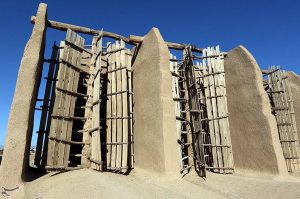
Ancient windmills in Nashtifan village. Photo: Mohammad Hossein Taghi (CC by 4.0)
Vertical windmills work on drag. Unfortunately drag is less efficient in transferring energy than lift, but some of the benefits may outweigh this downside. For example where horizontal windmills have their mechanisms toward the top, where the rotation center is located, vertical windmills rotation center is at the bottom and any mechanisms needing repair are within easy reach. Transferring energy from the top of a horizontal windmill requires a system to move the energy, often pulleys, which means more things to break.
Nowhere is the ease of maintenance and repair more obvious than the grinding windmills of Nashtifan village, which have been in use for over 1,000 years. To protect the village from the constant winds, a massive 65-foot wall was built. On top of the wall, since they were up there anyway, they put windmills. To make them even more efficient, they added some additional walls to direct the airflow into the windmills. A little rope, some planks, and grinding grain ceased being a constant chore.
Vertical windmills also don’t need any wind-sensing and orientation mechanisms built-in like the lift-based windmills. This reduces efficiency but, again, saves on maintenance. (See the wikipedia entry on “Vertical axis wind turbines” for more details.)
Considering the tradeoffs and developing both types of windmills (and other wind technology like the Vortex bladeless windmill) is part of creating a mature technology. Sometimes easy maintenance is primary and other times most bang for the immediate buck; having options available is key to using a technology to its fullest potential.
Who would think a thousand year old technology may be our go-to energy when settling other planets?

Image from Nasa
Worlds are opening up as we look to the stars and find planets. Many of the exo-planets found are gas giants, so the little information we have about our Big Buddies in the Solar System is becoming more and more valuable.
On June 27, 2017, Xin Cao and Carol Paty article “Diurnal and seasonal variability of Uranus’s magnetosphere” appearing in the Journal of Geophysical Research: Space physics released to some minor shock and awe. Uranus’s magnetosphere is messed up. Not only is its spin axis 98 degrees off – making the planet’s path around the solar system more of a roll than a hover, but Uranus’s magnetic field is tilted at a 60 degrees angle.
The crazy rolling field twists around every day letting solar winds in some of the time, no doubt creating spectacular Borealis for whatever lives on the surface trying to figure out where the north and south poles are. The balance of the time, the magnetosphere pulls off the fan dance, hiding the naked gaseous surface from the winds.
How does the atmosphere of the gas giant remain in the gravity field instead of being blown into space by the winds?
And how many of the gas giants we have discovered outside our system dance like a drunken marble around their suns?
One way to find out is studying our Big Buddies a little more. Uranus’s only visitor has been Voyager 2 in 1986. NASA has possible missions heading that way next decade, maybe; feel free to write your Congressmen to make them a little more possible. I wonder what new mystery Uranus is going to reveal if we drop by again.
Bibliography
Abstract for Diurnal and seasonal variability of Uranus’s magnetosphere. http://onlinelibrary.wiley.com/doi/10.1002/2017JA024063/full (Last viewed 11/10/2017 – link did not work on 11/16/2017).
Uranus is Even Freakier Than We Thought by Rae Paoletta, 6/23/2017. https://gizmodo.com/uranus-is-even-freakier-than-we-thought-1796378503 (Last viewed 11/10/2017).

Acquired from the SpaceWorks (SpaceWorksEng.com) image gallery
In May’s Geeking Science posting I discussed The Big Trip (visiting other star systems) in relation to how fast we could get there. Under current technology the closest star, Proxima Centauri, is 63 years away. A lifetime – from birth to retirement.
That’s a long-time to sit in the back seat going “Are we there yet?”
Space science is developing way to shorten the trip by going faster through slingshots and sails. Another portion of humanity’s sciences is devoted to making the trip bearable by letting the travelers sleep for a portion of it.
Science fiction calls them Stasis Chambers. Single person pods keeping individuals safe during long transits by putting them to sleep. Passengers (2016) centered around what happens when two people wake up because their pods malfunctioned, 90 years ahead of everyone else.
Scientists call them Torpor or Hibernation Habitats. They are not going to be a magic bullet instantly freezing and unfreezing people with no aging in between. They are no longer the dream of science fiction. And they certainly won’t be one per person.
Okay, this is where I started geeking. I am so used to seeing them as individual units thanks to sci-fi movies and television, I had never even considered they should be mass beds. But it makes so much sense. All the sci-fi stories talk about the expense of these units, the complicated wires, energy, fluids, temperature control. Why build it for an individual when transporting dozens or hundreds of people?
How close is Torpor technology to reality? Already arrived. Doctors regularly save lives using “therapeutic hypothermia” where they drop the body temperature by several degrees (to as low as 89.6). The patient’s heart rate drops, blood pressure lowers, and doctors have more time to save lives. Being cautious types, medical doctors limit the state to 2-4 days, but the technique has worked as long as two weeks.
Now to change the Torpor technology in use today from a multi-team, round-the-clock person-by-person to a space-worthy automatic process. Easy-peasy.
Developing the technology – Phase 1 started in 2013, Phase 2 started in 2016.
Yes (fist pump) we are in phase two! To Mars and beyond!
***
Read more about it at Digital Trends: “Spaceworks may have a real-world stasis chamber for space travel by 2018”
At SpaceWorks: “A Feasible, Near-Term Approach to Human Stasis for Long-Duration Deep Space Missions” (the slide show rocks!) …. update, the article has been taken down, but the slide show is still available here: http://www.sei.aero/archive/IAC-16-B3.7.10-Human-Stasis-Presentation-vFinal.pdf