Geeking Science: Grandmother Effect

Photo by Aleksandar Popovski on Unsplash (Cropped by Erin Penn)

Family Matters

Our days may come to seventy years, or eighty, if our strength endures. (Psalm 90:10)

Why do humans live past their reproductive systems? Nearly every other species continues to have the females give birth until it kills them. This maximizes population potential. Homo sapiens are fairly unique in that the females have their reproductive system turn off about the time system breakdowns will prevent viable births. Also about the time their children are having children.

The 1960s came up with the “grandmother hypothesis” after observing surviving hunting and gathering societies. Grandmothers are better at gathering and were more able to provide their children food – so those children were healthier and the children’s children were more likely to survive childhood ills. The ability to NOT have children gave an evolutionary advantage to the family, and, hence, menopause. At least that is the speculation.

Studies by Kristen Hawkes of the University of Utah done in the new millennium expand this hypothesis. She found that while a mother with one child who is good at gathering food will have a healthier child, this advantage goes away with two children. Then it is all grandmother. (The article by John Poole has a link below in the Bibliography. The article focuses on the hypothesis of how needing a larger social structure to maximize food for healthy children results in humans being social creatures from a very, very young age.)

Recently two new studies based on modern evidence came out in Current Biology. Jonathan Lambert breaks them down for NPR in “Living Near Your Grandmother Has Evolutionary Benefits.” (see the link to the article in the Bibliography).

These studies are based on the early industrial age and show how the grandmother effect continues even in more modern societies. A 30% survival rate increase between the ages of 2 to 5 when the grandmother lives with the child – nothing like expertise and wisdom. Now this bonus drops away and reverses as the grandmother passes beyond 75 and she takes more care than she gives. Death rates also spike as the grandmother passes beyond “usefulness”.

“Our days may come to seventy years, or eighty, if our strength endures.”

If you are interested in where evolution, biology, anthropology and culture meet. Dig into the full articles, and maybe hit up the Current Biology scientific studies.


Bibliography

Bible. Psalm 90:10.

Lambert, Jonathan. “Living Near Your Grandmother Has Evolutionary Benefits.” February 7, 2019. NPR.com – Goats and Soda. https://www.npr.org/sections/goatsandsoda/2019/02/07/692088371/living-near-your-grandmother-has-evolutionary-benefits (Last viewed 2/8/2019)

Poole, John. “Why Grandmothers May Hold the Key to Human Evolution.” June 7, 2018. NPR.com – Goats and Soda. https://www.npr.org/sections/goatsandsoda/2018/06/07/617097908/why-grandmothers-may-hold-the-key-to-human-evolution (Last viewed 2/8/2019)

Geeking Science: Three-D Printing

If you have been with me for a while, you know I am totally geeked out about 3-D printing. I think it will be world changing, and you can see my fictional examples in Keep Trucking, Pickup Line, and my winning flash in the eSpec flash competition for the February 2019 – My Lifestyle Choice is the Best One, Let Me Tell You About It. My non-fictional piece for Geeking Science is: 3D Printer Tech.

Yesterday, this came across my facebook feed. This! This is 3-d printing changing the world.

Geeking Science: Ancient Arts and Crafts in an Electronic Age

Image courtesy of dan at FreeDigitalPhotos.net

I need art to stay sane. Right now, as mentioned earlier this month in my Magical Words post, I’m not doing any. But I need to get out in the soil and garden, break out my silks and embroider, stain my fingers with ink, and smear clay over the world in one huge mosaic. I need to do it soon.

And now I have scientific backing about how important it is!

In a computer age, where things are measured in the nanosecond and the end-product is somewhere on the interwebs, having something that slowly grows, where you can gain skill and measure the difference with your own eyes and fingers, is calming in a way a computer game never can be. We are built for slightly repetitive tasks where we gain improvement and have a product at the end; basket weaving and gathering herbs are just two examples.

Crafts heal the mind and body, fighting depression and social anxiety. According to research, the benefits include:

relaxation; relief from stress; a sense of accomplishment; connection to tradition; increased happiness; reduced anxiety; enhanced confidence, as well as cognitive abilities (improved memory, concentration and ability to think through problems). (Luckman, 2018)

Basically crafting is a form of mediation, giving similar results including reduction of stress and fighting inflammation. Moving the fingers to create something that requires concentration, but not thought, gives the brain the time out desperately needed to decouple from the brain weasels presenting scenarios of disaster. 

“Playing” with arts and crafts provides the body something to do while the brain is relaxing. And the brain relaxes best, interestingly enough, when it gets used in a new way. Working in crafting involves:

many different areas of your brain. It can work your memory and attention span while involving your visuospatial processing, creative side and problem-solving abilities. (Wilson, 2015)

I could use some of that in my life right now. Mediation, relief from stress, and increased happiness. Maybe I do have time to break out the pins and needles.


Biography

Luckman, Susan. “In Our Brutal Modern World, Science Shows Our Brain Need Craft More Than Ever”. The Conversation. 2018 July 28. (last viewed 1/26/2019: https://www.sciencealert.com/modern-life-is-brutal-here-s-why-craft-is-so-good-for-our-health)

Wilson, Jacque. “This is your brain on crafting.” CNN. 2015 January 5. (last viewed 1/26/2019: https://www.cnn.com/2014/03/25/health/brain-crafting-benefits/index.html)

Geeking Science: The New Horizon and the Old Sexy

Image created in a Meme generator by Erin Penn

Our relationship with the International Space Station has moved into old married couple stage. Sexy new ideas, exciting discoveries, touches of imagination, lust of exploration, all are distant thrills of yesteryear. That doesn’t mean the relationship is over. Like an old couple, we check in periodically, encouraging those involved in our space exploration relationship to keep the long hours in the endless night. The pains of old equipment and the housecoat covered in solar dust isn’t exactly a candlelight dinner, but starlight is always there.

While we keep looking for the new thrill, like the furthest distant world ever visited by spacecraft which the New Horizon just passed and will be sending information back to us for the next 20 months (talk about long download speeds! – more about all this New Sexy here), we shouldn’t ignore this amazing relationship and responsibility we share with the world. The information gathered by the years and decades of operation will help us settle the great beyond.

If you don’t already have NASA bookmarked, go here.

I would also recommend joining the Planetary Society, a non-profit group supporting space exploration around the globe by government agencies, non-profit groups, universities, and commercial endeavors.

Space and the International Space Station may not be the New Sexy, but sometimes the best thing in the world is curling up by the fire with a good friend and sharing what is happening in our boring every-day lives. Especially when it involves Dragons. 

On Sunday, the Dragon module from the Space Station returned to earth with the newest scientific research. The experiments brought back by the Dragon include:

    1. The Design of Scalable Gas Separation Membranes via Synthesis Under Microgravity – An environmental experiment to remove excess carbon dioxide from the air. Useful for space exploration AND could maybe lead to developments which could reverse some of the carbon load damage here on Earth.
    2. Three-D printer-recycler – Turning waste plastic into filament for three-D printing. Cutting down on space debris, making every pound put into space worthwhile, and providing versatility once there. As with everything space-worthy, constant testing to make it the most robust product possible also translates to Earth uses in other harsh environments.
    3. Virtual Reality – This particular experiment is testing how astronauts react to and perceive microgravity. Long-term space use could mean we will be visiting Ultima Thule instead of just our cameras. Earth use includes helping people suffering vertigo and other perception issues.

More details about the experiments can be found at space.com: Some Strange Science Will Launch Into Space This Week for NASA (November 13, 2018) and throughout the web.


Image acquired from NASA – (the original blog post related to this has been deleted)
The SpaceX Dragon cargo craft is pictured moments after being released from the Canadarm2 robotic arm.

Geeking Science: Seed Banks and Bad-ass Scientists

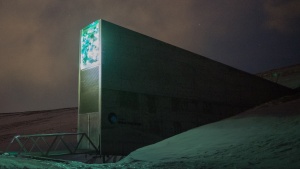
By Frode Ramone from Oslo, Norway – DSCF0896.jpg,
CC BY 2.0,


Bad-ass Viking Scientists. That’s how I think about the Svalbard Global Seed Vault and the Arctic World Archive. Norway is a culture who looks at the world dying and rebuilding as a given – and have prepped to jump start the next cycle after Ragnarok. The whole world is betting on them pulling it off.

Around the world, over 1,700 seed banks exist as a stop-gap between starvation and human stupidity – with Svalbard being the final line in the snow. At this time, 95% of humanity’s food comes from 30 crops. Monoculture agriculture at its scary finest. In case something happens like (cough) climate change (cough) making some of the food crops non-viable, humans (in an amazing feat of intelligence) have set aside historic seed for biodiversity.

Doing so wasn’t easy. Bad-ass Scientists around the world have died saving this hedge in the seed banks against humanity’s bone-headiness.  The St. Petersburg gene bank faced sure destruction during the siege of Leningrad from hungry citizens and a starving German army. The Russian scientists locked themselves in their vault, and some died waiting for the conflict to end surrounded by grain seed they could have eaten, hungry but never hungry enough to compromise their principles.

And just in case you were thinking this is all a pie-in-the-sky-someday-thing, in 2015 the first withdrawal of seed occurred. The Syria Seed Bank had been heavily damaged in a civil war and forced to be abandoned, so they asked for their wheat and barley seeds back. They had sent extra off to the Bad-ass Vikings for storage in the Doomsday Vault, as it is nicknamed. Doomsday just came a little early for them. The Bad-ass Farming Scientists then planted that defrosted seed in Lebanon’s Bekaa Valley and in Morocco – since home still wasn’t safe, and collected the seed, splitting it between their hopefully future rebuilt seed bank and the Doomsday.

Not having enough to do, the Viking Scientists decided to add a Data vault as well. They came up with data storage materials that can last 500 to 1000 years and offered their services to the world. They aren’t asking for the originals, just copies of what countries want to save. Like the golden record of Voyager.

“The data will remain searchable online … as long as the internet and servers are still functioning.” (Jones 2017)

A chilling thought, not to have the internet. But that is what Doomsday Vault is about. Against just that eventuality. Brazil and Mexico sent the first materials, Brazil from a collection of more than 300 life stories recorded between 2006 and 2016, and Mexico copies of documents dating back to the Inca period. 

addition 2019 – Since the initial deposit in 2015, other government and governmental agencies has sent in material. Such as manuscripts form the Vatican Library and the European Space Agency recording of data acquired by a 1991 satellite. (Piql 2019)

Scientists united around the world, picking up keyboards, digging holes, saving genetic material, and grinning with bloody teeth against humanity’s self-destructive tendencies and a planet who both is our mother and ready to throw the baby out with the bathwater. Geeking Science – Hear the Nerds ROAR!


Bibliography

Duggan, Jennifer. “Inside the ‘Doomsday’ Value.” Time. (undated). – Last viewed 12/2/2019.

Jones, Rhett. “Norway Gets a New Doomsday Vault That Stores Data.” Gizmodo. 2017 April 2 at 11:37 AM. https://gizmodo.com/norway-gets-a-second-doomsday-vault-that-stores-data-1793935778 – Last viewed 12/2/2019.

McCoy, Daniel. “Ragnarok.” Norse Mythology for Smart People. 2012-2019. https://norse-mythology.org/tales/ragnarok/ – Last viewed 12/2/2019.

Wikipedia. “Svalbard Global Seed Value.” (undated). https://en.wikipedia.org/wiki/Svalbard_Global_Seed_Vault – Last viewed 12/2/2019.

Addition 2019

Piql.com. “Arctic World Archive receives more world treasures.” 2019 February 21. – Last viewed 12/2/2019. (note – Piql oversees the Arctic World Archive)