Blog

Flash: Attrition

84942186 © publicdomainstockphotos | Dreamstime.com

Crunching underfoot within a forest is expected from leaves and last year’s ferns; in the forest of bones, the crunching is from some poor soul’s vertebrae from the Wars of Attrition. Not a place to walk through barefoot.

Not a place to walk through in general. The dead don’t like to be disturbed. Mourning for eternity, the skeletal trees radiated a perpetual winter chill from their bare branches, never budding with hope, despite the summer green and ripening fields Malloryson left behind. He would have never entered these damned woods if this wasn’t, ironically, his last hope. A stick, two days hardtack wrapped in a handkerchief, good boots, and, maybe, a ten-minute lead on his pursuers was all he owned at this point.

That lead became infinite the minute he passed into Dead Man’s Forest, for none but fools would follow him here. Walking around the forest takes days; not a single farmer’s path carved through the bones, chill, and unsettled dead of the blighted battlefield. Pushing deeper, Malloryson slowed his rush, confident the investigators would leave the walking dead man to the dead.

Water would be an issue soon, he thought, his mouth dry from his run. Last night’s gentle rains left red-tinted puddles reflecting oily rainbows, sitting strangely in the hollows between white roots digging into the black earth, bubbling yellow ooze clung to the wet edges like puss.

He pushed onward, looking for shelter and water, pressing against the horror each of his footfalls brought from the muffled crunching in the silent woods.

Once wizards walked here, summoning creatures from beyond to fight the rebel slaves. Humans died in droves, but for the hundreds of deaths, one or two of the monstrous beasts would fall, making the wizards vulnerable just long enough the slaves could kill a magical despot.

And then the cycle of destruction and death would start again, and end again.

Again and again.

And again.

The humans surviving the Attrition Wars didn’t win, so much as they didn’t die.

Malloryson’s hope was, like his ancestors, he was very good at not dying, so far. Unlike the burgomaster’s son, who he had accidently on-purpose killed. That soft throat needed to be squeezed to stop the poisonous words bubbling forth. It had been easy to squeeze tighter.

Malloryson didn’t regret the results. Some people are worth dying for.

The crunching of bones softened the spongy, squishing noises in his memory. A bubble, a gasp, a rattled wheeze.

The last echoed against the leafless trees. Not a memory.

The crunch of bones played counterpoint to the scrape of claws from some forgotten creature of the Wars.

Sucking sounds gurgled out from the mud as nearby bones cracked together into a new form.

A grimace splintered the blood-speckled rigor mortis grin engraved on Malloryson’s visage. Really, he had hoped to survive one meal within this cursed place. Part of his mind squealed “run away”, while another part debated if becoming a meal counted as the one meal he had hoped for.

He was done running. Too tired after hours of being chased by the investigators. If he was about to die, he wouldn’t die panting.

Instead he stepped forward to face the bone abomination, dead but refusing to admit it. Just like him.

Approaching the creature weaponless, Malloryson reached out his killer’s hand still dewed with the last breath of a hatemonger. The grotesque froze, tilting the head sideways, confused, before unhinging its jaw, exposing three rows of infinite teeth like a goose.

A mud-red tongue twisted out and looped around Malloryson’s hand, stripping the blood offering. Chill raided warmth from his arm. The tongue jerked back to the jaws of uncountable teeth, and Malloryson stumbled closer. He stared in the non-eyes of the forgotten bones and thought: how magnificent death looked.

A fitting last thought. Malloryson expected never to wake again. The return of awareness wasn’t kind.

(first published 3/5/2023, 650 words – Created from a Workshop attended at Ret-Con 2023 run by Tally Johnson. He provided thirteen possible visual prompts, all ghost/horror related. I choose prompt six which showed a traveler entering a forest of skulls.)


Magical Words: Balancing head, gut and heart

Photo by Nathan Dumlao on Unsplash

A.J. Hartley is a best-selling author. Way back on June 22, 2012, he wrote an article for Magical Words entitled “Balancing head, gut and heart.”

The blog post deconstruct why the Doctor Who two-part episode “Silence in the Library / Forest of the Dead”, works so well. And it isn’t just because of the solid sci-fi elements (time travel) bringing a reader’s HEAD into the story, or the chilling monster grabbing the GUTS, but also the emotions – the relationship between the Doctor and Donna, and the new-old archeologist straining the HEART. All three items, when in balance, make amazing fiction – whether book or visual medium.

The full URL is: http://www.magicalwords.net/really-i-mean-it/balancing-head-gut-and-heart/ … and be sure to read the comment section for additional advice.

Writing Exercise: Study how others do dialogue

Photo by Tamara Gak on Unsplash

Struggling with dialog? On a recent edit, the author constantly had people exchange looks – stares – and glances, while the speaking portion of the exchanges were in a rather formalistic structured dialog. The words of the dialog itself were great; the presentation needed work. I came up with the following writing exercise for the author to study dialog produced by others.

WRITING EXERCISE

Let’s look at other authors and see how they approach glances between characters in dialog, looking at / describing buildings and scenes, and other pauses of action while characters consider what is happening.

Pick three authors you enjoy reading and pick out a description of scene (three pages) and a dialog (three pages) for each. One should be in the genre you are working (say thriller) and one should be NOT be in the genre (not thriller, maybe romance instead), and one an author you sound similar too (if you have one in mind otherwise your choice). Total of 18 pages.

Make copies of the pages or print them out as your are going to mark them up a lot.

Highlight or mark the sections where they are describing a building or room. Do the characters look around? How does the “camera” sweep the area?

For the dialog, how does the “camera” switch between characters? Are they named each time? Where are the dialog tags? Are they firm – “she said”, “he asked”? Or implied “she turned around while pacing.” “he put down the tea cup”? How is the scene description put into the dialog … does the scene description and character description all hit at the beginning of the scene and then does all the dialog happen? Or is the narrative scattered throughout? How is the dialog broken up? Is it always (dialog tag) then (dialog) or (dialog) then (dialog tag) or always (dialog) (dialog tag) (rest of dialog)? How often is the dialog tag/dialog format changed up? How many dialog exchanges are there before a narrative break? Are there sections with just dialog/quoted material with no narrative or dialog tags at all?

Write a short paragraph on what you learned, mark the date, and staple everything together to keep for a year as a reminder.

Other Cool Blogs: Medium – Murray Blehart

Photo by K. Mitch Hodge on Unsplash

How much is too much?

Murry Blehart asked this question back in December in his blog “Is There Such a Thing as Too Many Stories in the Queue?” (Medium, 12/13/2022). (The link written out is:

He gives a comforting answer of find your own path and be aware of your joys and limitations (his blog on medium is about mindfulness).

Do I have too many jobs? At present count, now that the political job four-year term is over (and related supporting political job), I’m down to ONLY seven gigs. 

Do I have too many stories? (Looking over the blog, with flash ideas in the hundreds.)

Do I have too many projects? (Looking around the room at the to-be-done piles.)

Yes, and yet, no.

The jobs are needed to pay the bills and that loss of income from the political jobs – small though it is – hurts and I’m trying to figure out a way to make it up. But the keeping track of them and switching between them sucks up executive decision-making energy better used for creative vitality. I have fun with them, but I could have fun with other things too.

The stories just keep coming and I have no more control over them than the weeds in the yard – write them or pull them, the project is not a project but a process. (Project in business-speak has an completion-date, Process is on-going tasks like cleaning the home, making meals, or a manufacturing line. Individual tasks within a process many be completed, but the task will be there again tomorrow because most things in life is about flow. Life is a river, not a port.)

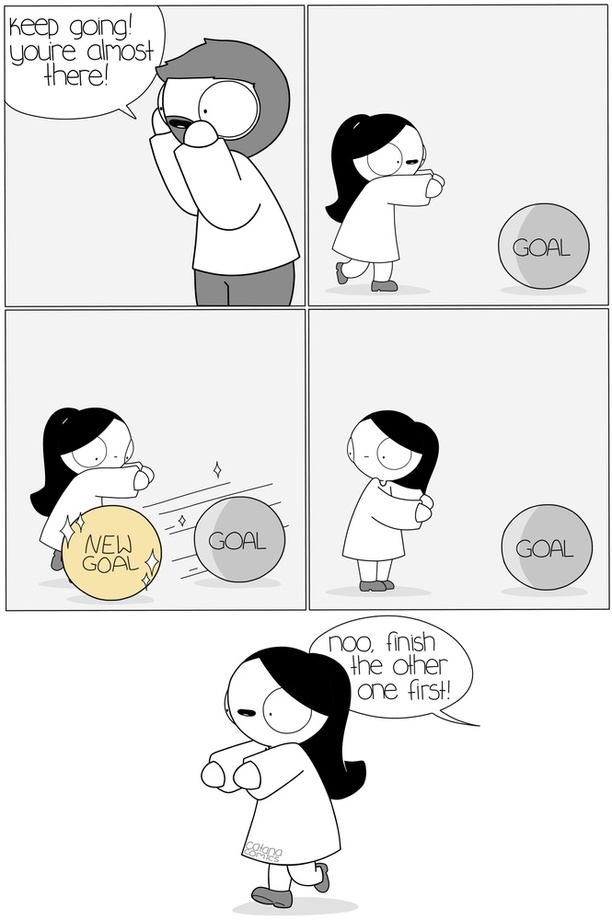
Projects? Well, I also try to keep the new shinnies down but…

Find more Catana Comics at: https://catanacomics.com/ (and many other web locations and in book stores)

WRITING EXERCISE: Take a moment and think mindfully. Are your “stories-in-queue” (or pictures to be drawn, or embroidery to be done, or tasks) bringing your joy or burdens? Is it too much? If too much, think what to trim to bring it under control. If not, celebrate the Joy and take a moment on your queue.