Editing Rant: No One Is Stealing Your Idea

Image courtesy of Sira Anamwong at FreeDigitalPhotos.net

What a bundle of mess. No one is going to steal your idea – and even if they did, they can’t steal your story. Pirate it, sure, but only after it is written.

Okay, let’s just deal with some of the concepts and myths new writers and non-writers have.

If I share my idea, and you write with it, I get some of the money.

How many of you have been approached by someone with an idea for a story guaranteed to make a bundle? You do all the work, but the idea man gets half the cash in the deal. Writers don’t have a problem coming up with an idea – the problem is doing the work to bring the idea to fruition. If someone has an idea and wants someone else to write it and the idea man gets the money, that is call GHOSTWRITING. The Ghost Writer gets paid by the IDEA MAN who then owns the writing – usually the Ghost Writer is paid something up front and the balance on delivery.

So, no, if you are an Idea Man, you don’t get money for not working. I have several hundred ideas – some of which are partially fleshed out in flashes on this blog. And every writer I know is in the same boat with far more ideas than time to write them. We don’t need someone else’s idea, unless it comes with a paycheck.

I can’t share my idea; someone might steal it.

The bundle of irrational this myth has includes unwillingness to query an agent who might give the idea to one of their contracted authors and the unwillingness to bounce ideas off of people who might sit down and type out the seventy thousand words to make the idea a reality. Nope and nope. Again, all writers have ideas – no one needs to steal more, if they are a writer.

A writer, on the other hand, DOES need to bounce ideas off of people. So do this.

Now it may look like someone has “stolen your idea”. This is because there are times when certain ideas come to fruition in a society; the winner in the writing game in those cases is whomever writes those 70K words first and cleans them up for publication. Some of the books I’ve read have been like “dude, get out of my head”. I’ve never met the author, but they have taken one of the ideas that bounced around my head and wrote it out. I’ve seen at least four science-fiction military stories on school debt.

They all are different. That is the thing. No one can steal your idea, because even if everyone starts from the same point – you end up with different stories. With a writing group where several of the members were scared of someone stealing their ideas, I had everyone start from the same exact words: “He took to the list…” – the flashes ended up with a contemporary romance, a historical military fight, and a science fiction courtroom drama. Same exact starting point.

Pirating isn’t stealing.

Okay, this one someone really is stealing your story. Or maybe music or art. Fight it.

And you – you who goes “I don’t have the money to pay.” don’t do it! There is a TON of free stuff out there. Look at this blog – I have somewhere north of 600 posts about writing and free fiction. I’m making videos. I make memes to share. All I ask is my name to remain attached to the product if shared.

If you are a content creator and you pirate, shame on you.

The free stuff is free, but pay for the stuff that isn’t. Content creators need to eat. (Speaking of which, I got a patreon you can sign up for if you want to make sure I eat so I can continue making the free stuff. – https://www.patreon.com/ErinPenn)

Pirating is stealing. This is complete work, not an idea. Hundreds of hours. But this isn’t in the “someone will steal my idea if I share it” at all. Pirating is taking someone’s completed work and is a billion dollar CRIMINAL business. Criminals don’t like doing the thinking work, they just want the product to resell. So an idea – pheff – that is way too much effort.

Plagiarizing isn’t stealing.

This is another one where someone actually is stealing work. But again, the idea has been taken to fruition. The work has been done – they want to steal the WORK, not the idea.

And again, my fellow writers, don’t plagiarize. You think it would be obvious to grown ups, but noooo. 

And readers will find you out. Some of us read over a hundred books a year – someone is going to go … “wait a minute”.

Conclusion

At the end of the day, no one will ever steal an idea. Even people with similar ideas or starting points, when the WORK is put in, will create something completely different – because the creators are different.

There are CRIMINALS who will steal the WORK once it is complete, but ideas aren’t worth the paper they haven’t been printed on yet so the criminals don’t care.

In conclusion, bounce your ideas off of people to hash them out to the point you can do Butt In Chair, Hands On Keyboard (BICHOK). The WORK is what makes a writer.

Other Cool Blogs: The Atlantic (10/1/2019)

Image courtesy of Stuart Miles at FreeDigitalPhotos.net

I’ve not run into the term “distributed mentorship” before, but I’ve used it time and again to learn new items. One-on-one mentorship isn’t available very often in life. You can wait around forever for your boss to notice you among the dozen or so other employees the middle manager is overseeing in between writing reports and attending meetings with the bigger bosses. Getting the special friendship that provides a yellow brick road to success is a combination of natural extrovert friendship and luck.

Neither of which most writers have in abundance. 

Reading Ms. Becks article on “What Fan Fiction Teaches The the Classroom Doesn’t“, I discovered the term “distributed mentorship”. And Fan Fiction is the perfect example. By putting your stuff out there in a friendly, open environment, you can get feedback (nearly all positive). When you reading for some real constructive criticism (concrit), you can ask for it and suddenly people who have been practicing for year break out their expert hats and can tell you things like – don’t be too nice to the characters and need more description – in between sending you hugs and happy thoughts.

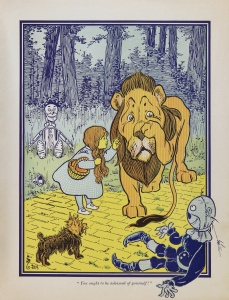
Wizard of Oz, original artwork 1900. In public domain.

What do new writers need most? (1) Something to write about that they are interested in. (2) Not getting caught up in worldbuilding, but do actual writing instead. (3) Get lots of support. (4) Get little bits of where to improve at a time instead of the firehose an editor uses. (5) Receive suggestions with multiple ways to improve, in case the solution presented isn’t the one for them. (6) Write for an audience. (7) Read stuff in the genre they are writing.

In short, the fan fiction environment.

A distributed mentorship environment where someone will have time one-on-one with you for a few minutes. And maybe tomorrow, someone else will have a different suggestion. And a third person tells you, you have done the best THING E.V.E.R. with their favorite character and could you pretty please continue your story.

Hawk – Publicity Materials for Buck Rogers

I’ve never gone the fan fiction route. By the time fan fiction was on the internet, I had moved beyond that stage of my life. (Though before then in my daydreams/writing, I walked beside Dorthy in Oz, operated the communication panel on the Enterprise, and got my first kiss from Hawk on Buck Rogers.)

Even so, I have leveraged distributed mentorship for most of my life, especially in my writing. First, attending conventions – where panel discussions are another excellent example of this type of mentorship. From there, I discovered Gail Martin‘s Thrifty Writers’ Publishing for Success Network and was lucky enough to be in a position to join. Also while attending conventions, I’ve networked into several editing jobs with publishers which in turn exposed me to different ways publishers want things.

And don’t forget just talking to person after person about writing and editing, an exchange of mentorship with suggestions, supports, and concrits shared back-and-forth.

Distributed Mentorship. Use it and share it. In your writing life, in your clubs, and in your day job. 


Bibliography

Beck, Julie. “What Fan Fiction Teaches That the Classroom Doesn’t”. The Atlantic. 1 October 2019. https://www.theatlantic.com/education/archive/2019/10/how-fanfiction-improves-writing/599197/ (Last viewed 10/24/2019)

Other Cool Blogs: Chuck Wendig 4/18/2017

Photo by Jen Theodore on Unsplash
Meme words added by Erin Penn

House Fire or Hot Property? Why not both? That pretty much is the publishing industry in a nutshell, and those that like to hang out in it. An living example of this metaphor is Chuck Wendig.

On his birthday in 2017, Mr. Wendig did a retrospective on his blog – Terribleminds – “What I’ve Learned After 5 Years and 20 Books: 25 Lessons.”.

Three pieces that grabbed me from the twenty-five on the list:

  1. Writing advice is … largely the product of survivorship bias.
  2. A writing career is a little bit jazz.
  3. Give the proper amount of fucks.

You can find the list here: http://terribleminds.com/ramble/2017/04/18/what-ive-learned-after-5-years-and-20-books-25-lessons/

WRITING EXERCISE: Read the whole list of twenty-five and choose one that really strikes home. Write it up in a comment below explaining why it is important to you. By processing it out, explaining it, the concept will stick with you longer.

***

A writing career is a little bit jazz. 

I’m a plotter. Jazz is scary, improvisation jazz is even more scary. It’s structure isn’t a structure as much as a growth, layers of paint building from a pencil sketch which may or may not match what is in the mind but ends up so much more than I thought possible – or total dreck. Wendig wrote “You plan what you can, but the rest is experimentation.” Eek! 

And yet, jazz has its own beauty. Something beyond any plan. Adding a bit of jazz, a bit of music to a page to a book to a sentence. Create a canvas which people get lost in. The concept of a career having the same unsteady base is frightening and freeing.