A.J. Hartley is a best-selling author. Way back on June 22, 2012, he wrote an article for Magical Words entitled “Balancing head, gut and heart.”
The blog post deconstruct why the Doctor Who two-part episode “Silence in the Library / Forest of the Dead”, works so well. And it isn’t just because of the solid sci-fi elements (time travel) bringing a reader’s HEAD into the story, or the chilling monster grabbing the GUTS, but also the emotions – the relationship between the Doctor and Donna, and the new-old archeologist straining the HEART. All three items, when in balance, make amazing fiction – whether book or visual medium.
The full URL is: http://www.magicalwords.net/really-i-mean-it/balancing-head-gut-and-heart/ … and be sure to read the comment section for additional advice.
WRITING EXERCISE: Using a novel you are reading or recently read, take apart its inciting incident. (The manuscript used needs to be at least novella length and the first of the series, to give the inciting incident a reason for being.) Comment below what book you chose and why. Review the previous writing exercise for details about inciting incidents.
My attempt
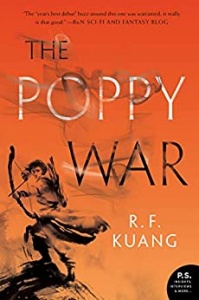
As I said, The Poppy War inciting incident stood out to me … because it had so little to do with the rest of the story. It could have been removed from the book and virtually nothing would have changed … except it is the pebble that starts the avalanche.
Quick review on what an inciting incident needs:
(One) Early in the book – check. Aside from the opening flash forward, the marriage proposal starts the book.
(Two) Disrupts the status quo – This is where the marriage proposal becomes important. While life truly is horrible for our protagonist, she is well used to it at this point. She works the shop, protects her little brother as best she can, and knows how to manipulate her adoptive mother enough to avoid the worst of the abuse. Being married even to someone in the same village, will change everything in her life, and not for the better as far as she can see. Especially at 14, to a twice divorced older male. Big disruption.
(Three) Not under the protagonist’s control – And this is where the inciting incident of the marriage proposal is different from her waiting for answers on the test she took. Rin chose to start studying for the Keju test, she arranged for her professor, she took control of her life to take the test. Even while waiting for the answer to the test, everything related to it was under her control. But the marriage proposal, nothing was under her control. Her adoptive mother wants it, the marriage maker didn’t even consult her, her possible intended never talked to her.
Similar to the inciting incident in Harry Potter is receiving the letter. Nothing in his life ever prepared him for this. But the Sorting Hat, while seemingly not under the children’s control does listen to them and is influenced by Harry’s wish not to be Slytherin. In the Wizard of Oz, the inciting incident is the tornado.
(Four) Forces a difficult choice – Rin chooses to take the Keju, and then further, chooses to leave home. While the leaving everything she knows behind is as disruptive to the status quo as the marriage, the difference is the protagonist chooses this “Call to Adventure”.
Oh, wow. I figured why the inciting incident bothers me so much. Usually the Inciting Incident for fantasy is a “call to adventure” – something that leads the person into the magical world. But in Rin’s case, she isn’t so much responding to a call as avoiding something unpleasant. The inciting incident so mundane, it doesn’t match the normal expected Call to Adventure or other Fantasy magic. In fact, the inciting incident is so hateful to her she twice uses it to whip herself down a path when things get rough. Anything was better than going back.
In conclusion, the inciting incident of The Poppy War stuck out like a sore thumb, different from normal fantasy and not really fitting in to the rest of the book, and yet it meets all the classic needs of the Inciting Incident – including and especially the fact the marriage proposal wasn’t under her control,
I had a teenager writer ask me about what a PLOT actually is a couple-few years ago (went looking for the date and found it: 7/12/2019). This is the very long email I sent in response.
***
So there are two videos that I watched recently which may help with defining plot.
Let’s take Miss Independent by Kelly Clarkson and Fighter by Christina Aguilera.
Miss Independent – the song lyrics – has a journey of change. (google search “Miss Independent by Kelly Clarkson Lyrics”) Miss Independent starts defining the character, and foreshadows her change of character. Next verse is her hesitation to change. Final verse and chorus is her deciding to give love a chance.
Miss Independent – the video (see below). Is more of a news report than a story, though most news reporting attempts story-like elements for engagement. You start with the end, where you see the party aftermath, then see party scenes – silly string, karaoke, pool time, and other fun things. Every now and again you get the hint of the guy. BUT this is more just like a bunch of disconnected scenes – you don’t get a romantic payoff, you have no character growth, no decisions are made, nothing changes. You can see that there COULD be a plot there if emotional transitions were added and the scenes connected, but right now it is a video hodgepodge. Cool but not a plot – maybe a story-idea, but no plot. Plot has a structure.
So for Miss Independent you have a plot in the song but not one in the video.
The reverse is true for Fighter, where the song doesn’t really have a strong plot, but the video does.
I wanted to really bring Fighter to your attention because of the Mermaid and Monster short story we were discussing last night. That story was a metaphor story both heavy-handed (nearly laying out everything word for word in case you couldn’t get who was the “mermaid” and who the “monster”) and didn’t really carry the metaphor well, because even with all that you were still asking what was the point the writer tried to get across.
Fighter’s video is incredibly surreal, and carries a metaphor storyline well.
For the lyrics (google “Fighter Christina Aguilera lyrics” and remember to open it up to get all the verses), you have a background-infodump more than a plotline. No one is changing and there is no clear beginning, middle or end (just like in the Miss Independent video – where we got a middle and end, but no beginning). Fighter is also an emotional character study – part of the reason there is no change of the characters. So Background-History and Character-Sketch, even good Worldbuilding, but no Plot.
Then you hit the video, where the plot is metamorphosis, again a change. It reflects an abused woman escaping her abuse to come into her true self by creating a metaphor with butterfly collection where the characters are stuck behind glass and pinned down, to eventually flying free after pulling out the pins and throwing them away.
A complicated two-layer linked metaphor – with the dancers creating a metaphor to butterflies, then the butterflies creating a metaphor of an abused woman transforming to strong woman. Beginning starts in the glass, middle is throwing off the pins, ending is transforming to a stunning white butterfly / and a red skirted fighter capable of walking.
Change needed for Plots – This is a fun video for me “Road Trip” by VoicePlay (I like Acapella).
Initially, you would think that the plot is a road trip, after all that is the title of the video. And that is where the story starts, but a road trip is just a type of action sequence getting a person (or group) from point A to point B.
That is not where the CHANGE is happening. The change is the music selection in the front seat. The beginning is just turning the music on and getting an unacceptable song. Middle of the plot is conflict, mediation with help of the back seat –SIDE PLOT BREAK (with a beginning, middle, and resolution there too) – and finally a full-circle ending of acceptance what cannot be changed.
I really enjoy VoicePlay for their ability to mime a full plot-driven story with a song collection. This one is not only a story, but several side-plots with an opening vignette story of trying to get into the car, and other side items which are not stories like the “aerosol” can and buckling the seatbelt.
I am going to define a plot for a story as (1) beginning, middle, end; (2) a structure, (3) something changes.
Webster’s Dictionary: the main events of a play, novel, movie, or similar work, devised and presented by the writer as an interrelated sequence.
SEQUENCE and INTERRELATED are the important parts of this definition. (sequence = beginning, middle, end; interrelated = structure)
I should mention this includes the plot where the beginning and end are the same, but you have a middle with changes – this is the “full circle” type of plot device. So after the entire story, there is no change if you only look at the start and end – but there is power in choosing not to change after something acted upon the character. In the case of the Road Trip – which is a one version of full circle, they start and end up on the same song, the characters’ middle with conflict changed them from rejecting the song to accepting it.
Well, I hope this helps. I had fun figuring out examples on the way home and will be making a blog out of it.
So today’s edit came with two sections marked by the writer with the following (paraphrased) question. “Do I need a scene break here, a transitional paragraph, or can I just do the jump?” I understand why the author did not want to do the transitional “just adding words” – both cases were characters moving from point A to point B – in a rather obvious fashion. Why tell the readers that?
It would be boring.
We don’t want boring.
So the question then becomes scene break or scene jump?
I said break for one and jump for the other, because of emotional situation.
The characters stuck at computers and cramping. (Scene break of three stars showing some time has passed) Opening the doors and going outside into sunshine and feeling free.
Characters in car tense, parking at location (Scene Jump with new paragraph) Characters hit a wall of noise when they enter the building making them tenser.
Transitions ignored for the break and jump – going for computer, down hall, to outside. / getting out of car, out of parking lot, into building.
This is something I’ve seen writers not really understand – using white space to add to the emotional development of the story. Sometimes a writer gets so caught up in the words, they forget paragraph-returns have their own powers.
I think the scene break helps the reader feel the difference between being hunched and free – though the conversation continues, the reaction between the characters is now shaded differently.
Whereas the jump scene increased the intensity. The reader gets whopped by the sound with the characters.
In both cases, the “white space” option complements the emotional investment needed by the reader.
Anyone else have stories (teaching-moments) about white space as an editor or writer, and how we can use “emptiness” to make a story better?
In Orson Scott Card’s book, Characters and Viewpoints, he breaks down M.I.C.E. – Milieu, Idea, Character, and Event. These represent four different story structures.
In Milieu, the character gets removed from the normal; though the normal still exists. Going off to college is one example; most classic quests are Milieu. Idea is a puzzle, a mystery of some sort. Character is a character-driven story where something is the character’s life has become untenable and they must fix it; the turning point of the character’s life. Event is similar to Milieu except the characters remain in the normal place, but something has happened to the normal so it no longer exists.
Discovering the paranormal is real would be a Milieu, having a Zombie infestation would be an Event.
Alongside this is Want. Story structures define a type of story – like a car choice. Want is the gas in the car. What make the characters move forward.
To read more about Want, Expectation, and M.I.C.E, look over these two Magical Words postings made by Edmund Schubert: