Other Cool Blogs: Magical Words 11/9/2011

Image courtesy of patrisyu at FreeDigitalPhotos.net


“I just had the best idea, hon. Just let me make a note of it on my phone.” I look up after a few minutes of quick typing and uploading to the cloud, ignoring both the cooling food in front of me and the character in my head going ‘and another thing’. “Now, what were you saying?”

Writing is a Solitary Business, as Faith Hunter explains in her November 9, 2011 post on Magical Words. The problem is even as introverted as most writers are, we aren’t solitary creatures. We have jobs and family. In November NaNoWritMo when writing dominates, Thanksgiving steals time away from the laptops and Christmas hides in the shadows waiting to pound us with lists and demands as soon as the 50K is clocked.

Ms. Hunter and the commentators on the post share some of the trials and tribulations of the story-in-the-head swiping moments meant for family and friends at . With the all-consuming NaNoWritMo, remember to breathe and listen to others in your life. There will be other stories; there is only one family.

Blog: National Novel Writing Month

Shark Angry GIF from Shark GIFs


***Guess what I am going to try again this year.***

To the tune of Baby Shark
November, Na – No – Write – Na – No – Na – No
November, Na – No – Write – Na – No – Write
November!

Choose a Theme, Na – No – Write – Na – No – Write
Choose a Theme!

P-O-V, Na – No – Write – Na – No – Write
P-O-V!

Write some words, Na – No – Write – Na – No – Write
Write some words!

Plot some more, Na – No – Write – Na – No – Write
Plot some more!

Find Buddies, Na – No – Write – Na – No – Write
Find Buddies!

Word Sprint Time, Na – No – Write – Na – No – Write
Word Sprint Time!

Lots of words, Na – No – Write – Na – No – Write
Fifty thousand words!

Type the End, Na – No – Write – Na – No – Write
Type the End!

Editing Rant: Drafts

Image courtesy of Sira Anamwong at FreeDigitalPhotos.net

Drafts are the self-editing phase of writing. If you participated in NaNoWritMo in November, my fearless author friends, you now have a ROUGH draft. This is NOT a final draft, not even close. What you have is the foundation to build your novel. Bet you thought those 50,000 words were the novel. Nope – average sellable novel on the low end is 70,000 for romance, mystery, horror, and urban fantasy; and 100,000 for science fiction and fantasy.

If you are like most, you worked NaNo without an outline. Time to put that together. A previous blog post covers the benefits of outlining here. Now you have your basic story flow, and the beginnings of a synopsis for later trying to sell the product.

Looking at the outline, combined with the Rough Draft, the Macro/Content Draft begins. Are there things missing – characters dropped, action slowing down when it shouldn’t, a plot line needing beefing up? Make notes on the outline of the fixes needed and take your Rough Draft to Macro/Content Draft. When done, an increase in word count should have occurred.

Update the outline, maybe start a Bible if a series is expected. What are the major characters and locations? Heights, clothing, props, eye color, etc. With the Book Bible beside you, go over the Macro/Content Draft and update it to a Micro/Line Draft. Check for consistency of character in dialogue and actions, verify permanency of props – do they appear before they are first used, and see if any “tell” can be flipped over to “show”.

It’s okay to do one or more passes for each concentration. For example, Macro pass one adds the scenes you thought you wrote, but never got around to, while Macro pass two you rewrite the Point-of-view character because you realize the story is really about the “side-kick” and not the leader.
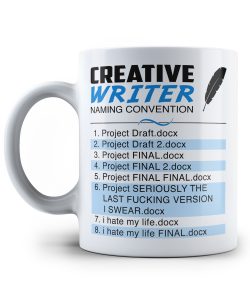
(Mug can be bought at GearBubble and other locations)

Once you have reached the “I hate my life FINAL.docx” phase, time for the proofreading to start. I recommend using an on-line proofreader such as prowritingaid or grammarly. As mentioned in a previous blog, it’s hard to proofread your own work.

All done.

You have gone from Rough Draft to … BetaReaderDraft. You’ve lined up those beta readers, right? Beta reader blog post is here.

A revisit of the editing levels can be found in “Editing Rant: Choose a Color“.

Congratulations on completing the National Novel Writing Month. Now you can make magic.

Quote from James Maxey