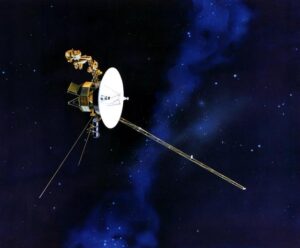
Voyager on November 18, 2026 reached on light day from earth. Sixteen billion miles.
When people on Earth see the light from the Moon, it has traveled for 1.3 seconds. That is after it has traveled a little over 8 minutes from the Sun to the Moon. Depending on the time of the year, because Earth’s orbit is an oval and not a perfect circle, it is eight minutes and 10 to 27 seconds.
Big, when talking outer space, is really big. And NASA, JAXA, ESA, and other space agencies must take it into account. We’ve all witnessed the slight delay on news shows. Most satellites for telecommunication orbit at 22,200 miles. It takes about a quarter of a second for the radiowaves on Earth to reach the satellite in orbit, another quarter of a second to bounce down. And to return back to the original broadcast location, another quarter of a second both ways – so a full minute, and that is not counting any encoding for transmission in all four stops. (Satellite Signals) To communicate to something in orbit, humans need half a second – literally.
To talk to any of the rovers on Mars, depending on where it is orbit around the Sun compared to where Earth is, can vary between four minutes to twenty-four minutes (rounded). (Ormstron) And if Earth-Sun-Mars is all in one line, no communication is happening until the conjunction breaks. This is why the hardy rovers are programmed for self-reliance. Worse case is a 24-minute cry of “Help! I’m stuck.” And a 24-minute response of “Here is how to fix it.” A total of 48-minute turn around, even if the fix was instantly known. Those hard-working rovers have been on their own out there. (We love you, little buddies!)
That still is under an hour.
Neptune, the furthest confirmed full planet from the Sun, gets hit by sunbeams just over four hours old. (WorldAtlas)
Voyager 1 is beyond that. Voyager 2 spent a little while longer in the solar system, swinging by Uranus and Neptune, before angling into the great unknown, and is expected to hit one light-day in November 2035. (Scale of Universe)
After traveling for 49 years, two months, and 11 days, Voyager 1 is a light day from Earth.
An inconceivable distance. Humanity’s hand has reached further than a full night and day rotation of the Earth in terms of light traveling through the vacuum of space.
The nearest star is Proxima Centauri at 4.265 light years from Earth. An earth year is 365.25 days. The nearest star is 1,557 light days away.
If Voyager 1 was aimed at Alpha Centari, it isn’t but if it was, then at the present rate of travel, it would reach there in 79,591 years.
Space is huge.
Voyager 1 has gone impossibly far, and yet is still so near.
Sixteen BILLION miles down.
Are we there yet?
Bibliography
Ormstron, Thomas. “Time Delay between Mars and Earth.” ESA. 5 August 2012. https://blogs.esa.int/mex/2012/08/05/time-delay-between-mars-and-earth/ – last viewed 11/16/2026.
Satellite Signals. “Geostationary satellite latency and times delay ms.” Undated. https://www.satsig.net/latency.htm – last viewed 11/16/2026.
Scaleofuniverse.com. “How big is a Light Day?” Undated. https://scaleofuniverse.com/en/universe/light-day – last viewed 11/16/2026.
Wikipedia. “List of nearest stars.” Undated. https://en.wikipedia.org/wiki/List_of_nearest_stars – last viewed 11/16/2026.
Worldatlas.com “How Long Does It Take Sunlight to Reach Earth?” Undated. https://www.worldatlas.com/space/how-long-does-it-take-sunlight-to-reach-earth.html – last viewed 11/16/2026.