Editing Rant: Submission Standards


Image courtesy of Stuart Miles at FreeDigitalPhotos.net

Editing Rant – Standards for submission. Read them – love them.

AND USE THEM. 

I now return you to your normally scheduled blog in-progress.

*****

When submitting to an anthology or a publisher (or even an editor or agent), read the submission standards. The people asking to review your work for publication did not just create a bunch of rules which they stuck up on the website under the “submission” portion of the menu for giggles. Nearly all those rules are up there for reasons.

First and foremost, it is a test. Can you, for the love of goodness, follow written instructions? If not, editing can’t be done. If you can’t read simple instructions on a website, where you found the information on how to submit, and then implement them, I already know you will be a problem child for my editing.

I don’t care if your work is the bestest in the entire world and will make me rich. I’m not in this job to be rich – I do this job because I like making great reading material. Dealing with a writer who thinks rules doesn’t apply to him/her is not in my “like” world. I won’t even read your manuscript; a form rejection takes me about 2 minutes to send – figuring out how to download and review a manuscript not following guidelines takes much longer. I rather work with a slightly less great piece and make it awesome then deal with people who cannot follow instructions.

Second, the guidelines sort out those who really mean it. If you take the time to correct your manuscript to whatever the instructions are (even put it in sans comic font – shudder), I know you really are serious about writing. This is your professional resumee after a fashion. More on that in another editing rant.

Third, the reasons for the particular guidelines. Double-space makes it easier to read and edit – to see errors and make comments for returning. Times new roman font (or whatever font is requested) is chosen as a standard for ease of reading. Standard margins, allows the reviewer to compare story length against what they are looking for. File format (.docx, .txt, .pdf, .doc), editors are poor and don’t have a lot of different computer programs – if you don’t send it in the format requested, it might be impossible to open. 

Be grateful to live in a time when the publication guidelines are easy to find and you don’t have to print off fifty, a hunderd, a thousand pages and mail it in and wait a year for a response.

Suck it up and follow the submission guidelines. You will make it further than 50% of all manuscripts in the submission pile just by doing that.

Yes, really. HALF of all electronic submissions my publishing house gets do not follow guidelines. And I DON’T READ THEM. 

You, you don’t understand guidelines. Form reject “Thank you, your submission does not match our current needs.”

Editing Rant over. (and ongoing with every submission I review)

Other Cool Blogs: Magical Words May 27, 2008

Image courtesy of freebieshutterb at FreeDigitalPhotos.net

Dry Season

Tax season ended, recovery (mostly) completed. The feast of money and famine of time has ended; now I have time to edit and write, but no money. I have entered my dry season, financially. 

For the last four months I have been making mortgage, student loans, and all kinds of other payments, trying to get as far ahead on them as I can. Four months does not make a year’s worth of payments, even in the insanity of the tax industry. Hopefully editing will continue to grow and I can sell a couple things to anthologies. Even better would be finishing a book and getting a steady (if minor and only quarterly) income stream.

C.E. Murphy, an author who actually is making a living writing, gives a glimpse behind the curtain in the Magical Words post “Royalties“.

Biggest take away:

“By this time you’re thinking, “Yeah, but ALL THAT MONEY! ALL AT ONCE! I CAN GO NUTS!” and believe you me, that’s what a person starts to think when she gets a several-thousand-dollar-check deposited in the bank.

And then she thinks, “I have no freaking clue when I’m going to get paid again,” and all of a sudden that big lump of money doesn’t look tempting, it looks cruel.”

You can read the whole blog post here: http://www.magicalwords.net/really-i-mean-it/royalties/

THOUGHT EXERCISE: Imagine being a published writer and deciding to go full-time (quit the day job). What changes will you have to make in your budget? How would health insurance be covered? Mortgage, car, food. Travel required for writing like cons, plus family obligations like Christmas. Could you manage the windfall to be trickled out for six months of bills? What life changes would you need to make? How much do you love your day job? Comment below on what will be the hardest thing to adjust financial-spending-wise for you.

***

I am a very miserly person by nature. I buy used cars at the three-year mark when they have lost the big depreciation but have the most years left. I then keep them until around their tenth year, when the maintenance and reliability becomes an “expense”. Non-reliable means lost jobs, break-downs requiring towing, etc – huge expenses. My house is small – to save time cleaning, to save money heating and cooling, to have a mortgage less than renting. I know how to stretch funds over time and make advance payments. I keep an emergency fund.

Even with all these skills and life choices, the months outside of tax season always are stressful. When will the next editing check come in? Will the car inspection reveal a major expense? Will my health hold out until I am old enough to get medicare, since health insurance is not a viable financial option? Can I convince my sushi craving that ramen noodles count as Asian?

The hardest day-to-day is not being able to help friends as much as I want. The internal debates of the gas costs even for visiting cut deep. I’ve decided to walk this path, but I know the choice means I will never be “living large”. In the real-world at least, my head-space is nicely decorated.

Other Cool Blogs: Just Publishing Advice Nov 2, 2016

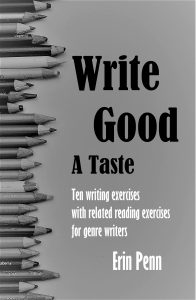
Cover by Erin Penn

If you were around in November, you may have noticed how my novel for NaNoWritMo went south. All October I thought and thought about Internal Lies based on a dream I had during the 2016 holiday season, carefully not writing a word down. I jumped on the computer on November first and typed up all the notes I had from the original dream – close to 1,000 words.

Then nothing on the second.

On the third my brain said “Let’s write a blog post.”

Now? Really? You haven’t wanted to work on the blog but in bits and pieces all year and you want to do one now. … Oh well, at least it is writing.

Yeah. The result? Nearly “won” NaNoWritMo by catching up on my blog – 35,568 words of blog postings. This was the most productive writing period I have ever done outside of writing Honestly. Actually more so, since Honestly is only 15K.

Anyway, I’ve long been thinking about maybe doing a collection of my flashes or putting the writing exercises together for something I can sell on Amazon. You can even see a cover above made for the Writing Exercises. The challenge is transforming the blog into a coherent how-to. Like taking a novel and changing it to a movie, the mediums of blogging and ebooks are different with different requirements.

How to Turn Your Blog Into a Book” by Julie Petersen (2016) and updated by Derek Haines (2017) on the Just Publishing Advice website gives some excellent advice I plan to use. If you are thinking about going this route with your blog, you might want to review it as well. While focused primarily on non-fiction, the biggest take-aways are reaching new readers, monetize your work without turning your website into advertising central, and hiring professionals for the professional bits.

Look for the four book series on Writing Exercises to come out this year: Write Good a taste, Write Good, Write Gooder, and Write Goodest.

Other Cool Blogs: James Maxey November 14, 2017

Quote from James Maxey

Meme created by Erin Penn (Quote from James Maxey, art from unsplash.com)

Conventions

Why go to conventions? For James Maxey, it’s seeing how they react to his book covers and book blurbs. Do people walk by his book covers or do they stop? If they pick up the book and flip it over, do they set it down again or juggle the book while pulling out their wallet? Conventions are his market research, the time he can connect with potential buyers and see them react to his product.

In one of the most detail, complete and HELPFUL blog posts I have ever found on Conventions, “Selling Books at Conventions” goes beyond the typical “attend conventions for networking opportunities”. For Mr. Maxey, the paradigm of conventions being a monetary loss was a challenge he was determined to conquer, and you can find out all his tricks here: https://dragonprophet.blogspot.com/2017/11/selling-books-at-conventions.html

Other Cool Blogs: Magical Words September 16, 2017

All Good Things Come to an End

Every story, at least one hopes, has a solid beginning and an ending. The Magical Words story has come to an end. On September 16, 2017, the final post was uploaded by Misty Massey.

Goodbye Faith Hunter, David B. Coe, C.E. Murphy, John Hartness, Tamsin Silver, A.J. Hartley, Carrie Ryan, Jim McDonald, Melissa Gilbert, Emily Leverett, .. your words and advice have been amazing. I shall miss this informative site.  I have learned so much from what you have shared.

Over the next few days, I will be going through the site looking for memories or missed gems. I don’t know how many blogs are left but I will be looking at them all and saving as many as I can. I also don’t know when the administrators are going to cut it off, so I will be saving as much as I can. As for the existing (and future) Magical Word posts, while the site is up, I will continue to point to it. When the site comes down, I will upload the content to my Magical Words posts.


MAGICAL WORDS