Writing Exercise: Paragraph Breaks

Blond Girl On The Camomile Field

FreeDigitalPhotos.net photo by Serge Bertasius Photography

The Power of Paragraph
So few people use the paragraph to their advantage. Yes, writing is about words and grammar and punctuation, but white space has power too.

WRITING EXERCISE: Write a scene, 100 words or less and use normal paragraph rules. Take the same scene, but change the paragraph breaks to enhance the story.

******

Matilda (without paragraph breaks)

The boy ran until he hit the crossroads. Looking right, he saw Matilda, the most beautiful girl in town. She would be going to the marriage festival in the city soon. He always meant to talk to her, tell her how he felt. But he was behind schedule, like always, and turned left, restarting his run. He never saw her again. (words 61)

*****

Matilda (with paragraph breaks)

The boy ran until he hit the crossroads.

Looking right, he saw Matilda, the most beautiful girl in town. She would be going to the marriage festival in the city soon. He always meant to talk to her, tell her how he felt. But he was behind schedule, like always, and turned left, restarting his run.

He never saw her again.

(first published 01/23/2015; republished new blog format 2/23/2016)

Other Cool Blogs: Magical Words February 17, 2016

A Cup Of Coffee On Writers Desk Stock Photo

FreeDigitalPhotos.net photo by Praisaeng

Replenish

This week’s other cool blogs postings from Magical Words returns to the incredible Tamsin Silver. (see other blog from her I commented on HERE)

This weeks blog is 
Hump-Day Help: Refill/Restore/Replenish. 


Very timely for me in the middle of tax season. I get an hour … yes one hour … of personal computer time per day right now. The other waking hours are one hour to get ready for work and the hour once home to pack for the next days work (lunch, layout clothes, shower, and the like) and an hour to wind down – not on the computer because that will not wind me down. On the weekends I get an extra hour each day, one for groceries and one for clothes. That is pretty much my life right now outside of work. Yes, I am working seven days a week and have been since January second.


Oh, and that one hour of computer time is devoted to keeping this blog running, keeping in touch with friends, dealing with bills, and the myriad of other obligations.


Any of it writing or creativity? Not really. And I am tired. Core-center through-and-through tired.


Ms. Silver hits it spot on. Take care of yourselves. It is necessary – as a writer, as an artist, as a human. Read the Magical Words blog – again the link is 
here. And go rest, refill, restore and replenish.


(And to all of you out there holding down two jobs AND raising kids – you people are amazing!)


WRITER’S & READING EXERCISE: Do one creative thing. Something that makes you smile with accomplishment once you are done.


(Addition from 2/25/2015 – 
Ms. Liana Brooks has an excellent addition to this discussion at http://lianabrooks.blogspot.com/2016/02/maslow-vs-deadline.html

I love Maslow’s pyramid of needs and this makes sooo much sense for writer’s block.)

Editing Rant: Beginnings

Determining the proper place to start the story...

Image acquired without permission from Castlegate Press 2014 posting

The image above is from a post by Suzanne Hartmann, one of the co-founders of Castlegate Press, for a July 6, 2014 posting entitled “Where Does the Story Start?”. (Castlegate closed in 2018, all links are now defunct <sad face>)

Starting a Story

One of the toughest parts of writing is figuring where your story starts. When initially writing, just write it out because often you don’t know where the story will start until you know where it ends and what happens inbetween.

Then come back to the beginning. The common agreement in 2016 is the story should start when the main character’s life begins to change. That rarely is when they are waking up or walking through a door – usually it is something like “The front door no longer had a doornob.” …

Some famous opening lines include:

Lord of the Rings “When Mr. Bilbo Baggins of Bag End announced that he would shortly be celebrating his eleventy first birthday with a party of special magnificence, there was much talk and excitement in Hobbiton.”

Pride and Prejudice “It is a truth universally acknowledged, that a single man in possession of a good fortune, must be in want of a wife.”

The Stranger ” Mother died today.”

Metamorphosis “As Gregor Samsa awoke one morning from uneasy dreams he found himself transformed in his bed into a gigantic insect.”

***

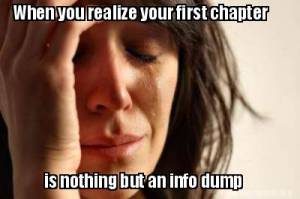
So a romance book I was editing started with three pages of exposition, describing the hero of the romance (the Point-of-View (POV)/narrator) leaving home, finding an apartment, finding a roomie, job hunting, and interviewing. Eventually we reach the point of the hero meeting his two possible love interests on a bus.

While his life was undergoing massive changes from the moment he left home until he got on the bus and met the love interests, none of that had anything to do with the plot. It was background. The job hunting, which took an entire page, ended with “I sat down, and he hired me.” (Actually it was “I sat down, and hired me” … but that is a different editing rant entirely.) The job is never mentioned again. The roomie is mentioned once, as a ride to the party and could have easily been included at the time of getting the ride. In fact two pages are dedicated to it when the ride is given because the roomie took his time getting ready. The parents are never mentioned except to leave home.

Half of the first chapter, close to 2,000 words, needed to be chopped. Nothing in those pages had ANY impact on the plot, romance, or character development. Maybe the job interview could have shown something about the hero’s character, but it was only “I sat down, and he hired me.” after the page of dead-end job hunting. At only 20,000 words this chop was a huge hit to the manuscript. (The first 10% of the length – this percentage is important so keep it in mind as we continue.)

And the manuscript should have never gotten to me in that form. One of content editing’s job is to define where the story starts, not line editing. All of that should have been decided long before it hit my desk. I should note this book was PREVIOUSLY self-published and I was reading it in relation to a reprint. So this story was already out there in the sales world and the author was wondering why he was getting no sales when he contacted me.

The reason? The romance story did not start with the romance, but a long backstory reading like a coming-of-age story – readers reviewing the 10% sample on Amazon received a false impression. Chuck the first part of the manuscript and have the beginning of the romance at the beginning of the story and suddenly readers know they have an interesting story with two possible love interests. Who is our hero going to end up with and is the romance going to break the friendship between the women? Much more interesting than a dead-end apartment with a dead-end job after leaving home and taking a couple of classes at the community college to get ahead.

Remember the start of the story is what most readers are seeing when trying to decide to put out their hard-earned money. Start the story when life gets interesting for the character.

A couple genre examples: For quest fantasy, start with why the character is willing to go on a quest. For military sci-fi, why the character is going to join the military. What had made the character’s life go off the rails so they are open to change?

Well, that is the editing rant about beginnings.

WRITING EXERCISE: For your work in-progress (WIP), review and see if the book would feel different if you add another chapter in front adding the day before to your story – then see what would happen if you just eliminate the first chapter. How would these changes impact your story?

READING EXERCISE: Have you ever read a book which seemed to start in the wrong place and you felt the first chapter or two were fillers? How about a book where you struggled through the first chapter not sure what is happening because not enough information was given i.e. the story started too late and you didn’t get time to be introduced to the changes?

Other Cool Blogs: Magical Words January 26, 2016

This week’s “other cool blogs” is another Magical Words author. You may know him as D.B. Jackson of the Thieftaker series (historical urban fantasy) or as David B. Coe  of Blood of the Southlands series. Either way the man writes some pretty amazing stuff, all character driven. And he obsesses about POV. Stories are viewed by the reader from the narrator’s Point of View (POV); usually the POV character is the hero or heroine of the book in genre fiction.

The January 26, 2016 blog, The Power of Secrets, is about … secrets (shhhh). Read the blog – link here: http://www.magicalwords.net/david-b-coe/quick-tip-tuesday-the-power-of-secrets/ 

WRITING EXERCISE: Create a secret for your present WIP.

For Honestly, Troy, the hero, has a lot of secrets. Some get revealed in the story, some get only partially revealed, and some never are shown but are driving him.

The most obvious of the revealed secrets is his amputee. Initially he hides everything under clothes and mannerisms. As he gets to know Kassandra, he shows more and more of this weakness.

The partially revealed secret is his present government work. He does translations. But for whom and why? … and what is he translating?

A secret I never shared with the reader since the POV character, Kassandra, did not learn about it during the story is how Troy’s mother died. Yet the secret drove him to quit school and join the military and even now drives several of his decisions. The reason he won’t let the pain control him lies with what happened to his mother.

YOUR TURN
If you are a writer, what secret does your characters have and how does it shape them? Are you going to reveal this to your audience or keep it a secret.

If you are a reader, what is a secret in a recent story you read? How did it drive the plot?

Other Cool Blogs: Liana Brooks

Snape "Detention, Saturday night, my office."

Meme from the Internet

At the beginning of January I reviewed a book by Liana Brooks. She is one of my favorite authors, and I follow her blog. Back in 2014 (when she updated her blog it was moved to a June 25, 2016 post) she wrote an amazing piece about villains; more precisely how to layer the villains in a story. If you are a writer of mysteries, superhero prose, or other genre where the character has people-type conflict, this blog is an absolute must-read. Her breakdown of the immediate villain, the intermediate villain, and the big bad really helped clarify writing for me.

For Harry Potter the immediate villain was his family (uncle, cousin, etc), the intermediate villain was Professor Snape, and the Big Bad was He-who-should-not-be-named. I never really thought about this formula before so I found this advice really good. … Sometimes formulas are bad because authors follow them mechanically; other times they are a reveal how the masterpiece was created. 

You can find the blog post here: https://www.lianabrooks.com/nanowrimo-boot-camp-day-3-the-antagonist/

WRITING EXERCISE: Think about your Work-In-Progress or other story you have read and watched. Is there a progression of villains within the story? I broke down Harry Potter – what other stories can you think of? Comment below.