Blog: Ah-Ha – A Study in POV

Ah-Ha – Take On Me video: A Study in POV

I previously blogged on the Ah-Ha video “Take on Me” in June. You can link to it HERE.

As mentioned, the story presented in the video resounds in me decades later. I use it for my “wake-up” alarm to go to work, encouraging me to take on the world and make a difference.

One of the interesting things about the video is the switching point of views (POVs) for the story. If you have been having problems picturing the differences between first and third POV, dissecting this video may help.

The opening starts with close first-person POV of the heroine. We glimpse her world in the diner, her reading the story for escape from the ho-hum, and her reaction to the hero breaking the fourth wall of the comic to invite her into his world. We see them fall in love. We don’t know why the male choose her or how he had the ability to reach out. That information is not available for her POV; at this point the story has all been about her and what she can see.

Now we switch to third-person omniscient. We return to the real world for a few minutes. The waitress discovers she has been left without the check paid. We see her react but don’t really identify with her as a person – only as a role. Omniscient has that effect; seeing the whole world keeps one from being emotionally drawn in. Next the third-person switches to the other drivers noticing the intruder to their world. The omniscient lets the viewer know what is happening and why, but not necessarily what the main characters are experiencing emotionally.

Initially the POV seems to have returned to the heroine, but it doesn’t actually. The running away, the music being played, etc. could be either first-person or close third-person. But then the hero saves the woman by returning her to the real-world. If we were in first-person heroine, we would not know he turned around to face the bad guys. This one panel lets us know what POV we are in. The switch to close third-person allowed us to know what is happening with both the main characters. The editor in me doesn’t like the amorphous POV at this point – it works for the video but if I ran into it in a story, I would ask the writer to more clearly define the POV. No head-hopping!

Back in the real-world we return to the woman’s first-person POV for the third-act of the story. We see the looming diner population, experience the fear and uncertainty overwhelming our heroine, and initiate the immediate reactions of rescuing the comic and running for her life. For a few seconds the video totally grabs and pulls a watcher in just like the black&white-sketch hand did with our heroine at the beginning of the video.

At her house, the pounding heart slows as she smooths the paper … and finds him dead. Her POV continues when she hears the crash and sees her hero throw himself out of his world into hers.

Would the story have worked if it remained 100% first person or third person? How would the story have changed without viewing the waitress’ actions or the male turning around after our main POV character left?

WRITING EXERCISE: For your present WIP, think about how you have used POV. Have you been consistent in usage? Would letting the reader know the antagonists actions help the story or decease surprises later on?

READING EXERCISE: Think about your most recent read. Was the POV consistent? Was there anyone else in the story you could have “followed” through POV and still have seen most of the story?

Writing Exercise: Writing Prompts

Image: Mark Lewis “Brave” – http://www.flickr.com/photos/83008453@N00/127143656
Prompt: Jana Wilson “Thinking Out Loud” –

Prompts

Writing prompts are great for beginning writers. My participation in a monthly one through (the now defunct publishing company) Breathless Press is how this blog started. Prompts come in many flavors, but two major categories: visual and verbal.

Based on a picture of some sort, visual prompts inspire a story through the eyes. The story may be based on the picture or just inspired by it. My recent “Glow” flash is based on a visual prompt from a writing group.

Verbal, or text, prompt come from words. Sometimes the requirement is to fit the words into the story and other times they just inspire. From the same writing group, I received a text prompt which resulted in “To Do List“.

Where might published writers be driven by prompts?

Anthologies are often theme-based, basically a verbal prompt. A couple upcoming anthologies include: Love and Bubbles – an anthology of romances which take place UNDER the sea (due 12/20/2017) – and Other Covenants – Alternate History involving the Jewish people (due 2/4/2018).

Visual prompts may come from being handed a picture to be the cover for a magazine and being told “Write something for this.” During the pulp fiction years, picture-driven stories were common as western, sci-fi, and fantasy magazines bought the rights to paintings.

Using prompts to prime the pump, get practice in writing, or just take a break from a long-form story can be fun.

WRITING EXERCISE: If you are part of a group which recently issued a writer’s prompt, write that story. Otherwise on a google search type in either “Writing Prompts” or “Writing Prompts Pictures”. Write a story of at least 200 words based on the result. If you want, post the results below including a link to where you got the prompt.

Editing Rant: NOT TO BE

Acquired from the internet Hive Mind

It’s baaack. The copula spider. (First post on the topic is Copula Spiders.)

The shiny wore off real quick on being a content editor. Two manuscripts and thousands (2% of the documents) from the “to be” family – mostly “was” and “were”.

           “Editors are to leave writers’ voices intact,” claims a would-be author. “My voice is passive.”

           “Your voice doesn’t sell.” I move to the next story in the slush pile.

I’m not the only editor, or writer, running into the problem. “Was” and “were” are easy to use. One of my friends fixing a returned manuscript, complained her editor (not me) marked all the “was’es”.

“Was! Oh bane of my existence! Stop tormenting me … (cries)” she posts on Facebook.

New to content editing, I reached out and I asked her about it, and her editor replied (I guess my friend was still busy killing the “was’es” or crying, likely both as she said she averaged 5 was’es a page in her opus). The other editor wrote: “Basically ‘was’ is either taking the place of or weakening a stronger verb.“

Copula is “a connecting verb, in particular the verb ‘be’ connecting the subject and a complement”. The “to be” family includes: am, are, is, was, were, been, has been, have been, had been.

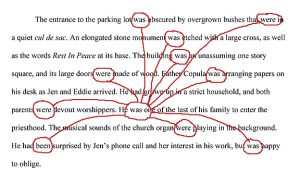
A copula spider happens when you circle all the was’es on a page and connect them. If eight or more legs result, you have a spider.

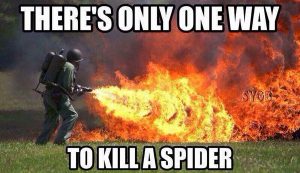
Was / were / is – the most evils of evils making writing weak. The Copula Spiders must be burned. Kill the spider. Have no more than five “was” ”were” ”is” on a page (one if an action sequence). Six would be a copula insect – and even those are unworthy of your efforts. Remove any of them running through your manuscript. Kill the spiders – burn the house and rewrite the section if you must.

READING EXERCISE: Find your favorite writer, action-based is best but any will do, see how many pages you go before you count ten copula usages.

WRITING EXERCISE: Take an action scene out of your present work-in-progress (WIP). Remove as many was-were-is from the scene as you can. Compare the original scene and the resulting scene for pace and verbiage impact.

Other Cool Blogs: Magical Words April 1, 2017

Acquired from the internet hive mind

NaNo – Well, This Isn’t Going As Planned

So much for my science fiction thriller I planned in my head all of October and attacked the first day of National Novel Writing Month. The second day I did the “Butt In Chair – Hands on Keyboard” … and I got a blog posting. In fact I got several blog postings. Sunset and sunrise saw me return for the BIC-HOK, and, well, I have a blog for today.

If this keeps up, my blog for 2017 may get completed before the end of the month and 2018 could have a great jump start.

Novel, not so much.

It breaks the rules, and I hate breaking rules. NaNoWritMo is about writing Novels – fictional pieces, long-form. Most of my blogs, and that is what my brain is providing right now, are neither. 

On the other hand after nearly two years of brain-to-keyboard disconnect, I am happy with ANY production. I just would have been happier to have salable production.

The plus side is I will have the basics for the Writing Exercise non-fiction book I have been thinking about.

Writing is a weird thing. The biggest discipline is “Butt in Chair – Hands on Keyboard”. Forcing your mind to stop thinking about writing and actually doing writing requires will-power; depending on the day and how long the habit has been in place, a great deal of will-power. After directing the will-power to the initial task of BIC-HOK, discipline in directing your mind in specific writing tasks can be lacking.

Sometimes it makes magic. Rarely does it meet deadlines.

Melissa Gilbert-McArthur wrote a Magical Words on the combination of BIC and deadlines, and it can be found here: http://www.magicalwords.net/melissa-gilbert/friday-fundamentals-deadlines/. Power to her for having the will power to pull off both at once.

Me, I am going to take the writing bug and get a little more blogging done.

WRITING EXERCISE: Butt-in-chair. Sit in your writer seat for half an hour today and write something. Do it again tomorrow. Do it five days in a row. Half an hour in your writer seat. No internet, no facebook, no twitter. If you live with someone, hand them your phone and walk to your seat and start. BIC-HOK and write. There you go -the first five days of the twenty-one days to create a new habit. The rest is up to you.

Other Cool Blogs: Liana Brooks June 23, 2016

Break thru your writing goals

Writing Meme created by Erin Penn

Getting Ready for NaNoWritMo

Like many writers, I will be participating in National Novel Writing Month (NaNoWritMo) in just a few short days. In preparation I visited the six-day Boot Camp Liana Brooks created in 2014 and republished in 2016 on her new blog, when I asked her if she could because it has been so useful to me.

The first Day concentrated on “Establish a Baseline“. In the thinly veiled co-operative Massive Online Game called NaNoWritMo, word count is king.

I like to point out writing 50 thousand words in a month and the techniques brought to bare to accomplish this are not exactly the professional process writers use, but NaNoWritMo does provide some of the skills, and the chance to test those skills, used by writers. It’s a game with lots of cool graphics, side quests, and companions; fun to play once a year. But if you go to it time and again and learn new “cheats” each time, the play becomes habit and the habit may become a profession.

Anyway, back to word count. Professional writers use metrics to meet deadlines; they learn the amount of pages or words they need to write each day. Establishing a baseline for NaNoWritMo develops the deadline/metric skills. Ms. Brooks provides four exercises to figure out your word count needs.

See the full blog post here: http://www.lianabrooks.com/nanowrimo-boot-camp-day-1-establish-a-base-line/

The upside of playing the NaNoWritMo game? At the end-of-the-month you have more to show for your efforts than the high score on a leader board. Even if you don’t “win”, you have words on paper.

WRITING EXERCISE: Do all four exercises as though you are thinking about participating in NaNoWritMo.

***

My results

  1. Ten-minute speed. While I type about 50 words per minute, writing speed is much slower as I think things out. Instead of 500 words, it’s more like 100 words if I have the basics in my head or 50 words if I am still sorting things out. Let’s go with 75 per ten minutes.
  2. Until you can’t write anymore. Somewhere between 2 and a half and three hours I need a break, brain feels like it is leaking at that point. I really should set things up so I stop every 2 hours.
  3. Days of writing in November: I have at least four days where I am not going to write, so let’s say 25 days I can write. Calculation – Word count needed is 2,000 per day. A 2-hour block produces 900 words; I need two 2-hour blocks.
  4. What I need: Just need quiet and no other urgent tasks. I can only work on one major project at a time, therefore must complete the tax training before NaNoWritMo.