
Writing Exercise: Look, Tools!

Image courtesy of Stuart Miles at FreeDigitalPhotos.net

“Look you, she had the look so I looked at her.”

Oh, the editing pain. Look has so many definitions:

Noun – (1) The act of directing one’s gaze – “give a closer look”. (2) An appearance or quality – “she had the look”

Verb – (1) directing one’s gaze – “I looked at her”. (2) have the appearance or impression – “he looked good”

Exclamation – (1) call attention to what you are saying. “Look, this is too many definitions.”

Serious. Pain.

Today’s writing exercise is to create a tool to reduce the pain.

WRITING EXERCISE IN THREE PARTS

PART ONE: Devote a notebook page or file to common words and start collecting synonyms for them. Some of the bad boys are: Look/see/saw, felt, start/began/begun/begin, angry/anger, try/tried, said, go/went

I’ll help you start the look one: Stare, eye, glance, peek, see, gaze, contemplate, survey, watch

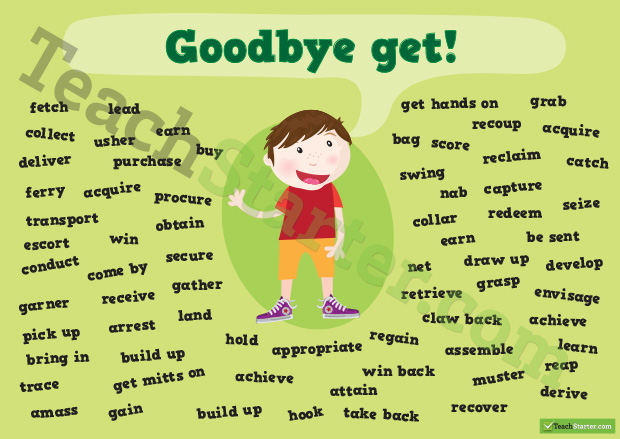
Google something like “other ways to say ____” and hit the image option. You should see lists created to help high schoolers expand their vocabulary. Take advantage of this.

An example from Pinterest (and originally from teachstarter.com):
 

PART TWO: Now you have a starting point fix the following paragraph and post your version below:

He looked at her and she smiled back as she handed him a cup. He felt good about the smile, a start to a relationship, and he smiled too. The woman looked at the customer in front of her, starting to take a new order. The sudden shift of her look felt bad.  He began to get angry. The fast food girl had looked so nice. Then he got it, he needed to try harder.

PART THREE: Finally go through your present work in progress (WIP) and search on the words. Write down how many times each appears in your manuscript. Now fix the ones that appear too many times.

How much is too much? If this is the first time you working of fixing issues like this, you will see it quick enough. For example, in 171-page manuscript I worked with the word “look” (or a variation thereof like “looked” and “looking”) appeared 420 times during the first pass. Over twice per page. That would be too much.

Below write your worst offender, how many times it appeared, and how many double-space, normal margins pages are in presently your WIP. If everyone shares, we can all see what words we need to watch for.

Editing Rant: As You Know Bob

Image courtesy of the internet Hivemind

You know something is a common issue when TV Tropes has an entire section devoted to defining it and providing examples. “As you know, Bob…” has just such a section.

And still, it persists.

What exactly is an “As you know, Bob” moment? It’s when characters share information which is common knowledge to those involved but might be unknown to the reader. For example:

“As you know Bob, cell phones had a major jump in technology when microprocessors because atom sized.” Bob-two said in the traditional speech of the twentieth century.

Bob responded in the way of modern people *Yes, Bob-two, and then bioprogramming allowed us to integrate it into our DNA allowing us to have the appearance of telepathy if a visitor from the past should visit our space-faring culture.* (As you know bob – 67 words)

These two Bobs both know all of this, having received learned this information years ago. To have them talk about it makes no sense. And yet something along these lines happens all the time in books and television.

The challenge is how does a writer provide the information to the reader without doing a data dump or having a “As you know Bob” moment? How to show without telling?

The following ways are popular: (1) a school setting where background information is shared such as in this Firefly video where the background of colonization is taught to River Tam at the beginning of the Serenity movie. (2) a military briefing where everyone may or may not know all the details and the military is going to make sure everyone knows. (3) a data dump – sometimes you just got to go with informing the readers.

And the best option, integrate into the narrative. Imply and trust your reader.

“Bob, toss me the spanner will you?” Bob-two’s voice rasped from the strain of shouting over the machines.

*When are you going to give in and get the bio-app, you old fossil?* The maintenance apprentice sent to the external-bud the master guildsman had tucked into his ear. The younger man chucked the lightweight alumcarb spanner over.

Bob-two snatched it midair, ignoring the question, instead turning his attention to mechanism which required mechanic intervention. The thought of reprogramming his DNA gave him hives. (As you know bob-two – 83 Words)

WRITING EXERCISE: Create an “As you know Bob” scene of 100 words or less, then change it so it works without the lazy writing trope. Share the results below if you want.

Other Cool Blogs: Magical Words 1/16/2012 and 3/26/2012

Ambition and Tenacity

Half of the year gone and not having half the goals met. Is that because the goals were too ambitious or my inner drive not tenacious enough?

What ambitions did you start the year with and what have you reached? Do you need a new set or to retool the old? Or just turbo charge that old tenacity?

When thinking about your goals, you might want to read the Magical Words – “On Writing: The Value of Ambition” by David B. Coe. It can be found here:

He mentions three ambitions:

  1. Material Ambitions – For me, this would be publication credits and sales numbers. Things I have no control over other than production.
  2. Output Ambitions – Which leads to Word Count, Complete Stories, and Anthology Submissions. To get #1, I have to meet #2.
  3. Creative Ambitions – How do I want to push myself as a writer?

In 2019, I started my patreon page at the beginning of the year (https://www.patreon.com/ErinPenn) and an Editing Rant Vlog (https://www.youtube.com/channel/UC4qqZ3dYm_OlXfecgzWRi1g) at the end of the year. One related to my material ambitions and the other related to my creative ambitions of exploring the video and sound field. In 2020, my goals include completing a novel and 500 words per day every day – both output ambitions.

I think I am ambitious enough, but am I tenacious enough for my ambitions?

Mr Coe covered that in “The Writing Life: The Value of Tenacity”:

The tenancies covered include:

  1. Day-to-Day Tenacity – That 500 words per day, or one hour, or every weekend or whatever it takes.
  2. Project Tenacity – Finishing that thing.
  3. Market Tenacity – Selling that finished thing somewhere.
  4. Career Tenacity – Finishing the next thing, and the next, and sell, and sell. Repeat.

For me, I think Project Tenacity is my major downfall. Between fighting the Oo-shiny syndrome and my mixed-up schedule forcing me to take a break a week at a time sometimes (or four months during tax season), once the “right now” issue settles and I reach to pick up an ongoing project, I rarely reach for exactly what I was working on before.

The dreaded “meeting week” being the worst offender. The second week of the each month I have a meeting Monday night, Tuesday night, Wednesday night, and Thursday night. I get NOTHING done this week other than meeting prep and meeting cleanup.  I collapse over the weekend (if it isn’t filled with a convention or other obligation) and try to restart the fires of ambition as soon as I can. I need to work faster so everything is completed in three weeks or figure out how to integrate the Meeting Week into an ebb-and-flow.

WRITING EXERCISE: Review this year’s goals. What have you been able to do and why? What has been a barrier? Should the goals be changed?

WRITING EXERCISE: Filling a White Room (The Power of Point of View Part 4)

Photo by Zachary Keimig on Unsplash

Most people have a handle on either dialogue or narrative descriptions. The last few months we’ve been exploring a scene with three people. I’m betting for most people, that meant a lot of dialog was written since the emphasis was exploring on how a point of view (POV) style and character changes a story and plot.

POV also changes the narrative description. A farmer might notice that a soil is dry, while a potter remarks on the porcelain white clay properties. A vegetarian might find the smell of a cooking meat dish offensive, where a hungry person’s mouth waters.

WRITING EXERCISE: For the last three months of exploring POVs, three different scenes have been created. The focus during those writing exercises was on the people, now let’s look at the room.

Review them for the scene descriptions. How did the scene change each time? For the different POVs, did each character have a different aspect to the room focused on during their time in the spotlight? For the singular POV, how did the world narrow or expand? Did sight, scene, or smell rise in prominence? When changing genre, did the palate/color scheme change – did the world get brighter or dimmer? Did the furniture and/or landscape become harsher or softer?

With these considerations in hand, pick one of the three previous scenes and increase the narrative description, filling in the white box. Word count should increase by at least 10%. If one hundred words, the rewrite should be 110. If a thousand, at least 1,100 words should result.

Why did you pick that particular scene to work with? Comment below.

This is the conclusion of a four-part series on the Power of Point of View. Each part can be explored as a stand-alone exercise.
Part 1 – March
Part 2 – April
Part 3 – May
Part 4 – June.

WRITING EXERCISE: The Power of Point of View Part 3

Photo from Unsplash.com

This is the third part in a four-part series. Each part can explored as a stand-alone exercise.

Two months ago we explored different point of views (POVs) in a scene and last month we concentrated on the “shoes” of an individual. This month we are going to look into the “world”. How people see the world and the world sees them changes the plot. The world in this case in genre – the prism of the action.

Boy meets girl seems to be a standard story. But what if the story isn’t a romance, but a horror? How about a YA coming-of-age? Or set in a science fiction?

Each genre creates a structure to the story. Just like the POVs do. As I mentioned in Part 1 of the Power of Point of View series, different genres have different focal point POVs. An Urban Fantasy – whose DNA borrows from thrillers, detective stories, romances, superheroes, and young adults (YAs) – runs into first person a lot with often an emotional focus or mental problem-solving. Science Fiction and Fantasy grew up together, focus more on exploring exciting new worlds, and therefore run to third person.

WRITING EXERCISE: Remember that scene with three different POVs you wrote two months ago and rewrote in first-person last month? This month change up the genre – if the focus was mystery, make it urban fantasy, or science fiction, or romance, etc. For the new genre, choose the best POV style to use (first, close-third, multi-third) and character(s). Word count should be between one hundred and three thousand.