
Created by Vincent Gabriel. Copyright 2015. Used with permission.
Facebook: VincentGabrielWriter
Created by Vincent Gabriel. Copyright 2015. Used with permission.
Facebook: VincentGabrielWriter

Image Courtesy of num_skyman at FreeDigitalPhotos.net
Inciting Events
ConCarolinas starts tomorrow; the convention which was my inciting event to stop thinking about writing and start actually doing it. Going through life you may have several inciting events – times when the phrase “So things continued as they had been until such time as they no longer did” would appear in your autobiography.
Two major events may occur in a story – the inciting event sets to story in motion while the key event draws the character into the story. In many genre fiction stories these two events overlap. In my recent “The Telling of the Myth of Hariti“, the inciting event is when all the villages in all the world no longer could handle the loss of their children. The key event is when the elders approach the Buddha, drawing him into the story. Until he entered the story, no permanent change took place.
To learn more about inciting events, read the May 9, 2016 Magical Post by Faith Hunter: The Inciting Event.
Other good posts on this subject include:
WRITING EXERCISE: For your present work in-progress (WIP), define your inciting event and your key event. Do you have both, are they the same event, and where are they located in your book?
READING EXERCISE: For your present read in-progress, can you figure out where the incident and/or key event in the book occurred? Did you become more or less engaged when the event milestone occurred?

Image courtesy of Praisaeng at FreeDigitalPhotos.net
I see you editing and going nuts. How many times was “throughly…thoroughly” wrong? How could “hte” be missed… ten times? Gird and grid are both real words, who knew? And how many times did the character fire cannons from the brig instead of the bridge. Sigh. Guess it is time for proofreading round number six.
What’s Up with That: Why It’s So Hard to Catch Your Own Typos is a blog posting on Wired from August 2014 written by Nick Stockton which give some insights on proofreading your own work is so hard. (Hint: It is because you are TOO smart.) Click here to read the article.

Image acquired from www.cafepress.com
“store” owner is James Macdonald, originator of Yog’s Law
If interested in the T-shirt of like products go here:
Yog’s Law – Money flows towards the author.
A mantra I have heard long and often as I have dipped my toes in the publishing industry, ran away, came back, researched the industry, had life, came back, attended cons, moved, came back … Well, nigh on twenty or more years now.
It made sense, back before Amazon and eBooks, when the publishers ruled. At that time they paid for the marketing, covers, editing, everything. If a writer was paying an agent to “proofread” or a publisher “for marketing costs”, a scam was occurring. James Macdonald became “radicalized” (his word) after talking to one poor new writer who fell for the scammers and likely lost everything. The story is here: https://www.sff.net/people/yog/. At the time Mr. Macdonald Message-board (yes, it is that old – when only message boards were the primary communication) name was Yog. Thus Yog’s Law was born.
But publishing has changed in the last twenty, last ten, heck … it changed from yesterday. A writer is often self-published until an agent or publisher gets interested. During this time the author is writer, marketing, and publisher. And while the writer should never pay, when the publisher’s hat goes on money flows out for the cover art, editing, and marketing just like in the old days under big presses. An author may be able to cut corners if they know art, or website production, or any of a number of skills. But each time the author is working under a hat other than writing, they are not writing.
Having a press take 35-70% of the income from writing isn’t bad when adding up the actual expenses of wearing the publisher’s hat. In fact after the first successful publish, if an author continues to self-publish, I would recommend putting 75% aside from each royalty check until the next book and then use that portion as the “publisher expenses”. That should cover all the overt expenses; there are still a lot of passive expenses, such as time not spent writing.
Excellent blogs to better understand the law can be found below:
Gail Z Martin – Magical Words – “Yog’s Law—It’s More of a Guideline” – 2/24/2016
John G. Hartness – Magical Words – “Making Money Mondays – Yog’s Law” – 5/2/2016
It is nearly con season. Here are some tips:
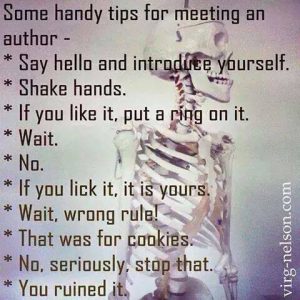
Image acquired without permission from (multiple) Facebook postings
(but does have the virg-nelson.com in the image)