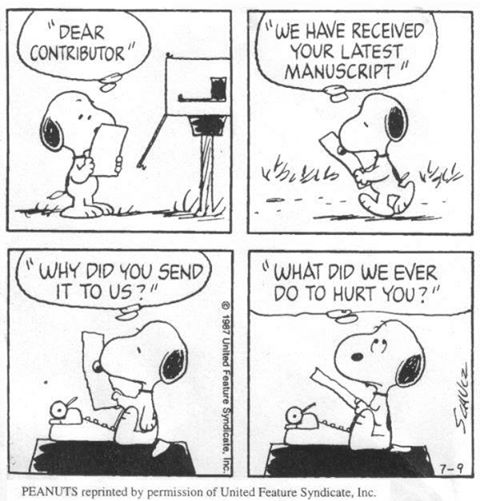
Image acquired from (multiple) Facebook postings
Published July 9, 1987 – Peanuts by Charles M. Schulz
Peanuts comics can be found here: http://www.peanuts.com/
(I could not find link to original strip on the website.)
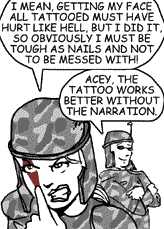
Missing the Magic
It’s posts like “I’LL SHOW YOU NOT TELLING” by James R. Tuck which I miss most about Magical Words. Raw, unfiltered, spot-on writing advice – not sanded down and made pretty.
“Show, don’t tell.” has been stated so often the phrase no longer has meaning.
Until Mr. Tuck picks up the advice, shakes it in his teeth, tears off a bite, and spits out the rest. Looking at the mutilated NSFW mess the pretty phrase now is in, suddenly the words are more real than ever before:
“I know how we writers are. We feel like the reader needs to know all the back story to really understand what we are trying to write….the ins and outs of the plot, the history and texture of the worlds and characters we have created so lovingly.
It’s bullshit. … Don’t you dare TELL me that crap.”
Want to see Mr. Tuck’s “I’ll show you not telling”, go here: http://www.magicalwords.net/james-tuck-2/ill-show-you-not-telling-something-i-read-somewheres/
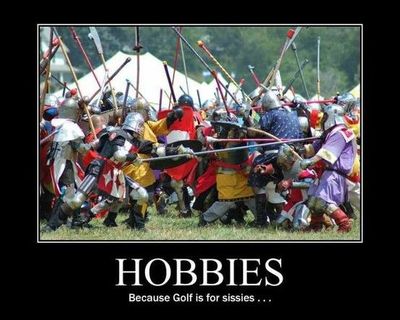
Pennsic War starts today. At 9 am Eastern Time, the flood gates open and I will be standing in the breach, my first year as a “general”. I am in charge of troll. If you want to check-in, you go through me and my staff. (Needless to say, I have prepped this posting in advance.)
Worldbuilding, whether creating a world through writing or through digging dirt and setting up tents, needs to be done on multiple layers. For Pennsic, it isn’t enough to buy a modern tent and show up. You need garb and money, food and equipment. And once everything is set up, learning, fighting, friends, and stories. Layers upon layers.
When writing about warcraft, the layers are also needed, especially in the fantasy and science fiction setting. Historic game-changers for war have included the spear, the bow, the stirrup, gunpowder, tanks, and missiles. Each modified strategy and logistics. Fog and rain negates long-distance weaponry. Mud negates heavy objects like horses and tanks. High ground, low ground. Water, food, heat, cold, distance, troops. Each impact a battle.
What happens when magic is added to the mix? How would scientific advancements adjust tactics? Could plain-old weather and landscape negate the fantastic science and magic? What worldbuilding is needed to make a magical world at war be real?
Fantasy Faction explores this in “Worlds within Worlds – Part Three: Magic Warfare“. Having lived through and in a (reenacted) medieval mud and war environment, I have some different ideas than are presented here. No mention is made of fortifications, and the magical enhancements to said fortifications. I seriously doubt the wizards would be the group leaders, more like specialists within a group, since they will be too busy casting to keep track of the battle around them. The healers in the backlines would be major targets, like the supply depots are today, though hard to reach.
And mud. Mud is a thing. I am so hoping this year will be a dry year for Pennsic. Though dust is also a thing. Dust and camp fire smog. The haze burns the eyes. So a little rain once every other day would be nice. But even a little rain means mud when you got 5,000 warriors on a field. Basically war is mud and dust no matter what and I will be living in it for three weeks. Checking in other crazy people for this worldbuilding of war exercise.
Read the article to see how layers can be added through worldbuilding: http://fantasy-faction.com/2017/worlds-within-worlds-part-two-magic-warfare
DAY-OF NOTE – It is a wet Pennsic … rain every day for three weeks is predicted. Scattered showers so around 10-20 minutes per day. Result will mean not as much dust … lots more mud. Clay mud resulting in “slick” in the hard pack areas; deep, boot-sucking fens in the grassy areas.
WRITING EXERCISE: If you are writing a fantasy or science fiction story, think about one of the defining magics/scientific advances of your story. Apply it to a battle situation, guerrilla or traditional. Where would changes occur: supply lines, medical units, food, mobility, communication, hand-to-hand, and distance? Take one of the changes and expand on how it would affect an officer, a grunt, and a civilian who lives near the battlefield.
***
A laser pistol. The beam goes until it hits something, then burns a hole – instantly vaporizing the material.
“until it hits something” – Missing is bad. The beam continues until it disperses. At this time we have home tools which can measure as far as 660 feet, about a tenth of a mile. Let’s say the laser pistol is has an effective TIGHT range of 0.1 miles and disbursement stops somewhere around triple that.
The radius of the hole is very limited, which means it needs to hit a particular spot on a human being to kill them (sniper) or go right through them. Sniper accuracy in battle is pretty bad, so it needs to be a borer – go through about a foot of human flesh.
Not a weapon one would like to use on a spaceship or in close-combat where the troops are mixed up.
The upside medically is the laser self-cauterizes resulting in less bleed-outs; if the wound isn’t fatal, the injured party can keep fighting. The downside medically is the self-cauterization means that wound is basically permanent. Dead flesh, whatever is left after the vaporization, all the way through. The medical staff would need to remove the burned, destroyed flesh as part of the treatment, significantly increasing the tissue damage.
First thing people are going to do is create an armor to deflect the damage. Armor adds heat and weight to soldiers. Face grills will be required, because even diffuse lasers will be nasty to the eyes at three-tenths of a mile, which will restrict vision – a requirement on the battlefield. Likely a full helmet will result, restricting breathing and being very nasty for when sick.
The grunt would prefer a splatter weapon with a shorter range, three-tenths of a mile is too big. Too much a chance of friendly fire downrange. The armor and full helmet will annoy and be horrific in hot environments, but the grunt will wear it anyway because getting hit pretty much mean limb or organ loss since medical ain’t got nothing to fix after its been vaporized. Thank the skynet for cyberparts, right?
Officers will train snipers and also need to set protection against being sniped.
The civilian will need to get out of the way. In urban warfare the range of the weapons is five blocks. I can’t even see that far. No hiding in the house from a weapon good at penetrating a foot of material. And out in open fields, lie down in a rut like a tornado is about to go over.
On Sunday, look for the flash “Wounds”, inspired by this writing exercise.

Image courtesy of Theeradech Sanin at FreeDigitalPhotos.net
People don’t move out of their comfort zone unless they have a Want. Neither do characters. Maybe it’s just to get away from the pain, but in those cases, usually the character doesn’t move further than the next room – away from the pain. Close door, forget the trouble, like they are a baby who hasn’t master the permanency of object.
To get a character to move and keep moving, they need to have a deep Want. In romances, it could be finding and then being with that special person. In Urban Fantasy, they may Want to save the world – more likely, they Want to save their favorite pizza joint who delivers, saving the world as a by-product.
If a story has stalled out, if the characters are just looking and talking and not doing much, maybe a huge glass of Want needs to be added.
Edmund Schubert went into this in the magical word post “The Importance of Wanting in Fiction”, and a huge light bulb went off in my head. Next time my story stalls out, instead of just blowing something up (which a lot of writers recommend), I’m going to see what my characters want. What is driving them. More details can be found here (and be sure to read the comments): (11/3/2023 – They have finally taken down the magicalwords.net.)
Want is also agency, or, more accurately, the ability to pursue and make choices to get what one wants. Want is very important to a character.
WRITING EXERCISE: For your current work-in-progress (WIP), write down what all the characters want by the end of the story. For a scene giving you trouble, write down what each character wants (1) in the next 10 years – their driving life plan; (2) by the end of the book – about a week out; (3) right now – by the end of the scene. Is the scene Want going to met (ending the scene) or change (also ending the scene, but now the character has a different driving Want)?
WRITING EXERCISE 2: Let’s play mad-libs for a moment. Think of a “noun”. Now a “person”. Okay, this is a person and their Want. Write a flash on it.
***
(my example added 11/15/2019) “Three” and “Editor”.
An Editor Counts to Three
One, two … One, two … No matter how many times Janey counted, she couldn’t make it three manuscripts. She had put out a discount call on her website and Facebook. Three manuscripts would pay for her week’s bills, even if the final one was discounted by 20%. Only two would mean something would have to give.
Food most likely. She wasn’t sure about giving up dinner for a week again. Last time she started getting dizzy about Wednesday.
Maybe she should email blast her publisher friends to see if they have things, but most of them pay when the product gets published, not on delivery of an edit. Small presses suck for income; people who work for small presses are in an even bigger bind.
Nothing doing, except by the doing. Janey winged off the blast hoping against hope and sat down to complete the edits on the second manuscript. She had already sent the first one back hoping a third would come in while she worked on the first. When she started the second, she had done her “flash sale” to no effect.
Style sheet, cover sheet, and annotated manuscript number two appended to an email. Clicking sent, Janey moved to close Outlook when a ping sounded. In the lower left corner of her screen a little blurb of an incoming email flashed, “Greenman@EarthColony.US – manuscript available – Dear Janey Curtpatrick, I saw your flash sale. I have a four-book epic fantasy in need of …”
She quickly clicked on the black box before it went away and it opened to the full message. “…editing, but before I make such a large investment, I would like to meet in person and get a feel. I notice your website says you operate out of Riverside. By lucky coincidence, I flew in from the West for a conference this week. I’m available tonight at the Hilton, could you drop by? I’m sorry for any inconvenience and will pay for dinner. Would seven work? – Sincerally, Mr. John Greenman.”
A four-book epic fantasy!?! That is some serious cash.
While she usually bumped into new clients at cons, Janey didn’t see much danger in meeting a new client at a hotel. Especially if he would feed her. Lunch had been skipped getting the last edit out. Hopefully he would be on a expense account, and she could pick up enough food to get a couple days worth of doggie bags. Even if things don’t work out for the fantasy series, and she hoped it did, she could still end up with enough food for this week.
She typed out a quick reply before rushing to get ready. (words 450, first published 11/15/2019)
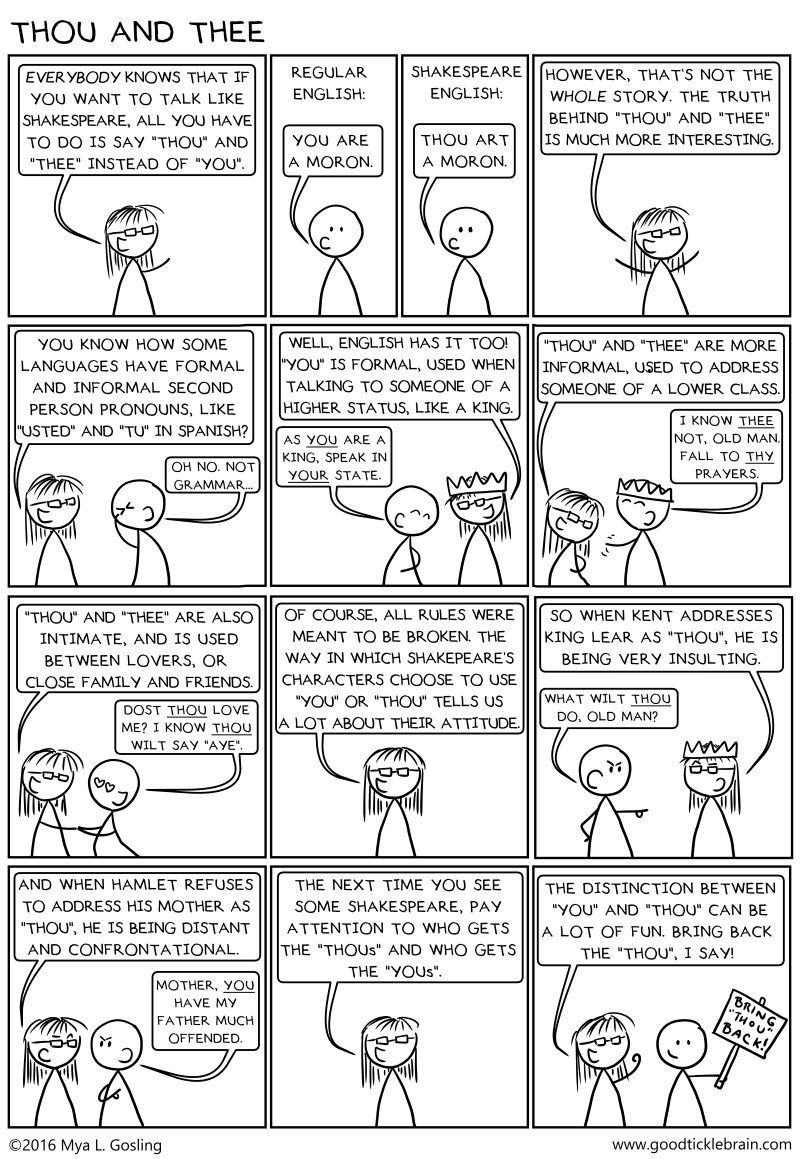
Created by Mya L. Gosling. Copyright 3/21/2016. Used with permission.
Read Goodticklebrain.com – the only Shakespearean-centric stick figure comic on the web.