
Category: Other Cool Blogs
G is for Give Your Characters Trouble
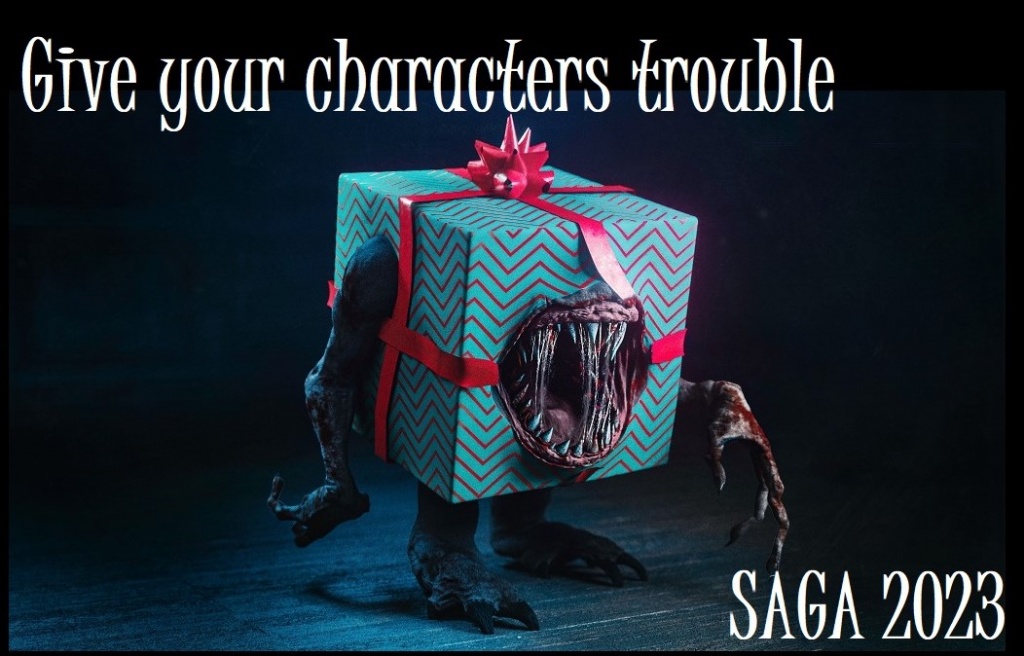
Meme created by Erin Penn
During several of the Craft of Writing courses at the SAGA Writer’s Conference (sagaconference.com next one scheduled for July 2024), the Faculty describe many things to give your characters: a solid background, emotions, friends and enemies, goals. But most of all, Trouble.
When things slow down, blow up their lives. Physical and emotional bombs – mix and match appropriately to genre. “I’m pregnant.” changes everything as much as a car explosion, especially when the character saying it is male. Explosions. Obstacles. A child who is sick at school and needs to be picked up ASAP, while the hero needs to stop a vampire coven before they wake at nightfall.
Every three chapters or so stop and brainstorm five to ten things of “What is the worst thing that can happen?” Pick one or two things from the list. And give your characters a gift that keeps on giving.
Below is a previous meme I made when I was offering advice to a young writer. Since all writing is in the author’s head, making problems can be difficult for young authors. It’s like they are attacking their alter egos. Until you can distant yourself from your characters, Giving Trouble can be challenging. But Giving Trouble is absolutely necessary.

Meme created by Erin Penn
Magical Words: F is for Fast

Photo by Jonathan Chng on Unsplash
Writing fast, especially to a deadline, is required to go “pro” (i.e., actually attempt to make a living through words). A to Z for April is just a taste of the day-in day-out delivery required to pay the mortgage and bills for the roof over the head and the food on the table.
In the December 6, 2011 Magical Words post “Abandoning Standards,” Diana Pharaoh Francis, discusses abandoning her normal methods to get the Zero Draft done so she can turn in her book on time … in January, just a month away. Her answer – concentrate on getting the action down on paper.
Or, if I was following this advice, get my dialog down. I don’t see action first, I hear people talking. Whatever you need to do to get words on screen so you can edit them.
Forget the deeper characterizations, themes, set design – all these can be added during the second pass to flesh things out. First pass, get the plot down through action or dialog or whatever gets you beginning to end the fastest. Live life in the fast (writing) lane.
Again the URL for the post is: – be sure to catch all the comments. Many of the responders are other pros making a living at writing, and the hints are wonderful.
E is for Enter Late, Leave Early
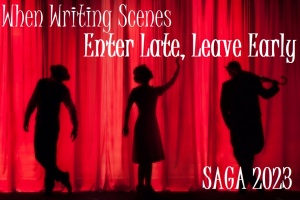
Meme created by Erin Penn
During the March 10th weekend this year, I attended the SAGA Professional Writer’s Conference in Winston-Salem NC (http://sagaconference.com/). A lot of good advice was to be had, and several of them had me making memes the minute I got home. I am a hands-on learner and making a visual memes helps things to stick.
I normally post three days a week, which leaves me twelve days to fill in for the A-to-Z Blogging Challenge for April. I’m going to post the five writing meme I made during my non-standard days complete with why the writing advice is important.
Both Dr. Hartley and Dr. Leverett, in two different presentations at the conference, gave a piece of writing advice stolen from the movie industry: Get in a scene as late as you can and leave as early as you can. Distill the action as much as possible. Obviously the advice is very important when two different people present the same information, and the advice works in different storytelling mediums.
What “Enter Late, Leave Early” means is focus the action. You don’t need the camera (or the written narrative) following the person climbing out of the car, going in the house, ringing the doorbell, getting welcomed, receiving a drink, taken into the family room, and the conversation starts. The important bit, distilled down, is when the visitor says, “The results came back with anomalies.” Heck, you can even push it back a couple of more seconds to the home owner responds with a shocked “Anomalies?”. “Yes, anomalies. I know we said it was a standard test but…”
At the other end, “Leave Early,” cut out of the scene the second the last bit of important storytelling data is presented. Only at the very end of the book, when providing closure, do you need to end a scene with all the bow-ties and swirls. Until then, push, push, push the storyline forward.
Should there be extraneous data beyond the mainplot line? Of course, there is backstory, character development, the emotional storyline, the action storyline, the series overarc seeds and advancement, and, my personal favorite, worldbuilding. All these things make a story layered like a good baklava.
But each individual scene needs to only have what is happening for that scene, and rarely does that include walking through doors.
Oh, that would be a good piece of advice too: Don’t Walk Through Doors
Writing Exercise: Conflicting Wants

Photo 16115879 © Olaf Speier | Dreamstime.com
Anyone still have their New Year resolution in place to lose weight, or has the joy of fat, sugar, and salt won the year, yet again? One of the basic conflicting wants – eat healthy & be healthy vs joy of eating and joy in life.
Your characters have these conflicts too. Two mutually exclusive, yet base level things. Defining these wants can really help bring a character to life.
Edmund Schubert made an amazing Magical Word post on May 28, 2011, “What Else Does Your Character Want?”
We are going to do his challenge as a writing exercise, so be sure to read the whole thing. Don’t look at the comments yet, but after the exercise, go over them to help you think about this. Again, the URL is:
WRITING EXERCISE: Take a major character from one of your present WIP (work-in-progress) and define two conflicting “wants” the character has, and tell us in the comments below how those wants impact your story.
My Attempt: I’m presently working on expanding the Quest for True Love. The unnamed main character loves gaming and wants to win the game, especially having defined the goal “To find my true love.” BUT they also want to escape the game and get back to the real world.