Book Review: The Human Division

Book Cover from Amazon

BOOK BLURB ON AMAZON

Following the events of The Last Colony, John Scalzi tells the story of the fight to maintain the unity of the human race.

The people of Earth now know that the human Colonial Union has kept them ignorant of the dangerous universe around them. For generations the CU had defended humanity against hostile aliens, deliberately keeping Earth an ignorant backwater and a source of military recruits. Now the CU’s secrets are known to all. Other alien races have come on the scene and formed a new alliance―an alliance against the Colonial Union. And they’ve invited the people of Earth to join them. For a shaken and betrayed Earth, the choice isn’t obvious or easy.

Against such possibilities, managing the survival of the Colonial Union won’t be easy, either. It will take diplomatic finesse, political cunning…and a brilliant “B Team,” centered on the resourceful Lieutenant Harry Wilson, that can be deployed to deal with the unpredictable and unexpected things the universe throws at you when you’re struggling to preserve the unity of the human race.

Being published online from January to April 2013 as a three-month digital serial, The Human Division will appear as a full-length novel of the Old Man’s War universe, plus―for the first time in print―the first tale of Lieutenant Harry Wilson, and a coda that wasn’t part of the digital serialization.

Old Man’s War Series
#1 Old Man’s War
#2 The Ghost Brigades
#3 The Last Colony
#4 Zoe’s Tale
#5 The Human Division
#6 The End of All Things
Short fiction: “After the Coup”


MY REVIEW

Mr. Scalzi attempted a new format of releasing 13 episodes as mini-ebooks; similar to the old method of serializing a story in newspapers or magazines (everything that is old is new again). A format option popular with self-published authors. After the episodes were all released, his publisher put together the whole thing in book format, adding two extras.

I did not read this during the episodic releases, and discovered the hard-copy book did not work very well as a straight read-thru. The characters’ lives had ebbs and swells that needed a break every three or four episodes. After getting about half-way through the book, I needed to set it aside for a week. Since my work was asking for 60 to 80-hour weeks during the time I was reading this book, it actually functioned well. Every Saturday I would set aside time to read three more episodes.

The writing is typical, brilliant Scalizi – a combination of humor and observations that are just too much fun. He continues to create a new character voice for each book. I love that his characters are unique – Zoe’s Tale had a teenage girl voice; The Human Division had a combination – each episode had a different POV (point of view) of diplomatic approaches. As such the diplomatic-POV did not have the pure snark factor of his first book of the universe (Old Man’s War). 

I should note the uniqueness of the universe is beginning to wane simply because of familiarity of the World – now in book five – but the universe hasn’t reached comfortable glove status. So, in places, this book felt … awkward… like a teenager – no longer a cute, shiny baby to ooh&aah over, but not fully mature like a George R. Dickson Dorsai! universe story.

This story is essential to the ongoing Old Man’s War Universe. It clearly sets up the conspiracy for the next story.

Worth the read, just do it in chunks for maximum enjoyment – the way it was originally published on the Internet.

Book Review: Athena’s Daughters

Book Cover for Athena's Daughters Anthology

Book Cover from Amazon

BOOK BLURB ON AMAZON

Athena’s Daughters is an anthology published by the small press, Silence in the Library (presently closed, but may restart in a few years – life happens with small presses).

Athena’s Daughters is a collection of short fiction by women about women from some of the best writers in science fiction and fantasy today.


MY REVIEW

Athena’s Daughters is a powerful anthology written by women, edited by women, illustrated by women, about women. And a very good read in the Fantasy and Sci-Fi genre. Stories range from steampunk (Looking Back by Danielle Ackley-McPhail)) to superhero (Commando Bats by Sherwood Smith), Gothic ghost (The World to Come by Cleolinda Jones) to time travel (First Flight by Mary Robinette Kowal), modern urban fantasy (Retribution by Gail Z Martin) to military sci-fi (Not Broken, Just Bent by Tera Fullbright).

I don’t think I have seen a book with such a wide range of ages for the main characters before. Some of the females are in their twenties, some forties, and some sixties (and then there are the vampires). Nice to see older women make an impact on the world. In addition to being stories about women and having a wide range of ages, the stories also have other character traits of “diversity” (see below for some details).

Stories that grabbed me:
Commando Bats – Hera, in her contrary wisdom, has stolen the powers of male gods who were being stupid and granted them to little old ladies around the world to show them how people can use the power for good. Being the goddess of the hearth and women, of course she chose to grant the powers to females. The main point-of-view character is also disabled. I would love to see more superhero-themed stories about these characters.

Millie (by Janine K. Spendlove) – Another wonderful US Marine military short story from Ms. Spendlove (I have seen her in other anthologies) with a time travel twist you see coming if you know your aviation history but still enjoy the entire time. I really like how the main point-of-view character is Hispanic without pushing it on the audience – the character just happens to be Hispanic like most characters in American writing historically just happen to be white.

Are all the stories great? No, as with most anthologies unevenness in skill exists.

Overall a great read. And being an anthology, easy to set down and pick up again while doing chores. And with 22 stories (400+ printed pages if you buy the softback) a really good buy.

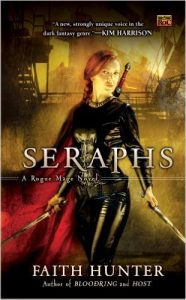
Book Review: Seraphs (Rogue Mage #2)

Book Cover for Seraphs (A Rouge Mage Novel)

Book Cover from Amazon

BOOK BLURB ON AMAZON

Seraphs (Rogue Mage #2) by Faith Hunter

Living among humans in a post- apocalyptic ice age, neomage Thorn St. Croix is a source of both fear and fascination for the people of Mineral City, and now she faces her ultimate test.

Deep under the snow-covered mountains beyond the village, an imprisoned fallen seraph desperately needs her help. There, hidden in the hellhole, the armies of Darkness assemble to ensure this subterranean rescue will be Thorn’s final descent?


MY REVIEW

I started in the middle with “A Rogue Mage” series by Faith Hunter. I read Seraphs before reading Bloodring. And this book isn’t *quite* standalone. Took me 4 to 6 chapters to understand most of the language of the world and the people and what happened previously.

But that is okay – the opening lines are “Claws gripped my throat, shutting off my air …” And so we begin another novel by Mrs. Hunter – in the middle of things and continuing into a non-stop ride of urban fantasy adventure with just enough character development bits to catch a breath while the tension cranks you to the top of the next hill of the roller coaster. Then the bottom drops out again, and the curves are slamming you side to side with action and plot twists.

I have read a couple of the Jane Yellowrock stories. I am liking this story much better, and I liked those stories just fine.

The religious themes innate to this post-apocalyptic world may bother some readers, but are they also add so many layers to the world-building. Ahh, just figured out why I like this series more than Jane Yellowrock – it required a lot more world-building, and I just love a good world-building.

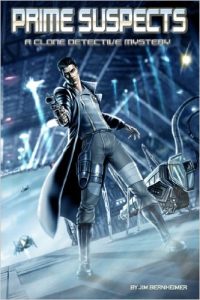
Book Review: Prime Suspects

Book Cover for Prime Suspects

Book Cover from Amazon

BOOK BLURB ON AMAZON

Prime Suspects by Jim Berheimer

Homicide detective David Bagini awakens on a strange world only to discover he is, in fact, the forty-second clone of the Bagini line. Having no memories of why his Prime entered into a clone contract, he wants answers.

The first problem is his Prime has been murdered and Bagini Forty-Two is now in charge of the investigation.

The second problem is all the clues point at one of his fellow clones and they already know all his tricks.

How can he solve his own murder when all the suspects have his name and face?


MY REVIEW

**At last, something to go with Caves of Steel on my shelves**

Prime Suspects secures a place alongside Caves of Steel by Isaac Asimov in the sci-fi-mystery genre. An extremely well-done mix, mingling the police procedural and the science fiction in equal parts. Keeps one guessing to the end, but provides all the clues. A reader is right beside the detective gathering the clues and learning the world until only one possibility is left.

Jim Bernheimer‘s trademark snarky main character gets a little old in this particular book because, well, it is the distinguishing characteristic of so many of the characters, an inherent aspect of a clone story. I am pleased to see the clones remain close in personality, yet each develops as a unique person as well. The delightful comedic snarkiness of Confessions of a D-List Supervillain takes on a Noir overtone in this novel.

Worldbuilding – Oh, the sociological worldbuilding in this story is absolutely awesome. Identical twins raised apart will each develop along similar patterns; identical twins raised together will deliberately work to differentiate themselves through dress, hair and hobbies. Prime Suspects’ world shows what happens when an individualistic person suddenly is faced with dozens of twins.

And Jim takes the worldbuilding to a second level. For psychology – the struggle for ego in the detectives is worse than the waitresses because the police must work closely together instead of in isolated restaurants. For sociology – In a society without children and without elders, rampant college behavior dominates as the clones struggle to define themselves. For Social-Psychology – In a world without advancement or dreams, the clones face years of therapy, depression, and escapism.

Prime Suspects works well a police procedural, and the mystery is solid. But the story truly shines as a science fiction speculation about how a clone society might function.

(bought at a Convention from author’s booth at full price)

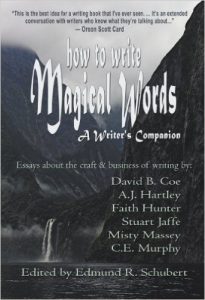
Book Review: How to Write Magical Words

Book Cover for How to Write Magical Words

Book Cover from Amazon

BOOK BLURB ON AMAZON

How to Write Magical Words: a Writer’s Companion is a non-fictional collection of writing advice from the Magical Words blog participants.

A compilation of essays originally published on MagicalWords.net, a popular writing blog with thousands of regular followers. Distilling three years worth of helpful advice into a single, portable volume, it contains nearly 100 essays covering such wide-ranging topics as:

– Getting Started . . . Again
– Creating Characters in Small Spaces
– Storytelling Tropes: Belief
– Binding Character and Narrative: Point of View
– Word Choice and Pacing
– Metaphors, Similes, and Analogies, Oh My . . .
– Writing Action Scenes
– The Beginning of the End
– Developing Your Internal Editor
– Artistic Choices and the Market
– Business Realities for the Writer

Many of these essays are accompanied by comments and questions from the blog’s readers, along with the author’s response, making this volume unique among how-to books on any subject.

The core members of Magical Words — David B. Coe, A.J. Hartley, Faith Hunter, Stuart Jaffe, Misty Massey, C.E. Murphy, and Edmund R. Schubert — have experience writing and editing fantasy, mysteries, thrillers, romance, science fiction, non-fiction, and more. This group is uniquely qualified to cover the full spectrum of writing-related issues. How To Write Magical Words: A Writer’s Companion is a book that belongs in the library of anyone interested in the craft of writing, the business of writing, and the writing life.


MY REVIEW

How to Write Magical Words is a very good how-to writers book. But face it, there are dozen such books out there.

But not from seven different authors, each giving what works and doesn’t work for them. A tool that might work for one might not work for you – but with seven different people throwing out examples and hints, at least one set of tools will fit your needs. Faith’s metaphoric examples, David’s technical knowledge, Misty’s beginner’s enthusiasm and doubt, Edmund’s editor’s perspective … each author brings something unique to the table.

The best part for me was the Self-Editing section. As someone interested in self-publishing and not yet able to pay an editor – this is the true gem of the book. Describing crutches, and the difference between revising and copyediting, and how to revise dialogue. All gems. “BIC and Rewrite Tips” is something I am going to read through every time I complete a flirt from now on. In fact this book as a whole just became a must-read after completing each of my books and before I post it to Amazon.

(BIC means “butt in chair”)

The only issue is book covers the first 3 years of the MagicalWords.net blog – 2008 to 2011, and the section on “Business” is getting a little long in the tooth. Vanity press and POD is covered, but not the true self-publishing now available. For that you need to monitor the magicalwords.net blog and attend sci-fi/fantasy writer’s conventions such as ConCarolinas and DragonCon. The business has changed so much in the past three years and will continue to change dramatically for the near (and maybe far) future. 

(Review originally written on June 24, 2013)