Movie Review: The Man of Steel

(Republication from the old blog, originally 2013)

A little away from my normal posts – but right now I am learning about editing, revisions, and making stories better.

Some authors say, after you start being an author yourself you stop enjoying books and other story forms. You see the flaws. So far I have been fortunate – except in this particular case. I don’t look forward to the time when I react to all stories this way – I hope I never do.

Man of Steel Review

I went expecting the epic blockbuster with typical Superman twists related to an origin story. In that respect, the movie delivers. Explosions, buildings destroyed, flying, etc. – all the wonderful special effects one needs for a summer superhero flick. The slow unveil of the back story of Clark Kent growing up was acceptably poignant. A bonus with the Krypton sequences just as unique and otherworldly as Superman (Christopher Reeves) version. Gritter and more complicated than the ice-white sets of the 1978 version, but perfect for 2013.

If you liked the movie, don’t read further. I don’t want to ruin your pleasant experience. I am going to go into a lot of details (SPOILERS) because this movie is the perfect example of why you need to be consistent about a magic system and worldbuilding. I don’t remember any other movie where I was thrown out of it so often and so far by poor content. If you remember anything I missed or would like to comment about it, please respond. If it will be a spoiler, please clearly state where spoilers.

If I could have enjoyed blockbuster features and only those features, the movie would have been perfect. But the worldbuilding was so cringe-worthy I nearly walked out during the last third of the movie (you know, the “best” part of a summer action flick – the final battle). Maybe if I hadn’t spent the day studying editing … but no, if I was using AJ Hartley’s ABC(D)s for Beta Readers  (p. 220 in How to Write Magical Words: A Writer’s Companion) the whole movie would have been marked up with D: Don’t Believe. Time after time I was thrown out of the story

I mean I am okay with the bad science already integral to the mythos. Superman flying, and getting his power from the sun, and wormhole transportation from Krypton, and X-ray and Heat and the dozen of other Visions and Super-Senses. Those mythos were absorbed as a child and part of me still believes them. I’m okay with the comic book violence and the emphasis of action over plot for a summer flick. But …

START OF SPOILERS …. STOP HERE IS YOU DON’T WANT THE SPOILERS

At least get night and day correct! My movie companion says I should treat the errors related to night/day as continuity errors. I am laying them at the feet of worldbuildng or fact-checking. Since we are using a present-day Earth as the base instead of a fantasy planet like Krypton, I feel the writers/directors should have gotten night and day correct under worldbuilding rules.

Technically Bad – Fact-Checking Editing Errors

So the first night-day issue was General Zod’s announcement. They go around the planet and we see people huddled around TVs (should have had more variation in size and “age” than shown) – all in twilight. Kind of cool – sunset around the planet at the same time. The other one (the final straw to throw me out of the story and want to crawl out of the theatre) – The world engines – one in Metropolis (New York) and other in Indian Ocean – on the other side of the planet. Both are in daylight. – WHAT? I mean, they even had Kal-El fly into space, have the planet (half-day and half-night) rotate around him and come back down. That was an awesome way to “fly” faster – use the planet’s rotation in your favor. But if the planet is half-day and half-night, …. Why isn’t the two terraformers under different light? If the world engine near Australia had been dark, I think the action sequences would have been spectacular – reimage the scene with dark and all the light happening around it – the water floating reflecting rainbows against stars.

How hard is it to get time correct? Pretty hard from the looks of it. Perry and his crew are at work always – no one but Lois traveling away for stories. I think we see the Daily Planet staff in the office early morning to late evening. Do they live there?

Other “technical” issues: (1) On Krypton, a broken moon is shown in the sky, yet when we pan out for Krypton exploding this is gone. I forgave the “art” issue. (2) Girl screaming under water on the school bus.  Really bad “foley”. I was going with it as an action flick, tension heightening item, UNTIL she inhaled and screamed again – really how did she get that second scream out … underwater? Check out of movie. I pushed myself back in as Clark brought the bus out of the water – I told myself this was a sound-editing mistake, one of the last things a movie lies down. No one caught the issue.  (3) Zod aged (beard goes white) in the 33 years since Superman grew up on Earth and Faora, his female sidekick pet-psychopath, did not.

A mantra I often use to enjoy movies with a few glitches – “It is art; let it flow over you”. A couple technical issues are to be expected. The daylight on opposite sides of the planet during the biggest battle – well, that is just crap. Like walking into the Louvre and discovering the Mona Lisa had Tammy Baker makeup added by the Joker.

Bad Worldbuilding

Worldbuilding is all about making consistent mythos. We all remember the scene in Supergirl as she slides while crossing the tilting floor and we are screaming at the screen – Fly! You I.D.I.O.T., you can Fly! Not very consistent in 1984. Destroys the dramatic moment.

Kal-El gets his powers from (1) Low Earth gravity, (2) Earth’s “rich” atmosphere (as explained by Jor-El) which seem related to super senses (Zod gets them when exposed to Earth’s atmosphere), (3) Earth’s “younger” sun producing radiation to harden skin and strengthen his muscles and structure still further (also explained by Jor-El), (4) End product of years of Kryptonian genetic manipulation with a bit of natural mutation by parental breaking of rules (implied).  All clearly explained.

The movie not only explains (tells) the world building, but also shows the world building, making the mythos believable and real. I assume the Oil Rig knocking him for the loop and pushing his superstrength to the limit is because he was growing older and in power. Initially the scene is dissatisfying because oil rig – pah, he can handle that. But if he was and is still growing in power because of time on Earth, I will happily absorb the worldbuilding.

We see him gaining control of his super senses – I guess that just hit him suddenly (?). He already seemed to have a good handle on the heat vision since the door handle heating was controlled. Poor Martha having a toddler with that power. Kal-el  learns to fly by jumping then ignoring gravity. I remember one comic stating low level telekinetic/levitation ability might have been something Kryptonians had bred into.

The worldbuilding shows time and again you need to be on Earth a while to gain all the abilities Superman has. Then throws it out the window making all Kryptonians are as strong, fast, and invulnerable as Superman. Ugh!!!

How did Zod get supersenses immediately upon exposure to the atmosphere when Clark didn’t get them until Elementary School – nearly a full decade on the planet?  How the heck did Zod get HEAT vision so quickly and under control to threaten people? Kal-el fell down coughing blood on the Kryptonian ship and took hours to recover – yet Zod can get rid of his breather and go to town in seconds? Faora and Ursa get POUNDED on by Kal-El and the American military – guess they spent lots of time in Earth-like tanning beds on the trip through space because they walk out without a scratch. Invulnerability much?

I am willing to give Zod flying since that seems to be related to Earth’s gravity and/or natural Kryptonian telekinesis. But the rest wasn’t needed. These Kryptonians came in BATTLE SUITS. Can you imagine the epicness of Kal-el going toe-to-toe with very strong people in the best armor ever made? Would have been awesome and believable. I didn’t believe Ka-el fighting a unit of elite military troopers – as strong and fast as him – bred and trained for war and surviving. The storytellers didn’t need to break down the worldbuilding they did to give Superman his powers, they could have used the Battle Suits and superior technology. I think that is why I don’t forgive them – they had an alternative works just as well, if not better! (And imagine them coming BACK in another movie after exposing themselves to the environmental features of Earth– sure, Kal-el will always be a little ahead, but EPIC possibilities!)

Bad Character Decisions

Still all of that may have been forgiven (well, I still think the night-day issue of being on opposite sides of the planet is a killer like Supergirl not flying), if the characters worked. Characters drive the story. At the end of the day, I don’t care about the invulnerable Super-Duper can do everything man – I care about the corn-bred boy from Kansas in over his head living in New York City – Metropolis – whatever you want to call it.  Therefore the actions of the characters and their decisions need to work.

And they don’t.

How did Clark infiltrate a military base in the arctic? More important, how did Lois Lane backtrack Clark from the base to his mother? Remember she has been pulled off the story already. Remember she does this quickly (the clock starts ticking from the time Kal-El activates the scout ship). Does she have private funds of her own? I know people who work even when rich – if she is one of them, establishment of her resources would be nice. “You are on two-week sabbatical without pay.” – “Dang it, I love to work.” “Right, money doesn’t matter since you are a Lane – make that a three-week sabbatical.” We don’t need to know where the Lane family has their money – we just need to treat the name like Hilton or Mars or Walton or Kennedy. One sentence, only one more sentence was needed in the dialogue.

Extremely annoying is the New Yorkers – I know Metropolis isn’t officially New York, but any comic collector knows the truth. In Avengers, the on-the-ground normal New Yorkers scream, but they also fight, they run, they plan, they move.  These people have seen buildings fall over. They know to leave the buildings, get on the streets, and head for the bridges out of town. You might walk for hours, but you get gone. Unlike the Avengers – the Man-of-Steel civilian counterparts stay put. What? At least let them be reporters – with Perry turning around and shouting at people to get the Story and the office emptying. Watching the battle forever and finally announcing “It’s time to leave now”. No, really it is not time to leave – it was time to leave half an hour ago!!!

The only gem of character action-development was General Zod. Once all his plans fail and he was alone in the world, his soliloquy about being bred only to protect Krypton and her people is perfect. You understand everything this man has done was for one purpose, the purpose he was bred and shaped for. He could not have chosen any other path. Confirmation and foreshadowing in the Krypton backstory and Jor-El remarks about wanting to give Kal-El, his son, choices no one on Krypton make you believe this. I was little put off by Zod then attacking the Man of Steel. He had just said he didn’t have any people left, but he did have one. Kal-el. I think the soliloquy should have ended with “All I have left is you, and you … you chose humans. You are human. You killed my people!” Still, I believe Zod beginning to end as a character and the actions he choose.

The scene where Superman has to kill Zod is suppose to be an OMG moment. Anyone following Superman mythos – comic and movie – knows Superman doesn’t kill. It is the one weakness (?) this god-power man has. Him killing Zod is suppose to be the climax of the emotional journey. Except this journey was NEVER ADDED TO THE PLOT!!!!  In this particular movie, Superman’s aversion to killing was NEVER established. Instead we see him going toe-to-toe with Faora and Ursa on Smallville’s main street with the army shooting guns and releasing bombs. He told people to go into buildings, but bullets ricochet. He tosses Ursa through buildings. Some of the Kansas residents must be hurt and killed. He never debated attacks on the villains – maybe in this scene he could have established an aversion to killing.  His heartache at failing to save people.

Or how about regretting losing his temper and beating on the villain after his mother was attacked?

I was so far out of the story by the time Zog was using his Heat Vision to hold the people hostage in Union Station (I know train station is “unnamed” – but come on, we all recognize where that scene was shot!), I couldn’t care. All I could think about was – Superman, you just destroyed half a city. Tens of thousands are dead, hundreds of thousands are seriously injured, a couple million have lost their home or their work. And you are upset by four people? Why were you not upset before? Why did you toss your enemies through buildings? I.is.confused.

CONCLUSION
So do you agree with my assessments? Did you see anything else that is bad? What did you think they did right with plot and character development?

I think my problem boils down to this – I have a “Willing Suspension of Disbelief”. I worked with the movie as best I could. They just used up their quota. Or as TV Tropes put it I was able to “believe the impossible, but not the improbable.”

(Originally published 6/26/2013; republished 8/30/2018)

Book Review: Terms of Enlistment

Book Cover from Amazon

Terms of Enlistment by Marko Kloos

BOOK BLURB ON AMAZON

The year is 2108, and the North American Commonwealth is bursting at the seams. For welfare rats like Andrew Grayson, there are only two ways out of the crime-ridden and filthy welfare tenements, where you’re restricted to two thousand calories of badly flavored soy every day:

You can hope to win the lottery and draw a ticket on a colony ship settling off-world, or you can join the service.

With the colony lottery a pipe dream, Andrew chooses to enlist in the armed forces for a shot at real food, a retirement bonus, and maybe a ticket off Earth. But as he starts a career of supposed privilege, he soon learns that the good food and decent health care come at a steep price…and that the settled galaxy holds far greater dangers than military bureaucrats or the gangs that rule the slums.


MY REVIEW

A solid military sci-fi read with good worldbuilding. Didn’t quite hit the “best of the genre” – which I reserve 5 stars for. Better than most and, dang, when is he going to write the next so I can see where the story goes? – is my reaction.

Not a happy world. And for the grunt on the front lines that can make for some unhappy times. Andrew (the main character) entered the military for one of the two reasons most people do (1) it is more relaxing and less work than home (people coming from a farming or boondocks background) or (2) it is safer than remaining at home (Andrew’s reason). Andrew is moving up in the world to safety and better food – even with the being shot at and blown up thing happening.

Book Review: Sanctuary

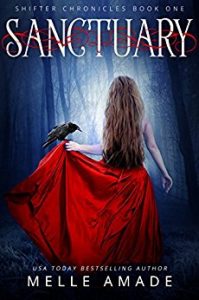
Book Cover from Amazon

Sanctuary (Shifter Chronicles #1) by Melle Amade

BOOK BLURB ON AMAZON

Shae is sure the icy rage that claws at her is driving away her friends and pulling her closer to the wrong boy. After all, it’s Aiden she has always secretly wanted, not Callum, who has barely spoken to her in the last year.

But, as her protected life unravels, she discovers the violent supernatural world that lurks in her quiet hometown and the ancient feuds that threaten to destroy both her friends and her family. 

To save those she loves, Shae must succumb to her own fury and take on the Ravensgaard, the renegade warriors of the Order, but as the battle approaches her deepest fears are coming true, she’s becoming just like them. Shae’s not sure she can afford the price she’ll have to pay—her own humanity.


MY REVIEW

“That Moment When” was an anthology of sample chapters, available for free to encourage people to try new authors, and included the first three chapters of Sanctuary. I was intrigued enough to look at the Amazon sample which went all the way to a portion of chapter 5. And the next thing I knew I had bought the book at around midnight and completed it at 5:30 am. Good thing we just had a wicked snowfall and no work was happening.

An excellent Young Adult (YA) Urban Fantasy (UF) shifter story, with layers of worldbuilding and unique characters leading to a unique story even with the comfortable tropes of YAUF like two love interests for the main female character (MC), who are also loyal to each other as well as interested in the same girl.

If the story wasn’t a shifter story, the heart of it would be about dealing with genetic mental illness. The MC’s mom has rage issue and Shae and the rest of her family (dad and little brother) have spent their lives tip-toeing around the mother – dealing with things thrown at them and mild physical abuse. The mother does try to control her issues and isolates herself from those she loves most. Now Shae (the MC) is starting to have the same problems, destroying her room in her rages. She doesn’t want to be like her mother.

Another part of what made this book amazing is actually obeying the typical Urban Fantasy trope of information about the magical world (in this case shifters) is not shared with those outside the community on pain of death. In most urban fantasies, YA and adult, the new person is told everything flat out within a couple of chapters – a great way for an author to explain the Urban Fantasy world and rules. Some stories I just shake my head level of sharing of information between the teenagers wondering how the world-at-large could possible still be out of the loop. 

In Sanctuary, Shae’s group of friends are all shifters and despite being close friends with her for their teenage years, they have told her nothing. The secret is only revealed during a life and death situation and then her friends try to convince her what she saw isn’t real. They very reluctantly and slowly reveal their world to her, knowing each reveal makes her and their deaths at the hands of the shifter authorities that more likely. In this story I truly believe the secret of shifters is secret. I gave the book an extra star based on this alone, since it is so rare in the genre.

The final worldbuilding bonus beyond no vampires or werewolf shifters (which is explained and really cool and unique – the bat and wolf shifters were part of the good guys – and I love the back story for the (typical trope) shifter war), is the biggest bad shifter no one wants to deal with is a  frog. A FROG! A fight is going down – feather and fur flying. The hundreds-of-year-old wizard shifter, the shifter teenagers have come to, has wiped the floor with them and is about to kill their human friend when the Frog, in human form, just calmly steps between the claw-and-teeth dervish and the human. The dervish immediately stops. That is just bad-a@@. You will have to read to find out why a frog is so dangerous no one will dare touch him in combat. .. And Ms. Amade, I want to to see the frog end up with a love interest or maybe a story centered around him and not just because of “diversity”; the character is a total sweetheart.

I also loved the fact the characters were typical teenagers. They made good choices, they made bad choices. They made choices based off of emotion, what they were taught, and intellect. They obeyed the rules as much as they broke them. They loved their families and hated them. None of them knew where the others stood all the time, because even they didn’t know. They gossiped, lied, exaggerated, told the truth, and were amazingly loyal while also ruled by hormones. Throughout the story, a reader loves the characters and sometimes dislikes them. All the teenagers are strong, unique people.

In conclusion, amazing characters, a cool backstory about the shifter war, and the comfortable tropes and tropes turned on end, make Sanctuary a must-read if you love YA Urban Fantasy of the shifter variety.

Book Review: Were- (an Anthology)

Book Cover from Amazon

Were-, an anthology published by Zombies Needs Brains, LLC.

BOOK BLURB ON AMAZON

Werewolves rule the night in urban fantasy, but everyone knows there are other were-creatures out there just as dangerous and deadly, if not as common, each with their own issues as they struggle to fit into—or prey upon—society. What about the were-goats? The were-crows and were-wasps?

Here are seventeen stories of urban fantasy by today’s leading science fiction and fantasy authors that introduce you to some of those other were-creatures, the ones hiding in the dark background shadows, waiting to bite. Join Seanan McGuire, Ashley McConnell, Susan Jett, Eliora Smith, David B. Coe, April Steenburgh, Gini Koch, Mike Barretta, Elizabeth Kite, Danielle Ackley-McPhail, Jean Marie Ward, Katharine Kerr, Sarah Brand, Anneliese Belmond, Faith Hunter, Patricia Bray, and Phyllis Ames as they take you into the hidden corners of our world to see some lesser known were-creatures. You may want to bring along some silver … just in case.


MY REVIEW

Normally I give anthologies four stars, because while one or two stories are standouts, usually I run into a couple clunkers as well. I loved all the stories in Were- – most of the stories created solid worldbuilding in a few short strokes. 

Avoiding the ubiquitous werewolf, Were- follows the dozens of other shifters of folklore and urban fantasy: weregoats, shape-shifting unicorns, young children-cubs, murders of were-crows, were-plants. … Yep, were-plants … and many more things which will make your skin crawl or, maybe, shift.

The stories and writing style varied as much as the were-creatures – from detective noir to superhero. A+ read!

Best in Show by Seanan McGuire – Detective noir sent to a cat show.

We Dig by Ashley McConnell – Worldbuilding with miners and historical industrial (and racial) issues.

Eyes Like Pearls by Susan Jett – You never forget your first holiday crush.

Among the Grapevines, Growing by Eliora Smith – Were-plant.

A Party for Bailey by David B. Coe – Children bite, and momma bear really should keep her cub closer to home.

Cry Murder by April Steenburgh – Age old issues of crows versus owls.

Missy the Were-Pomeranian vs. the Masters of Mediocre Doom by Gini Koch – Wonderful superhero snark!

Paper Wasp by Mike Barretta – Who put this back to back with Missy the Were-Pomeranian? Really the whiplash between the upbeat superhero story and this horror one is mind-blowing. After all the light and joy building from A Party for Bailey, to the family vibe of Cry Murder and pure fun of Missy vs. the Masters, Paper Wasp stings deep. 

Well done editors with the pacing of stories funny, sad, scary, and thoughtful.

Point Five by Elizabeth Kite – Email format writing style and an amazing “if this, then this would happen” worldbuilding.

**Usually about here in anthologies, things start to be the second stringers. A reader feels like they got their money worth and is willing to try a couple new authors who are learning the craft. I swear, in this anthology, things got even better after the half-way point.**

The Promise of Death by Daniell Ackley-McPhail – Unicorn without a horn.

The Five Bean Solution by Jean Marie Ward – I’ve read the first short-story about these characters in a different anthology and this one is even better. The characters and POV character’s voice in the story are nicely nuanced.

Witness Report by Katherine Kerr – Historical were- story.

Attack of the Were-Zombie Friendship with Benefits by Sara Brand – Another worldbuilding twist – when it is no longer safe to go out at night, how does the night-scene teenagers and early-twenty adjust? 

The Whale by Annelies BelmondEven humans unconsciously recognize the majestic and tragic hidden in human form. The worldbuilding of Weight-bound gives an entirely different approach to shifter/were- relations and activities. I would say this one was my favorite short story, except I want to say that about a few others as well. I will say this is the most original in a collection of very original material. A must-read.

Anzu, Duba, Beast by Faith Hunter – A story from the Jane Yellowrock world.

Shiftr by Patricia Bray – Again with the worldbuilding. If you have “this” then “this”. Love the apps – from hook ups to family tree to DNA investigation.

Sniff for Your Life by Phillis Ames – If you like rats, this short is a must-read. Big alpha werewolf needs a nose even more sensitive than a canine’s to save the city.

Book Review: Thieftaker (Thieftaker Chronicles, #1)

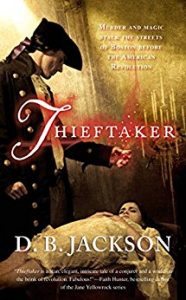
Book Cover from Amazon

Thieftaker by D.B. Jackson

BOOK BLURB ON AMAZON

Boston, 1765: In D.B. Jackson’s Thieftaker, revolution is brewing as the British Crown imposes increasingly onerous taxes on the colonies, and intrigue swirls around firebrands like Samuel Adams and the Sons of Liberty. But for Ethan Kaille, a thieftaker who makes his living by conjuring spells that help him solve crimes, politics is for others…until he is asked to recover a necklace worn by the murdered daughter of a prominent family.

Suddenly, he faces another conjurer of enormous power, someone unknown, who is part of a conspiracy that reaches to the highest levels of power in the turbulent colony. His adversary has already killed—and not for his own gain, but in the service of his powerful masters, people for whom others are mere pawns in a game of politics and power. Ethan is in way over his head, and he knows it. Already a man with a dark past, he can ill afford to fail, lest his livelihood be forfeit. But he can’t stop now, for his magic has marked him, so he must fight the odds, even though he seems hopelessly overmatched, his doom seeming certain at the spectral hands of one he cannot even see.


MY REVIEW

Harry Dresden meets Revolutionary War Boston

I have a new author to add to my faves – D.B. Jackson. The worldbuilding in Thieftaker is superb. Normally I avoid “alternate histories” – the tweaks never follow out to logical conclusions.

Example: The American Revolution inspired the French Revolution. Keep America loyal to British Rule so no American Revolution and jump forward 200 years … what happened in France and does the emperor still rule there and how does that affect France during WWII … do they accept occupation or fight? All of history feeds off itself; you can’t change just one thing.

But this book is not an alternate history, Thieftaker is an urban fantasy set in historical time. Ethan Kaille could be Harry Dresden, if the Chicago wizard lived in Boston just before the revolutionary war.

The characters are real, from the flawed hero to the merchants rivals on the warf. The arguments are urgent from the dreamers driving the country to the brink of revolution to the honest (and not-so-honest) people who just want to make a living and fear changes to the status quo. The scenes are authentic from the riots in the cobblestone street to the country manors of the Crown government. D.B. Jackson does an outstanding job blending his academic background as a historian with his occupation of fantasy author. A reader can immerse in fictional history.

Is the main character likeable? Not always, but I always rooted for him – even when he was being unlikeable. Can’t buy a good tea without paying England her tax, can’t have a good detective without him also being a Dick when interrogating suspects. And that is also part of the excellent worldbuilding.

If you like urban fantasy via detectives, pick up this book.