Arts: Embroidery – Blue Cross-Stitch Pieces Continued

TIMELINE: August 3 – 28, 2025

August 3, 2025 – I decided to clear out the blue cross-stitch projects as part of my clearing out of the stash. I have five pillowcases and four dresser scarfs (one of which I finished and can be found under the July 29, 2025 post: Embroidery – Cross-stitch Dresser Scarf).

The pillowcases only have embroidery along one side, rather than four, so I decided to start with those first. I will be taking pictures every three days.

First picture is the cover photo. Second picture is the chart, the four inch embroidery hoop (it needs to be that small to maneuver inside the pillowcase), and a picture of the DMC thread 809 (light blue) and 798 (dark blue). The cross-stitch is worked with three threads and the additional stitches will be worked with 2 threads. Third picture is the design printed on the fabric. It is about 13 inches long and 6 inches wide. The ink will disappear if water hits it. I don’t know how these have survived all these years. I believe I picked them up at A.C. Moore (which closed in 2019).


A picture of four of the pillowcases and all the materials together.

8/5/2025 (total time spent about six hours) – Third day of project. Sewed the normal one hour on 8/3. On 8/4, I took a little extra time (about 1 and a half hours total) to complete the dark blue stitches on the first pillowcase because I had a phone meeting the next night and if I got that done I could do the embroidery during the meeting because I would not need to pay attention to the chart. 8/5 Over two hours and a half hours of phone meeting, I got a LOT of the light blue done and then I started the pillowcase’s dark blue. I got three more meetings this month, and if I get all the pillowcases prepped with the dark blue cross-stitches at night when I can pay attention to the chart, then I can knock out the light blue during the meetings. The dark blue on the second pillowcase is from one hour of work after the meeting was complete.


8/6-8/11/2025 (total time spent about six hours – 16 overall)8/8/2025 The first picture captures the work completed 8/6-8/8 (one hour a night, about). Yes, that is a fifth pillowcase. Guess what I found while cleaning stash? That is right another one. Makes me wonder if I got yet another one for a total of three pair, or if I just have five pillowcases. 8/11/2025 (two pictures) Just a little bit of the final pillowcase left to complete. Then I will work on the LIGHT blue leaf patterns. There are five on each pillowcase. Once that is done, all the things left to do will not need the pattern for reference – all the cross-stitch will be light blue and all the rest (stem, leaf, and satin) will be two-thread dark blue.


8/14/2025 (total time spent about three hours – 19 overall) – 8/14/2025 Three days, about an hour each, of sewing, completed the dark-blue 3-strand cross-stitching as well as the two-strand light blue stitch of leaves. The first picture is the overall shot. The second picture is just the dark blue cross-stitch and the light blue leaf stitch. Final picture is what a pillowcase looks like with the light blue cross-stitch complete. Getting close to having one done!


8/17/2025 (total time spent about three hours – 22 overall) – 8/17/2025 Three days, about an hour each, of sewing, and one of the pillowcases is complete. How I approached this to start was first get two of the pillowcases light-blue cross-stitch knocked out. Now what I am trying to do is work on the more detailed dark blue two-strand stitches (stem, leaf, and satin) in the quiet by myself at night, and work on the light blue during meetings. This upcoming week I got four meetings, so I hope to knock out the rest of the light blue cross-stitch there. First picture is all five pillowcases. Second picture is what a completed pillowcase looks like – yes! one is complete!

8/21-27/2025 (total time spent about twenty hours – 42 overall) – Meeting week. Like, lots of meetings. 8/21/2025 First Picture is a four-day mark. I had a meeting each of those four days where I worked on the project for a little over an hour each time, plus the normal evening work. Total hours is more like ten between all sources. Two of the pillowcases are now completely done. 8/24/2025 Second picture is back to the normal three-day cycle, but two very long meetings this time of about two hours each, so seven hours worked. I also did more stash clean and found a SIXTH!!! pillowcase. In the picture, on the left side is one folded and one displayed completed pillowcases. Then on the right side are two completed cases on the bottom (the original four I started with project with are now complete); I have completed the light blue on the third case and am working on the light blue on the fourth case. I believe I will finish this project this week. Just need to do the embroidery, then a wash to remove the preprinted design. 8/27/2025 Third picture. Another three-day cycle of just three hours. Five pillowcases complete, only finishing dark-blue lines on the sixth pillowcase. Almost there. It has been a month.


8/28/2025 (two hours, including hand wash – 44 hours overall) – Last of the embroidery is completed!!! First picture is a round of handwashing all six pillowcases to get rid of the pre-printed design. Second picture is what the underside looks like. Third picture is everything complete.


DONE DONE DONE – One of the pillowcases with a pillow

Blue Cross-Stitch Pieces Series
Blog 1: Cross-stitch Dresser Scarf (7/29/2025)
Blog 2: Blue Cross-Stitch Pieces Continued (8/31/2025)
Blog 3: Cross-stitch Dresser Scarfs – The Sequel (TBD)

Museum Visit: Borderlands

Third episode of the Museum of Texas Tech University visit from a spring-time trip. Here are the pictures I took of the “Icon and Symbols of the Borderland” exhibit showing until August 17, 2025, plus things from the main exhibit which caught my eye.

First let me mention, the sculptures from mesquite wood are mindbending in their craftmanship. The mesquite tree is not in any shape or form “straight” wood. I didn’t take pictures of them because the sculptures just wouldn’t have come out well, but I highly recommend going in person (if you are traveling through Lubbock, Texas).

Onward into the Borderlands. Two artists worked with metallic labels to create collages. I took pictures of one of Cesar Martinez’s collages and two from Diana Molina. The use of trash to create Borderland art is, well, shiny.

The museum card reads: Cesar Martinez “Cabeza de Vaca Stele”, 2013 (Collage – on loan from the artist)

Alvar Nunez Cabeza de Vaca (c. 1490-1560) was a Spanish explorer and one of four survivors of the 1527 Panfilio de Narvaez expedition that reached Tampa Bay, Florida, a year later. Marooned on the Texas coast, he wrote an account of his eight-year trek across the American Southwest to reunite with his Spanish countrymen in what is now the northwest Mexican state of Sinaloa. In “Naufragios y commentarios” (Shipwrecks and Commentaries) originally published in 1542, Cabeza de Vaca documented detailed descriptions of the many Native American tribes he encountered.

About the icons and symbols in this collage, the artist explains they “are inspired by the Native American rock paintings, petroglyphs, and Mesoamerican visual representations that de Vaca may have seen during his travels.”


Diana Molina “Serape Tecate”, 2013 (Paper collage – on loan from the artist): Depicted here is an iconic trademark symbol of a popular beer brand of the region. The discarded wrappings of contemporary Mexican American consumption form the palette of representation of consumer culture along the borderline. Molina is “drawn to recycle post-consumer wrappings to create work that reflects the cultural heritage, environment, and commercial intake of a binational landscape.”


Diana Molina “Agave”, 2014 (Paper collage – on loan from the artist): The agave epitomized Molina’s passion for the Chihuahuan Desert landscape. Also called mescal, its use is a long-standing tradition among native cultures of the Southwest. Mother of tequila and provider of sweet nectar, the slow-growing desert plant stores water in its thick leaves and produces one magnificent bloom before dying.


Next is a painting of a horse, but the details fascinated me. Do you remember doing doodles in school, then drawing lines around them, expanding out like ripples to fill the space? I did a lot of them; still do if a meeting get boring enough. This reminds me of that, only 10,000 times better and more meaningful.

Richard Armendariz “Tlazoltleotl as a Horse”, 2013 (Oil on carved plywood – on loan from the artist): This work is inspired by the Mesoamerican deity Tlazolteotl. Armendariz describes her as “the goddess of midwives depicted with a black mouth because she eats filth or disease so that the mother can give birth to a healthy child. In my painting, I depict a horse as the midwife deity ingesting drones and missiles on a dystopian future border.”


The rest of the photos are from items in the TTU museum’s permanent exhibit. Let’s start with the beadwork. This exquisite piece was worked on deerskin. I’ve done a lot of beadwork over the years (see The Coif Continues 12/31/2019 for one example), and, let me tell you, working on leather rather than cloth is another level of crazy. You see with cloth, the hole formed by a needle is temporary … with leather, you got a hole for the rest of eternity. You put a bead in the wrong place while sewing on leather, there is no plan B.

“1870 / 1970” by Teri Greeves (born 1970), 2006 (Beads on deer hide)


While I have attempted a couple rounds of basket-making, I have never worked with pine needles, although one of my friends have. Basket weaving, with the constant wet hands, isn’t for me, especially if I want to work embroidery with silk thread. But I do have enough background to appreciate the precision crafting of this piece.

“Untitled basket” by Fran Kraynek-Prince (born 1943), 1979 (Pine needles)

I love woodcrafting, though I haven’t worked in wood in decades.

“Puzzle” by Michael Pat Butler (active 1970-1995), 1974 (Painted wood)

The balance of the photos are works in glass. The delicate shaping while working with high heat items is something I have admired and researched, but never personally attempted. The first picture is a typical multi-color vase, followed by a ceramic sculpture in a mostly traditional manner, and finally some painted abstract clouds.

“Untitled vase” by Kent Ipsen (born 1933), 1976 (Glass)

“Hummer 1” by Annette Corcoran (born 1930), 1999 (Ceramic)


Taking photos of sculptures rarely can capture the complex beauty of the three-dimensional object. Pictures are just not good enough. Nearly always with museum art pieces, I want to take them home (or just make them myself). On the other hand, I wouldn’t want to have this delicate piece in my house. Not with Space-X eighteen miles away regularly shaking the foundation with rocket testing.

“Bountiful Flying Art Clouds” by Ginny Ruffner (born 1952), 1999 (Glass, painter)


Museum Visits

  1. Y is for Yesteryear (4/29/2025)
  2. Museum Visit: Watercolors and Paintings (5/29/2025)
  3. Museum Visit: Borderlands (7/31/2025)
  4. Carlsbad Caverns (10/30/2025)

Arts: Embroidery – Cross-stitch Dresser Scarf

June 19, 2025 – I broke out my threads and needles again. I am working on a printed cross-stitch piece.  The first and second picture show the designs. The first picture is design printed on both ends of the dresser scarp. The second is the one printed either side of the middle.

This is the full length of the piece.

6/24/2025 – I have finished the cross-stich on one side. I still need to do the loops, stem stitch, and satin stitch., I am using DMC thread 809 (light blue) and 798 (dark blue). The cross-stitch is worked with three threads and the additional stitches will be worked with 2 threads.

7/5/2025 – Deep into the stem stitch, satin stitches, and the loops.

7/8/2025 – Finally complete the project! (Just needs a wash and iron)

Displays – end, side, full length


Blue Cross-Stitch Pieces Series
Blog 1: Cross-stitch Dresser Scarf (7/29/2025)
Blog 2: Blue Cross-Stitch Pieces Continued (8/31/2025)
Blog 3: Cross-stitch Dresser Scarfs – The Sequel (TBD)

Museum Visit: Watercolors and Paintings

Last month, in the post Y is for Yesteryear, I mentioned visiting the Museum of Texas Tech University. In that post, I went on and on about Quilts. Today, I am going to wax poetic on the Western Federation of Watercolor Societies 50th Anniversary Exhibition (which ran from February 5th to May 4th, 2025).

I make a goal of attending four Museum or Museum-like things a year. I meet this goal about half the time, but this year I blew it out of the water with heavy beginning-of-the-year group of opportunities. I caught the glass exhibit at Texas A&M when I attended AggieCon in February. Then on a trip in end-of-April/start-of-May, I swung by the previously mentioned TTU Museum, visited the Roswell International UFO Museum (no pictures, but may result in some stories), and walked through Carlsbad Caverns. There may be a few more Museums this year, but that is a good group of very different experiences.

TTU had four exhibits I explored. The first was the quilts, Treads of Tradition, second is the Watercolors (shown below), a small gallery showed the Sacagawea Dollar (closes September 2025) which isn’t full of cool pictures but did have cool information, and fourth is “Icon and Symbols of the Borderland” showing until August 17, 2025. I may drop the Borderland pictures later this year.

But today I am sharing the watercolors. I will start with my least favorite and go to my most favorite; these are the ones I took pictures of – I liked all of them enough to take pictures, download them from my camera, resize them for computer upload, write up the description and upload them. The “big” pictures should be great to expand out, even though I chopped them from 4 megs to 250 K. If you would like any of these for study, drop me a comment and I will forward them to you. It is true for pretty much all the work I post, unless copyright restrictions exist, I am willing to share.

“Moonblind” by John James is a mixed watermedia (San Diego Watercolor Society). A lot of my friends are into collage work, so this is more a picture for my friends than for me personally but moonscapes always capture my eye.


“South Fork of the Salmon at Stolle Meadows” by Renee Galligher  is watercolor (Idaho Watercolor Society), and more about inspiration than just standing in awe at the creation. I think this, or something like this, is within my capabilities. I always mean to paint more, and I would love to paint river scenes.


Next on the docket are two bird paintings and one fish painting. All are beautiful and showcase the power of the watercolor medium well: “Ponderosa Raven” by Lauralee Stenzel is watercolor and gouache (Arizona Watercolor Association); “Rooftop Spies” by Lou Sosalla is watercolor on Yupo (Colorado Watercolor Society); and “Old Friends” by Annie Strack is watercolor (Arizona Watercolor Association).


“Nested” by Rene Eisenbart is watermedia (Watercolor Society of Oregon). Last of the pictures I have of the watercolors and, by far, my favorite. The raised golden sticks in the nest, the hummingbirds, the beauty of the person’s face, all of it is gorgeous.


One oil painting from the permanent exhibit also caught my eye (and the photos came out). “Autumn Landscape” by Henriette Wyeth (born 1907, died 1997) , circa 1935 (oil on canvas) falls into the same category as “South Fork” above in that … I can make that, maybe, someday.


I will close out this post with the two pictures of the cool information I found in the “Sacagawea Dollar 25th Anniversary” exhibit (and the transcripts).

Sacagawea

A Shoshone woman born in the late 1700s near present day Montana, taken captive and removed from her family at age 11, and won in a bet by a French-Canadian who made her one of his several wives, Sacagawea served as an interpreter on the U.S. expedition on the potential trade-routes led by Captains Meriwether Lewis and William Clark in the early 1800s.

Having just given birth to her son, Jean Baptiste, the 16-year old Sacagawea accompanied her husband over 3000 miles as a vital partner in his ability to accomplish the role for which he was hired. Sacagawea spoke with her native Shoshone people and translated the Hidata(missing letters) Chabonneau, who translated in French to another member of the party, who then translated in English to Lewis and Clark.

On the journey for which Sacagawea is known, a river was named after her, and she showed fortitude, calm, and resolution. She is described in the expedition’s journal as a “slave, one of only two in the party, … the only Indian, the only mother, the only woman, [and] the only teen-aged person.” The National Park Service, musing why Sacagawea is so remembered suggest that “unlike other indigenous women, White men wrote about her, and those works lived on in print.”

Second Picture

Did you know that the Sacagawea Dollar has 17 stars on the reverse side? Typically most U.S. coins have 13 stars representing the 13 original colonies; however the 17 stars on the Sacagawean Dollar represent the number of states in the Union during the Lewis and Clark expedition in which Sacagawea took part.

Museum Visits

  1. Y is for Yesteryear (4/29/2025)
  2. Museum Visit: Watercolors and Paintings (5/29/2025)
  3. Museum Visit: Borderlands (7/31/2025)
  4. Carlsbad Caverns (10/30/2025)

Y is for Yesteryear

I’m traveling for the end of A-to-Z, adding a level of difficulty for visiting people (sorry folks), but today I got the perfect “Y” while visiting a museum. The Museum of Texas Tech University has a temporary exhibit “Thread of Tradition: Erlandson Collection of 18th and 19th century quilts” through mid-August, and since Lubbock was on the way to where I needed to go but about the distance I would need to take a break, I grabbed the opportunity. (Other temporary exhibits include Watercolor and Symbols of the Borderland, which I will post on a later date.)

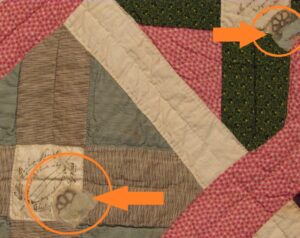
I’m going to start with the most unusual of the quilts. Some of my A-to-Z visitors may be aware of the Victorian tradition of saving hair of loved ones. Usually the created mementos were things like hair wreaths or hair jewelry (rings, etc). In this case, Eliza Burt Walton of Chesterfield, New Hampshire attached netting holding coils of hair to the quilt. The center block is inscribed “This album is composed of tokens of remembrance from old friends, associates and school mates in Chesterfield, New Hampshire, October 1854”
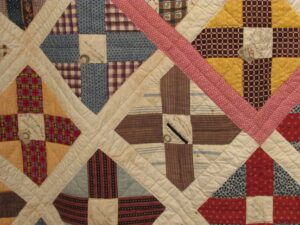
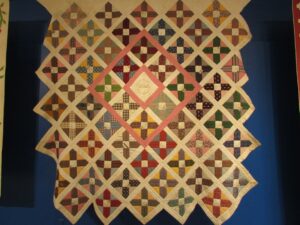
The pieced blocks all bear names and are set on point. I love the square edges creating a diamond-like fringe.


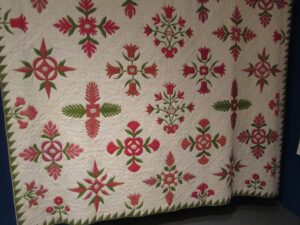
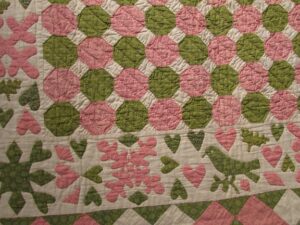
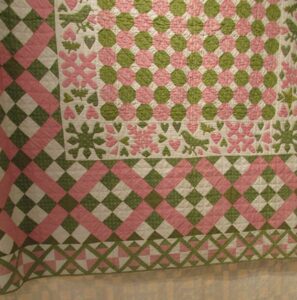
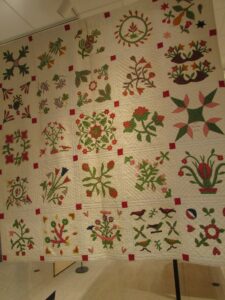
This first quilt was an Album quilt. This is when each of the blocks is a unique design. I took pictures of two more album quits. The first is a 1862 applique quilt, where red squares are in the corner of the sashing between the blocks. The second was created in 1846 by Esther S. White of Lancaster County, Pennsylvania. She was a Quaker. I love the green sawtooth boarder and the symmetry of the motifs.


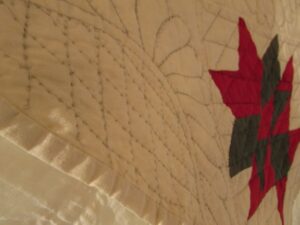
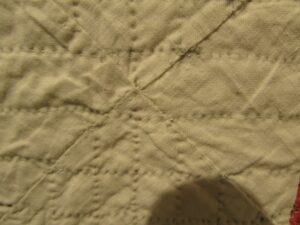
I did several up-close looks at the stichwork. The ones marked with pencil and/or pen make me feel better about my skill set. (Yes, that really is pencil marks) — I also got a close-up of where four pieces of cloth come together.


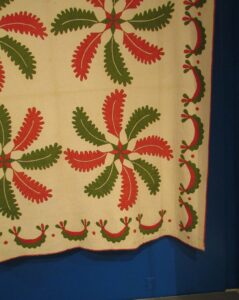
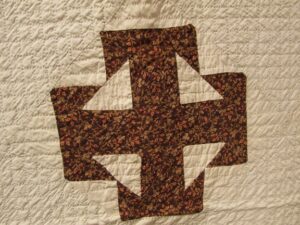
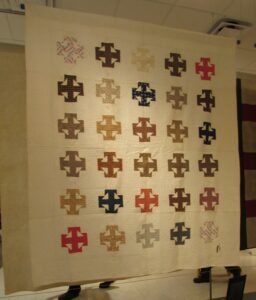
Two designs elements fascinated me: Princess Feathers and Double T. The name Princess Feather comes from the similarity of this motif with heraldry that honored the Prince of Wales and is a variation of “Prince’s Feather.” The circa 1860s quilt was created by (or for) Margaret Kearney from Auxvasse, Missouri. The Double-T pattern doesn’t have as rich a history, but the pattern is just as distinctive. The quilt was made for Elizabeth “Lizzie” P. Smith Heckard and her husband David Heckard, likely by Lizzie’s mother. (“Lizzie & David 1905” is quilted near one corner.) I personally would never attempt the Princess Feathers – I’ve done enough similar designs in applique and it is not easy, but the Double-T could be fun.


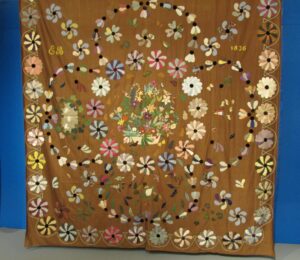
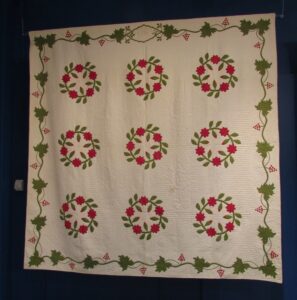
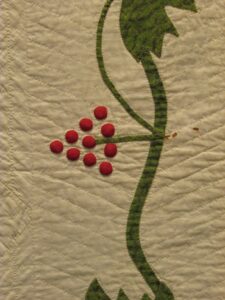
Several of the quilts are just out-and-out beautiful with their flowers. Below is a brown silk coverlet embroidered with the initials “E.B.” and the year “1836”, likely documenting the maker or who it was made for and the year the piece was completed. This exuberant summer spread of pinwheels and flower motifs has many eye dazzling details all sewn on an unusual dark background. And beside it is a Rose of Heaven appliqued quilt. The grape clusters are padded over and above the normal expected on quilts. The name associated with this quilt is Sara Dorliska Armsbury who either made this in Adams, Jefferson County, New York, or it was made for her. The rose wreath is a typical applique motif but the border of large grape leaves and small clusters of grapes is unique.


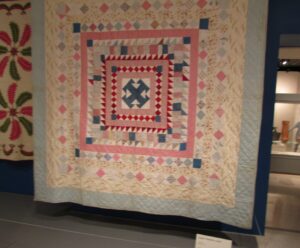
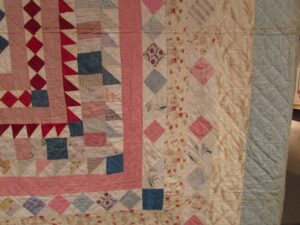
Next up is a medallion quilt. Like typical medallion quilts, this begins with a central pattern and builds out with borders.

The card beside the quilt read: The family history that come to the dealer with this quilt was that it was made by Eliza Woodfield Hagaman of Toms River, New Jersey beginning in 1874 with the October 16th birth of her daughter, Ellen Malsbury Hagman, and finished by the girl’s wedding in 1898. The website Find-a-Grave states that Ellen married Otis E. Hyers (1873-1960) in 1987. The bridal quilt gives many clues to when it was probably constructed. The fabrics as well as the use of a 3-ply thread and absence of any machine stitching suggest an earlier time period than the supposed 1874 start date. Eliza was born in Leicestershire, England and came to Pennsylvania about 1843 as a toddler. The England frame style construction suggest that the quilt could have been made by her mother, or her mother could have influenced the style Eliza chose. It is possible that Eliza began the quilt earlier than 1874, always planning to give it to her first-born daughter, who turned out to be Ellen.


I also took pictures of another medallion quilt. In this case, the picture of the description card was not legible, so I don’t have details on this one. But seeing two versions of medallion quilts can help one get a feel for the design. You can see the herringbone design used in a border of one of the Album quilts; this time the design is red.


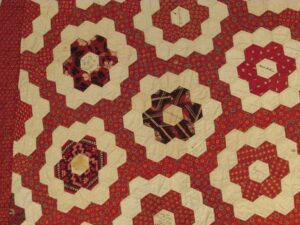
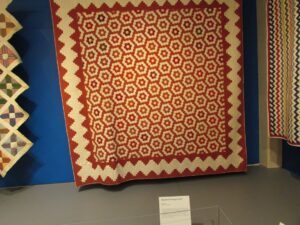
Last, but not least, especially to me, is a Hexagon quilt. Why this one is important to me is I inherited a hexagon quilt my grandmother made in New Mexico. Unlike these presentation quilts, that one was hard-used and I have been repairing it by replacing the damaged hexagons, appliqueing new pieces over the worn-out ones. Someday I will be done fixing it. When I do, I should post the results here.

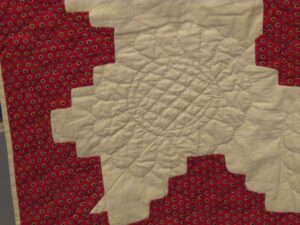
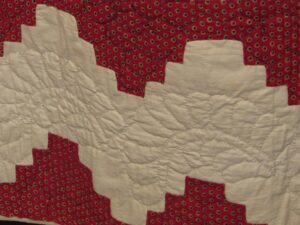
Meanwhile this beautiful Hexagon red quilt is a great way to finish off the yesteryear blog. Take special note of the quilted border.

From the museum’s card: This striking red and white quilt was likely made via the technique known as English paper piecing where fabric is basted around a paper backing to create the hexagon shape. The border treatment is unusual for an English paper pieced quilt but solves the problem of how to handle the edges of a hexagon quilt. This border treatment is almost exclusively found on quilts made in Maryland. The use of this pattern – a hexagon – for inscribed names is rare, likely because the pattern is time consuming and there isn’t a lot of space to sign.


The beauty and the work of quilts is amazing.

Museum Visits

  1. Y is for Yesteryear (4/29/2025)
  2. Museum Visit: Watercolors and Paintings (5/29/2025)
  3. Museum Visit: Borderlands (7/31/2025)
  4. Carlsbad Caverns (10/30/2025)