Blog

Magical Words: Show, Don’t Tell – Except When You Tell

From the Internet Hive Mind

One of the hard and fast rules of writing is SHOW DON’T TELL … except when it isn’t.

Showing takes time. A lot of time and words. And if what is being shown is boring or slow, well, maybe a quick tell is better.

Faith Hunter wrote a Magical Words post on 9/1/2010 which provides some guidelines for breaking the rules … and writing as to guide the reader through transitioning the borders of rules and rulebreaking. “Rules of Writing: Show, Don’t Tell, (Except When You Tell)”

Rule number one of When NOT to show is “Transitions”. Read the blog post for the rest.

Full URL is:

WRITING EXERCISE: After reviewing the blog, write something that should be a TELL instead of a SHOW as a SHOW. And then write the same something as a TELL. Why is the Tell better than a show in this case?

My Attempt:

As a Show: The distance from the car to the front door contained only seventeen steps, not counting rounding the car. Since I parked backwards, that wasn’t as much of an issue as most days. The minivan took a while to walk around, at least four steps, more like six. I hopped out of the front seat, closed the driver’s side door, opened the passenger door, dragged out my lunch pail and purse after the long day of work. The front steps brought my quick walk to a pause. Age charges a toll, and the knees collect most of it. While I’m much more confident walking up the step than down them, gravity and balance strangely work in my favor mounting the trivial three steps, a pause to verify all the skills I need to walk up is still warranted. Yes, my body is willing to not be disrespectful of my inner vision of youth and verve today. One, two, three steps. After juggling the keys out of the purse while holding the lunch pail and the screen door, I unlock my front door and step inside. That’s when I notice the smell.

As a Tell: The long day at work gave me exhausted fits unlocking the front door while juggling my purse, my lunch pail (so I could save money to pay off my mortgage before I die of the old age my knees say I already reached), and the screen door. I’ll claim concentration on the task at hand as an excuse to my dying day for not noticing the smell. Someone else had reached their dying day sooner than me, and I don’t live with anyone. And yet, my living room contained a dead body.

Telling over showing: How I parked, walking from the car, all of that doesn’t matter to the story. The story is the dead body. I do need a little exposition to setup the character, but not 190 of them. Two sentences of 67 words is much better – even gave me room for two more sentences to set up the story premise after the character introduction and description. People pretty much know what it means to come home from a long day at work.

Show and Tell Series
Part 1 – 8/3/2023
Part 2 – 8/22/2023

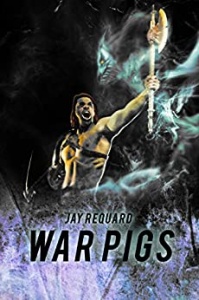
Book Review: War Pigs

Amazon Cover

War Pigs by Jay Requard

BOOK BLURB ON AMAZON

Among the tribes of the Wagani war is life, and for Lut, war is his way out of the poverty that he was born into. A reaver, a warrior, and the chosen of the enigmatic goddess the Azure Queen, he has dedicated his existence to furthering her glory by the bite of his axe. Bloodthirsty, powerful, and without mercy, he marches upon the world to spread the name of his beloved deity.

But what happens when the goddess no longer loves her champion?

From the award-winning author of The Saga of The Panther comes a dark tale of violence, betrayal, and redemption where David Gemmell’s Legend fights alongside Steven Erickson’s Gardens of the Moon. In this world victory always comes at a price, love is forever the final victim, and not even the gods can stop the ruthless march of history. This is the world where only the strong and cunning survive.

This is the world of the War Pigs.


MY REVIEW

On one hand while reading this, this would be easy to group with LitRPG – the main character is unmistakably an orc. You follow him surviving his first levels, gaining the favor of a goddess, and acquiring an enchanted weapon. Further adventures continue and he goes from solo hero to building his fortress, etc.

On the other hand, there are no stats tracked. This isn’t a game within the story or any of the typical requirements for LitRPG. It’s full of actual story features like the point-of-view character undergoing a growth arc. You root for the character, not the dice rolls.

Sword & Sorcery, down and dirty. The Orc, Lut, isn’t a good guy. He will never be a good guy. But he is a guy with a plan to get out of the dirtiest, lowest, downtrodden places of his species – through fighting and focus. Blood, sacrifice, raids, sex.

With a Plan and Focus he is able to beat his species short life span to reach the pinnacle of existence. Then betrayal happens, destroying everything he worked to. His betrayer left him alive as a lesson to others.

Lut, though, is really good at lessons and learning from them. He gets a new Plan and a new Focus. Even the gods should fear the results.

(Read through Kindle Unlimited)

Flash: Misty Lake

Image from freedigitalphotos.com

Holding the screen door, Brona carefully shut the rental’s front door and then guided the screen to frame without a sound. Likely the only time the screen hadn’t slammed shut from the over-pressure pneumatic closer since the two-week vacation started. Carefully picking her way down the path in the twilight over the slippery pine needles and new fallen autumn leaves, the girl made it to the pier between the four bungalows the family rented for the annual reunion so her mom and aunts could keep in touch and the cousins could know “the meaning of family.”

The mists for which Misty Lake was named rose as the first light of day kissed its surface. Air and water waged a temperature war in the heady transition of humidity. Perfect for a last kayak trip.

Ducking under the weather-worn cedar pier, she tried to pull out one of the brightly colored single-person boats. A few choice words the thirteen-year-old learned never to say around grown-ups slipped out quietly.

“They’re chained.” A deep voice said above.

Brona jumped, hitting her head on underside of the silvered wood. “Fuck.” She managed to bite out in an undertone, before she shimmied out to find who caught her sneaking around before dawn. The masculine voice worried her.

Sitting midway down the pier, huddled over his ever-present sketch book, sat her cousin Delaney. At fifteen, his voice alternated between his old sweet child voice and the gravelly bass his oversized Adam’s apple promised would be its final form.

“Scare a girl, why don’t you?” Brona hissed, stepping onto the pier to join him watching the mist.

He shrugged his narrow shoulders, running a pencil over his paper.

Brona dropped beside him, pulling her legs against her chest. “What’chu doing?”

“Drawing.”

“At least that is a two-syllable word. You’ve been mostly monosyllable this trip.” Brona quirked a smile, looking over the landscape being sketched. “But if a picture is worth a thousand words, I guess you’ve been talking up a storm all week.”

“Yay.” Delaney chuckled. “That’s a good one, shrimp.”

“Thanks.” Brona eyes darted between the sketch and the feature her cousin picked out from the lake, on the paper the twist of two trunks hinted at a stork shape with the mist swirling about it like the ancient wood could take flight. “Been here long.”

He shrugged. “Didn’t need to sleep after the fireworks last night.”

“Won’t your parents be worried?” Brona hugged her legs tighter. “Aren’t you cold?”

“No and no.”

“But what about—”

Delaney slapped his book shut before turning his dark eyes, mostly hidden under black bangs and unkempt hair, to her. “I don’t need to talk. Do you?”

“I…I…” her voice broke, struggling in the face of his apparent anger. “no.” She dropped her eyes and whispered. “No, sir.”

“Brona?” The teenage boy reached out a hand to her long brunette hair, touching it gently. “You okay?”

Try as she might, she couldn’t help but to flinch away from his touch. “Sure.”

Delaney drew his hand back slowly. It curled into a fist, then straighten out a finger at a time before he placed it palm down on his ten-by-twelve yellow sketchbook. He stared at her. “I don’t believe you.” The crickets and frogs screamed in the early morning light, muffled in the mist. “Why did you want to take a boat out alone?”

Brona buried her head into her knees.

“Shrimp, come on girl.” Delaney took off his flannel shirt and dropped it around her shoulders. “You know I ain’t going to tell anyone. I’m the king of monosyllables, right?”

“I can’t.” She sniffed noisily. “I can’t go … I won’t go back. Not with him.”

“Your dad?”

“Don’t you fucking call him that.”

“Damn.” Delaney tucked his sketchbook into his backpack, before he asked. “Just hitting, or… um … the other too?”

She turned her head to him and whispered. “All of it.”

“All of it.” Delaney’s dark eyes became pits of sorrow. “That is why you want to take the boat.”

Brona nodded. “I can’t kill myself. I don’t want to go to hell. But, since people have disappeared on the lake this year, I thought maybe, that wouldn’t count?”

Being Irish-Catholic like her, Delaney understood unaliving oneself isn’t an option. “The big house might have a canoe we can use.”

“What?” Brona asked, watching Delaney stand and offer her his hand.

“No one should die alone, and it’s not like I got a lot to live for. Come on, shrimp.”

The teenager wiped her hands over her face before letting her cousin help her up. “Why?” Brona touched the flannel and made to take it off, but he shook his head.

Delaney shouldered his backpack while she poked her arms through his overshirt.

“Why what?” Delaney jumped off the pier, heading toward the large house about a quarter mile away. The people who owned it, owned the lake and all the surrounding area, renting bungalows out throughout the year. “Why do I think the house might unlocked canoes? The disappearances didn’t start until midsummer, and the Regans only stay in the house in the spring. The caretakers are keeping a sharp eye on the boats the visitors use but usually don’t mess with the big house. Since everyone is pretty much a regular, no one messes around because we want to come back next year. At least, that is my thought.”

“Wow, you can talk when you get going.” Brona chuckled as she walked beside him. “But, no.” All humor fled when she asked her question. “Why don’t you want to live?”

“I’m gay.”

Brona stopped on the path, her mouth opened in a small “o” before rushing to catch up.

He glanced down at her. “The parents sent me to conversion camp. It’s why I was late showing up this year. I ain’t going through that again. I was going to run away after I finish sophomore year. I think I could fake it for a year. You can do things at sixteen.” Delaney shrugged. “But you. You can’t wait. May as well be the two of us.”

“What if…” Brona waved a hand. “What if whatever is out there only does it with one person.”

“Nope, one boat only, but it was one guy, known for being stupid so no one thought much of it, two people who snuck out for their affair, then one old woman who just wanted some quiet in the morning, for a total of four. At least that is what Mr. Kennedy said.”

Once close to the house, a heavy mist deadened all sound. The deep waters around the house whispered as the fog rose. The two slipped along the wet, overgrown path until they came to the boat house. Locked.

“Look for a can or fake rock.” Delaney ordered.

Brona picked up an edger stone, lining the path from the boat house to the lower pier. “Like this?” She flipped it over to reveal a key held in a cavity by a magnet.

“Exactly.” He plucked the resin rock from her hand and removed the key. Moments later they were inside the boat house, picking out the lightest canoe and a couple oars. They moved the boat to the edge of the water. Delaney stopped her before she climbed in for him to push them off. “We need to leave a note.”

“No.” Brona shook her head vigorously, black hair flying. “No, we don’t.”

“Shrimp, you got two younger sisters.”

Her hand flew to her mouth. “He wouldn’t.”

“When did he start?”

“I was eleven, just after my period started.” Brona met her cousin’s eye. “Riley turns eleven in November.” Her face hardened. “I’ll write the note.”

They left Delaney’s backpack on the pier in plain sight. If nothing happened before the mist started burning off, then they would collect it. If they didn’t get back, it would be easy to find.

The backpack was easy to find when two sets of angry parents went looking for them after packing was finished at ten.

***

Rowing through the mists on the twisty cedar water lake revealed shape after shape. The two moved in unison after a lifetime paddling in these waters. A dip, a turn, a lift. Drip, drip, drip as the paddle switched sides. The twin trunks wishing to be storks were far behind. They passed the alligator log, cattails alongside the favorite splash pond brown-to-bursting. Sun streaked, blinding through the denuding trees as the autumn leaves fluttered and fell, the bright light turning the mist into pure white fog.

Neither talked, both hoped, feared. Praying whatever happened would be swift, but nothing in their pains had ever been quick. Determination pushed them on; weirdly growing more tense across their young shoulders, and also feeling their twisted bellies relax in the quiet morning.

Brona dropped her paddle into the water, turning it sideways to slow the canoe, drifting the aluminum boat to the left.

Looking up, Delaney made eye contact with his cousin and she lifted one hand from the paddle to wave at something. A wall, white-gray visible as they turned the bend. An emerging building with crenelations and a glass dome. A building that never existed in the fifteen years Delaney spent the final two weeks of summer at the lake.

The moss growing up the side, the cracks and chips, told a story of a building older than a summer build. Cloudlike mist swayed through formal gardens near a gravel shoreline, leaving water-drops like diamonds on roses and small berries. The two drew alongside the anomaly when the gravel had been washed aside along a sculpted cement drain way, the top of the shaped-stone ended against the building where a gargoyle with a wide mouth sat at the bottom of a downspout. Beside it rested a kayak and a rowboat against the building.

“Well…” Brona whispered, grabbing onto a pole beside the drain way.

Delaney brought them to a complete stop. “Yep.”

“Can’t be any worse.”

“No going back.”

Their black eyes met again, a thousand words passed between them and nothing was said. Brona stepped out of the boat, onto the submerged cement ledge, soaking her already wet shoes, pulling the canoe toward her. Delaney used his paddle to rotate the boat so his end bumped against the shoreline and got out. Together they ported the canoe to where the other boats were located and stored the paddles inside, out of the weather.

The other two boats showed signs of being out in the elements for a while. Leaves gathered around the bottoms, some spider webs between them and the building. The rowboat had moss growing in the shadow against the building; the kayak looked cleaner.

“Which way?” Brona asked.

Delaney looked southeast and then northwest along the building. More stonework pathways existed to the southeast side. “I think the front is this way.”

(words 1,820; first published 9/5/2023)
Other Cool Vlogs: Writer Brandon McNulty

In April I struggled with several flashes and ended up rewriting them. I know, I know, that is not how flashes work – it is write and done, yes? But the story or scene just didn’t work. They were passive, telling, not showing. The dialogue fell flat. They were a mess.

In particular, I rewrote two of the four flashes for the Under Contract Series.

N is for Noise (4/16/2023) seemed okay as is.
Q is for Quicken (4/19/2023) mostly stayed as is, just needed brightening. A quick rewrite.
Y is for Yield (4/28/2023) got burned to the ground and totally rewritten.
Z is for Zzzz (4/30/2023) needs to be burned to the ground and redone, but I haven’t done that yet. I was tired of rewriting and realized that this particular series will not go on to bigger things. I decided to leave it as is because it does present all the bits of the scene I wanted. It just didn’t have any umph.

After rewriting them, I ran across Writer Brandon McNulty vlogs on dialogue and what was the ACTUAL problem I was struggling with in April got revealed. Dialogue – I was writing bad dialogue and when I fixed things, they became good dialogue.

Mr. McNulty defines Good Dialog as

  1. Natural – Sounds natural to the character, scene, and world.
  2. Conflict – Attacks or defends
  3. Subtext – Expresses unspoken meaning

In his first Round (video below), he defines five examples of bad dialogue …. but also gives an example of when “bad” can be done well.

  1. On the nose – States the obvious; baldly states thoughts or feelings; no mystery, subtlety, or subtext.
  2. Melodrama!!!
  3. As you know Bob (I have covered this in my editing rants and writing exercises before)
  4. Forced poetry (I usually call this purple prose)
  5. Wooden Dialogue – Too formal; unnatural; on the nose.

In his second Round (video below), he gives five more examples of bad dialogue and how they could be fixed.

  1. Name calling
  2. Preachy dialogue
  3. Filler Dialog
  4. Relentlessly Repeated Phrases
  5. Clunky Comebacks

Now, all the examples he gives are spoken in movies or in video games instead of reading aloud examples from books. He is using the video medium, so pictures and speaking are the best for the format, but the examples do translate well into writing.

Let’s examine Y is for Yield (4/28/2023) and Z is for Zzzz (4/30/2023), the extensive rewrite and the one that NEEDS FIXING.

How Y is for Yield got fixed mostly is I added Conflict, one of the marks of good dialogue, and I made it more natural. It was already pretty natural, but there wasn’t really a conflict. If you read it, you might think “where is the conflict?” because the two aren’t actually arguing. They are just talking as people do. But Malcolm is a teen and while he wants to talk about his day, he also doesn’t want to talk about his day. Abby understands this and gently pries the information out of him that he wants to share. She makes him face a hard truth about himself, and then puts him in the position of having to report all of this to his mother. There actually is a lot of subtext happening; Malcolm is in his last year of high school and is facing a lot of changes in his life and needs to sort them out. Abby is being a sounding board, a very active sounding board in that she is making him talk. The conflict is internal to Malcolm, but being shown through his conversation with Abby.

I’m actually very proud of the final product I came up with there in the second try at that flash.

Z is for Zzzz hasn’t been fixed. Nearly all the words exchanged are FILLER dialogue, very clique. And the entire thing is WOODEN – some of the things Abby says is Unnatural to her manner of talking. Overall, the dialogue is way too formulaic. There is absolutely no conflict, internal or external, and no subtext. I break all the Good Dialogue rules and click off the boxes for several of the bad dialogue lists.

At least, the flash now serves a purpose: “If you can’t be a good example, be a bad one.” And Z is for Zzzz certainly meets being a bad example.

Under Contract was interesting to write in that each of the flashes is from a different POV. If I ever rewrote Z is for Zzzz, the conflict would be internal again – this time for Jonathan. I would make it much more of a ghost story, expanding on the scare atmosphere and maybe even leave a lingering fear in the Normal Man of the supernatural he has to live with. Except I really don’t like that twist for this family story. I don’t want to create internal conflict between the house dwellers. Which is one of the reasons this scene will never be rewritten. I can’t do it to make it a good scene and still have the story be the one I’m trying to tell. Yet this scene is essential to the overall story.

The Under Contract series was initial worldbuilding to see if I have a broad enough story and thick enough plot. In this case I don’t.

But it did give me a better feel about writing dialogue. A good lesson.

Please watch the videos, they are really helpful.

Bad Dialogue vs Good Dialogue Round 1

Bad Dialogue vs Good Dialogue Round 2

Writing Exercise: Paper vs. Tech

Photo by Nick Morrison on Unsplash

Last Thursday, I wrote “Learning through Paper vs. Tech” Geeking Science blog post (7/20/2023). Ready to apply science to your writing?

In the studies, scientist pointed out while tech allowed faster reading and faster note-taking, comprehension and higher level processing and retention suffered.

How would this apply to writing? I remember when I first began writing, and the computer was buried in the basement and not constantly on, writing the first draft on paper and then spending hours in the slightly damp and slightly dark basement transcribing the material. When transcribing the first draft into the second draft, I was rewriting so much of the material – making it better, getting the flow right. The story bloomed during my dark, damp times.

As time has gone on, computers and typing have become a way of life and my hand now cramps within minutes of writing instead of hours. All the muscles are for typing, not writing.

Hmm, that is telling – “not writing”. Is not writing the first draft out by hand one of the reasons I am not writing much? I know a lot of my writer friends, who are writing regularly, swear by their journals.

Obviously tech lets writing be faster with the computer, but is it better?

Today’s writing exercise is to physically write.

WRITING EXERCISE: Write a scene out by hand, and then retype the second draft. How is this product different from the normal written scene done through typing?