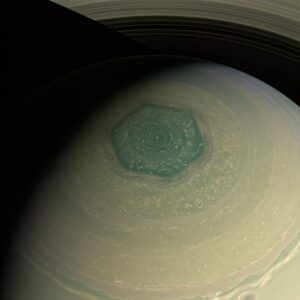
By Kevin Gill from Los Angeles, CA, United States – Saturn – July 24 2013, CC BY 2.0
https://commons.wikimedia.org/w/index.php?curid=146336274
Everyone knows about Jupiter’s Red Spot; I previously covered it here: The Forever Storm (June 19, 2025). Like Earth storms, the Red Spot varies between being round and oval as the other winds swirl around the hurricane. Hurricanes on Earth are round. It just makes sense, fluid flow – curves and lines.
Then we got the Saturn Hexagon. Yep, that is right – see the picture above – hexagon. Six-sides mostly flat sides of about 20,000 miles each mark the storm of the northern pole. In the winter, the color is an icy teal and the summer a golden yellow.
The strangely shaped storm was discovered by the Voyager mission in 1981 and all four missions to the planet since then have had it show up. Not as persistent as the nearly 200 year old (recorded observations) of the Red Spot, but then Earth’s “eyes” couldn’t see that far until recently so maybe it has been there forever and a day as well. But at this time we got 45 years of observation, which is nothing to sneeze at.
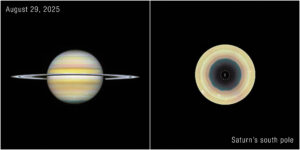 Equally strange, the South Pole of Saturn does not have a hexagon storm. You think if one pole would have it, the other would too. The NASA/ESA Hubble Space Telescope didn’t show anything unusual. Until recently that is. In 2023 the normal tendency toward a round swirl, flattened out into sides of about 10,000 miles each…of a decagon. (You’ll need to expand out this picture to see the 10 sides – or go to the original picture at Bruce Murray in the bibliography.)
D&D dice anyone?
Scientists don’t think the decagon phenomena will be persistent.
So how do these storms gets their curves sheared into flattened sides? Time to dip into fluid dynamics. What present simulations created by Oxford University indicate is the circulation, if rotating at different speeds between the center and the edges, can create polygon shapes in the flow varying between three to eight-sided, with hexagon being the most common formed. (Wikipedia)
And now we got a ten-sided form, because the Universe just loves to give scientists more questions.
Saturn isn’t just spectacular for its rings and moons. The storms either side of the planet want to become dice in roleplaying games.
Bibliography
The Downlink. “Space Snapshot.” The Planetary Society. 2026 September 11. (email magazine)
Kuthunur, Sharmila. “What is the Hexagon of Saturn.” Love the Night Sky. Undated. https://lovethenightsky.com/the-hexagon-of-saturn/
Lagatta, Eric. “This newly discovered decagon above Saturn leaves scientists perplexed.” USA Today. 2026 September 3. https://www.usatoday.com/story/tech/space/2026/09/03/hubble-saturn-decagon-south-pole/91590389007/ – Last viewed 11/2/2026
Murray, Bruce. “Saturn’s decagon.” The Planetary Society. Undated. https://www.planetary.org/space-images/saturns-decagon – Last viewed 11/2/2026
Murray, Bruce. “Saturn’s hexagon.” The Planetary Society. Undated. https://www.planetary.org/space-images/saturns-hexagon – Last viewed 11/2/2026
Wikipedia. “Saturn’s hexagon.” Undated. https://en.wikipedia.org/wiki/Saturn%27s_hexagon – Last viewed 11/2/2026
Very cool.