Photo by Aaron Burden on Unsplash
I love me some good worldbuilding. When a writer adds magic to the world, what are the other impacts socially, technology, and emotionally? If the magic is defined that everybody can use it or only a few? If only a few can use it, do they become elite or enslaved? What does isolating specialists do to everyone else? You cannot tweak one thing and not have everything else change around it.
Witness: the cell phone. Telling children about being stuck on the side of the road waiting for someone to drive by and help…”Why didn’t you just call?” “Yeah, that area has really good reception.” Or talking about arguments about what the lyrics of a song were. “Why didn’t you look it up?” Or getting lost? “You didn’t just Quest it?” Their world is infinitely different than the previous generation. Every change changes everything.
It makes some good worldbuilding with the unintended consequences. Encyclopedias have disappeared out of houses, maps out of cars, and worry about what happened to someone showing up late diminished.
Onto climate change. The world is getting warmer, with the added impact of climate becoming less stable. Currents, air and water, are changing paths. Predictable rainfalls and snowfalls are modified. The EXTREMES of temperature mean colder winters and warmer summers, impacting the survival of wild and agriculture plants and animals. These are expected. But what other unexpected consequences are happening? Today for Geeking Science, I will cover three: opportunities for navigation clearing, bee populations, and fires interfering with deep-space astronomy.
Navigation Clearing: In 1944, the Germans scuttled boats during their retreat from Russia. Partially to deny them the resources, and partially to prevent them from traveling down the river. Over two hundred wrecks along the Danube River have impacted shipping ever since. The wrecks had been sunk to prevent boat traffic; they continue to do the job to present day. Removing them is a nightmare as unexploded munitions and other surprises are hidden in the river muck. Thanks to climate change bringing droughts, these wrecks are now visible above the water line and inspection is much easier. (Andrew)
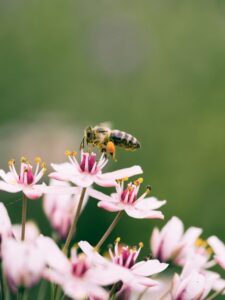
Bee Populations: Flowering food requires bees; bees require flowering food. But if climate change disrupts when flowers bloom, putting them out of synch for when the bees come out, then the bees starve and the flowers cannot seed. Heat is sending bees further north, but bees navigate by sun position and if the sun rays are at the wrong angle, they cannot tell their hive where to find food. In addition, “moving north” means the bees are stepping into another animal’s territory which could fight back while at the same time leaving all the familiar plant further south without their primary pollinator. (Biology Insights, Zanco)
Deep Space Astronomy: How on EARTH could climate change impact deep-space astronomy? Well, the wildfires in Spain created evacuation orders for both the ESA Cebreros antenna and NASA’s Madrid Deep Space Communication Complex. The NASA complex is only one of three sites worldwide to keep continuous contact with missions operating beyond Earth’s orbit. The other two are in California and Australia. With Spain unmanned, a third of the communication was done. Backup sites are needed, but the backup will cost just as much as the original. The world is on fire and so is humanities ability to study the causes. (Cosmosrocket)
Bibliography
Biology Insights. “How Climate Change Affects Bees and Why it Matter.” 2025 July 29. Last viewed 8/11/2026. https://biologyinsights.com/how-climate-change-affects-bees-and-why-it-matters/
Cosmosrocket. “Wildfires in Spain Threaten Two Critical Deep-Space Ground Stations.” 2026 July 27. Last viewed 8/11/2026. https://www.cosmosrocket.com/en/journal/wildfires-in-spain-threaten-two-critical-deep-space-ground-stations-40mk-en
Paul, Andrew. “German WWII shipwrecks resurface in Danube River.” Popular Science. 2026 August 3. Last viewed 8/11/2026. https://www.popsci.com/technology/german-ww2-shipwrecks-danube/
Zanco, Brooke. (Ebba Widman, Tahila L. Fulton, Sarah E. Diamond, Carmen RB da Silva, Fleur Ponton). “Bee vulnerability to climate change in a shifting nutritional landscape: why sociality and life-history strategy matters.” Current Opinion in Insect Science Volume 77, October 2026. Appearing on Science Direct. Last viewed 8/11/2026. https://www.sciencedirect.com/science/article/pii/S2214574526000726