Geeking Science: Architecture

Photo by Meriç Dağlı on Unsplash

Fighting White Boxes (mentioned in Septembers writing exercise) can be an uphill battle. One of the ways to win the war is think about the architecture of the building.

Ready for Geeking the Science of Construction?

Let’s start with a life hack which I find very helpful. Electric wiring and plumbing are expensive and time consuming, and architects and construction crews like to put all of that together for several reasons. Less cost of running wires and pipes. But also so they can get on the business of building while waiting for the government inspectors to sign off so the walls can be closed. Which means bathroom, kitchen, and elevators are all going to be in close proximity to each other. Going to a job interview and want to have one last bathroom trip before sitting in the reception area waiting for the interviewer to free up, look for the elevators – the bathrooms will 90% of the time be somewhere in that core column. Just walk around the “block” until you find them. At a house party and trying to find the downstairs bathroom, find the walls adjacent to the kitchen. Likely the bathroom is near there, that or the stairs. If the downstairs bathroom is full because the party is already full swing, go to the second story and find the space directly over the other bathroom or the kitchen.

There is so many cool things about architecture!

Photo by Diana Davolyte on Unsplash

How about pagodas? These tall delicate buildings made completely of wood with their large overhangs look like a strong breeze will destroy them. They are also one of the most earthquake resistant building styles in existence. The wide eaves, the wooden central column, the box-style construction, all contribute to a building which sways and stays. If you would like to see related videos, check out the link in the Bibliography under Kalovic. The wide eaves also contribute to controlling heat entering the building during the summer, but the shallow nature likely allows the low angle winter sun in for warming the building during the cold months.

Talking about controlling heat and cold without massive amounts of air conditioning and heating – which those big monster skyscrapers with their glass sides require, let’s take a stroll through the north and south. In old school Philadelphia, the buildings are close together – row homes in fact. These retain heat making winter bearable. They are not meant to be lived in during the summer – that is what porches and parks are for.

In the south (and throughout the world in warm climates), houses and entire towns are built to catch prevailing breezes. Multi-story buildings make use of the “heat rises” principals and pull air flows through from the bottom to the top of the house. Awnings and porches are welcomed additions in the summer, and can even double the house footprint. The porches on my house in the Carolinas add 20% to my modest living space during the warm months (my house is about 900 square feet, so I love my porches).

Image courtesy of Witthaya Phonsawat at FreeDigitalPhotos.net

The push to be “modern” (read, European materials), can be counterproductive when one forgets the past. The “air cooler” (see DiStasio – warning, some of the physics are suspect. They might be looking at the wrong reasons for the benefits they are seeing.) which everyone talked about in 2016 and 2017 of forcing airflow through small holes to make the inside of a house cooler amused me because, well, Ottoman architecture. Have you seen the widows with the small deep holes? Combined throughout the house, heat can change easily but slowly when the indoor/outdoor are different, averaging out extremes of a cold night and hot day.

Mr. Holland (see Bibliography) collected a lot of examples of how returning to study native buildings can give a better idea of using less imported materials, making the buildings more responsive to the local environment, and more sustainable for maintenance and climate, all the while being aesthetically pleasing for the culture. Things like curved roofs protect against cyclones (hurricanes), using reeds with hollow stems for their insulating properties, circular buildings to protect against monsoon rains, and window placement to collect solar heat and create cross-ventilation. 

The geeking science list for architecture goes on and on. Flying buttresses, keystones, spiral staircases, …. add them to your writing to make the world more real. Tie the environmental problems people face to the houses they choose to live in. In Urban Fantasy, does the person live in a shotgun house or a penthouse? In a fantasy, is it a “Winter is Coming” or “Afternoon Siesta” culture? For a science fiction, how long does it take them to abandon the old colony ships and build their own places? Break the white box.

Bibliography

DiStasio, Cat. “The amazing Bangladeshi air cooler is made from plastic bottles and uses no electricity.” Inhabitat.com. https://inhabitat.com/this-amazing-bangladeshi-air-cooler-is-made-from-plastic-bottles-and-uses-no-electricity/ – last viewed 11/12/2019.

Holland, Oscar (CNN). “What traditional buildings can teach architects about sustainability” CNN.com. https://www.cnn.com/style/article/vernacular-architecture-sustainability/ – last viewed 11/12/2019.

Kalovic, Alen. “Shinbashira – pagoda’s exceptional earthquake resistance.” Medium.com. – last viewed 11/12/2019. (Author deleted the article in 2022.)

Kipnis, Nathan. “Natural Cooling Strategies.” Mother Earth News. https://www.motherearthnews.com/renewable-energy/other-renewables/natural-cooling-zm0z11zphe – last viewed 11/12/2019.

Author Spotlight: Michael G. Williams

Amazon Cover

Around the time I wrote the Author Spotlight on Michael G. Williams back in 2017, my publisher asked me if I knew Mr. Williams and would be interested in editing a book by him. Seems the boss had picked up the series which I discussed in the blog post, plus would be publishing the last of the series. If I was available, he would assign it to me.

Oh my goodness, oh my goodness, OMG, OMG!!!! Squeal!

After I calmed down, I worded a reply – deleted that one as being way too fangirl – did another after I calmed down again. Finally I managed something along the lines of: “I have enjoyed his work and believe I can fit another book into my schedule.” Hit send on the email, then finger out and take a sip of tea. So professional. While quivering in excitement.

One book turned into two, then three, and now I am his go-to editor at Falstaff. (He does get some of his short work published elsewhere.)

My mantra when editing his work is “Don’t pull a J.K. Rowlings with Mr. Williams.” I want his work to be the best possible, which means he must get edited completely. Unlike Ms. Rowlings, whose books clearly had editing slack off as her editors changed into fans, I had to remain an editor. No matter how much of a fan I am.

And if I stay good, I get to see his work before anyone else!

That’s a big incentive to stay on the straight and narrow red editing line.

This year Falstaff Books put out three of his novels/novellas.

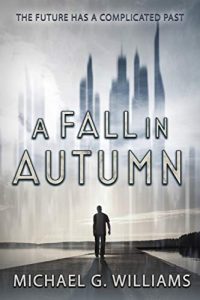
First one happened back in January 2019, A Fall in Autumn. In fact, it was Falstaff’s first publication of the year as well as the first book in a science fiction series about a detective. It’s amazing! The central conceit of the SF aspect is organic manipulation, not the typical military and spaceship story.

Second happened in June, Nobody Gets Out Alive, concluded the Withrow Chronicles. (I.touched.it. I.got.to.make.this.series.better.) The final cross-genre for the vampire series was War Chronicles. I had to dig deep to remember what I knew about the tropes of that genre, but I truly feel that the conclusion delivers on the promise of the series. Not an easy thing to do for a five-book opus.

Amazon Cover

Third, and last one, published this year, Through the Doors of Oblivion, the first of a new series in the Quincy Harker/Shadow Council universe. This is perhaps his best story yet, mixing in so many of his passions. Mr. Williams love of San Francisco bleeds through every page. In fact, most of my editing felt like: “Pull back. This scene doesn’t fit this story right now. I know you love it, but save it for later books.” This time the urban fantasy focuses on witches vs. a demon, with a lot of the City by the Bay history thrown in.

Each book published this year had a different focus, a different sub-genre, and yet his author’s voice dances throughout even as the series voice and character voices adjust. He is an amazing writer.

And I get to edit him! (squeal, hands clapping)

Read his stuff. Give him a reason to complete the next book of the Fall in Autumn and the Servant/Sovereign series. I can’t wait to see them.

You can follow him at: http://www.robustmcmanlypants.org/perishables/

Flash: Dissolve

Image courtesy of renjith krishnan at FreeDigitalPhotos.net

I am actually one of the people who saw someone dissolve in November ten years ago. Just out of high school, I was working a big retailer, the one with the blue words and the yellow asterisk, putting together the salt and shovel display right near the door when I saw this woman walking out. It was late at night about two weeks before Thanksgiving and the Black Friday sales so it was just me, Billy, and the store greeter.

I remember her. Normally I wouldn’t. Thousands of customer walk by me every day. Normally I wouldn’t have even been looking at her pushing the cart out the door, but the salt bags were heavy and I stood a moment to take a breather. The woman had stopped near the doors, but just short of activating them to automatically open. Outside the winter chill was conspiring with the breeze to steal people breaths. I had done cart wrangling earlier and agreed with her decision to stop and pull on her gloves. The vibrant red coat, jeans, and boots weren’t going to be enough. In fact, she should had been wearing a hat, but no one really starts wearing those until it actually snows.

I remember her because as I watched, her image unraveled. About three cart lengths from me, she dissolved into nothing, leaving behind a cart full of gifts and groceries. Her purse had been tucked under her arm, so that disappeared with her leaving us no way to trace who she was and let people know she wasn’t coming home ever again.

I gasped as had the greeter. I looked over at the old lady, and she stared back at me.

“Did you see…”

I don’t remember which one of us asked, but both of us nodded before turning to look toward the doors.

Billy looked up about then and noticed the overflowing abandoned cart and sighed. “Jeez, I hope she doesn’t expect us to load the car after she brings it around. It’s fuckin’ cold out.”

I shuttered, staring at where a human being used to exist.

The old lady proved experience sometimes is more useful than muscle. “Do you think it was caught on camera?”

“Yeah, maybe.” I replied still unable to move my eyes from the new void.

“Go get the manager Dave.”

I still couldn’t move.

“Now. Go get the manager, Dave,” she repeated. “I can’t walk that far.”

The store night manager was in the back of the store helping accounting prep tomorrow’s payday. I blinked before turning my head back to the greeter.

“Now, please,” she said firmly, nodding toward pickup and technology.

I shuffled a couple of steps, walked the next few, and before I knew it I was running faster than my gym coach had ever made me run to the back of the store away from the impossibility. The horrific impossible impossibility.

It had been caught on camera. One of the few, so you might have seen it in the internet newsreels.

Just under half a million people worldwide, according to the statisticians, disappeared in a two-hour window. That sounds like a lot until you realize 7.5 billion people lived on the planet at the time. Less than a tenth of one percent had dissolved. Less than 1 in 1,000.

So we had a bunch of conspiracy theories from the kook-branch of humanity. These people never existed, these people were abducted by aliens, the people had been picked up by the government, just to name the saner versions. My personal favorite is we went through a giant amoeba’ space fart and had a mass hallucination. The Christians, especially the Mormons, thought the Rapture had happened and wondered why they had been left behind. The Mormons settled down when the count went over 100,000 and the rest of the Protestants were willing to listen to the scientists for once.

The scientists looked to find commonality, but didn’t find any among the people they could prove were missing because of the dissolving. Statistically they were spread across the planet, for example only 16,000 people were missing from the good U. S. of A. To put that in perspective only about 400 people were missing from New York City. More people died during those two hours than disappeared. Skin color, religion, age, wealth, health, gender, location, locomotion – nothing was what the scientists called “statistically significant”.

Actually, there was one bit. No one was touching the people who disappeared. In fact, no one was within two feet of the Dissolvees. This likely saved a lot of passenger on buses and in cars, but a few people traveling solo left cars driverless. Accidents worldwide were attributed to the Dissolving.

For the first year, once the scientist figured out about the closeness rule, people held hands … a lot. And a lot of babies were born the second year because people stopped sleeping alone. Things have calmed down a bit from the extreme closeness, but I think the breaking down of the personal space barriers created by modern technology is the best unexpected benefit we had. That and the wedding business still is booming which helps the insurance business.

Now a decade later, my retail years building to me being an insurance salesman, we still don’t know what happened. Lots of speculation, but no one knows the real answer to the most important of the burning questions: will it happen again?

Which is why I am standing in my old store staring at the space where the woman had dissolved  … her name was Shelby Lowe. We found the receipt she had taken out to show the greeter and had left with her groceries and traced her back on her debit card. She left behind three children and a boyfriend.

Those of us who were Witnesses all do this. Visit and stare. Not often, but my wife knows where to find me when I don’t come home from work on time.

(words 997; first published 12/15/2019)