Image acquired from the Internet Hive Mind
Image acquired from the Internet Hive Mind
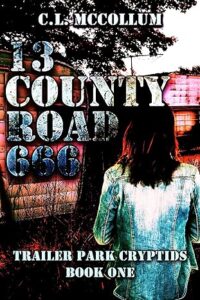
Amazon Cover
13 County Road 666 by C.L. McCollum
BOOK BLURB ON AMAZON
It’s the full moon again, and that means Melanie Smithson’s job just got a lot harder. She’s got a demon boss, a drunken werewolf tearing up the place, a long-time crush on her straight trans girl best friend, a toxic witch-with-benefits situation, and brand new interest in the aforementioned drunken werewolf.
But Mel’s relationship problems are hardly her worst problems.
A stranger appears on the property after a vicious attack by what looks like a rogue werewolf, but may be something even more sinister. Worse yet, one by one, Mel’s tenants turn up possessed and violent, forcing Mel to kill in order to protect herself and her other residents. Mel has to track down the one responsible for all the carnage before she risks losing one or more of the people she cares about.
But finding that killer may not save her from a monster much closer to home, and that confrontation may change Mel in ways she could never predict.
MY REVIEW
Full disclosure. I was on the editing team for this one, and have been talking about it ever sense – telling people to look out for it.
Being on the editing team means, basically, I got the equivalent of an ARC read. And I LOVED this book. As soon as I get discretionary income, I am going to pick a paperback for my trophy shelf … and reread it. I read it over a year ago for it (due to the length of time things take for publication) and I have been wanting to reread it ever since but couldn’t, ethically.
Let me tell you, when you want to reread a story after editing it … after seeing it at its “worst” … that is one heck of a book.
This is a FUN romp. Over 5% of all Americans live in trailers and mobile homes. In Urban Fantasy, that number would include werewolves and ghosts. Melanie Smithson, a human, has learned over time how to deal with those that live in the trailer park she manages at 13 County Road 666. But when the things that bump in the night get bumped, they expect her to keep things safe at home.

ID 103740765 | Writing © Pavel Shlykov | Dreamstime.com
A favorite new topic at conventions is how writers can create a community, build third spaces, and connect with others to help keep them growing as writers. Whether this is fallout from the isolation of COVID, the continuing reduction of the size of family and places for people to create friends, or just a natural cycle of knowledge, community and connection is on everybody’s minds.
WRITING EXERCISE: Interact with a writing community.
First off, define what you (1) NEED and what you (2) WANT from a group of people involved in writing. This could be I need to learn more about writing, I need some one to encourage me in writing (daily, on weekends), I need a critique partner. I want accountability. I want someone to talk to over coffee about writing. Remember to define the difference between what is NEEDED to feed your writing and what is WANTED to feed your happiness.
Second, if you are not now part of a writing community, define the steps to find one or create one. And how you want to interact with it. Should it be in person, or social media, or zoom?
Third, if you are part of a writing community, interact with at least one of the formats this week/today. Respond to someone’s memes. Attend a convention. Check in with Con Tinual (on Facebook – https://www.facebook.com/con.tinual.37 or YouTube https://www.youtube.com/c/continualconvention ). Go to your favorite writers on TikTok and watch a video there. Call a writing buddy out of the blue.
Fourth, if you haven’t already, set up a weekly, monthly, or daily writing contact. Record it in Outlook or some other format to remind you.
Do as little or as much of this writing exercise as you want or can. Start the building blocks of the community you need.
My attempt:
First, I needed one more interaction with people in-person to happen regularly. I looked and looked and looked for a writing community locally. The conventions were two hours away and the people who attended them were even further. My local city had nothing. I checked at book stores and the meet-up app. While I was part of a book club, and had several other book clubs I could join, I NEEDED a writing group…In-Person. I WANTED to not be the one to organize it. I’ve created groups so many times before and didn’t want to do that yet again; partly lack of energy, but partly because I don’t know when I will be pulled away from the duty for other things and I didn’t want to have others depend on me for it. I would like to be in the position to be a learner, not a teacher, bur realize at this point of my life that is unlikely.
Second, miracle of miracles, a nearby library system started a writer’s guild. It is a ten-mile forty-minute drive, lots of lights. They are mostly older folks and not really in this professionally. But they want community and so do I. It’s been three months; no one is working to friendship outside the group, but it is much, much better than nothing.
Third, for the discord group of Falstaff (give me a shout-out in the comments if you want to join), I drop a daily meme and interact with anyone doing stuff there. Once a month, I have an open-door discord where we can hang out in Discord and talk and I also host a once a month type-in where the discord is open by we are.not.talking, but writing.
Fourth, the once-a-month Discord meetings are in the Outlook for reminders.
To one of the Discord people who asked about community creating, I wrote the following:
Silent writing time in person; twined writing over the phone, discord, or zoom; non-reading brainstorming session (MUST ALTERNATE!) – describe the issue (sometimes describing the issue helps to resolve it) – maybe not even have an issue, but describe the story can help find flaws; break time once a month just to talk and support (more for extroverts) — like the Open Door Discord we have once a month here.
TIMELINE: October 1, 2025 to March 17, 2026
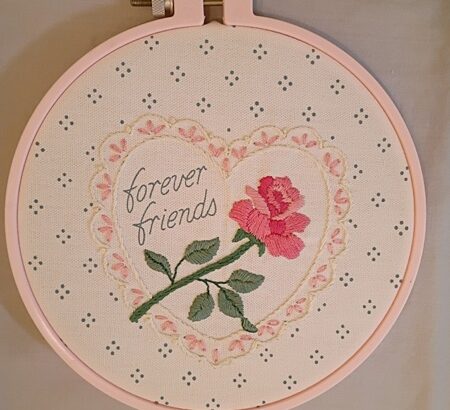
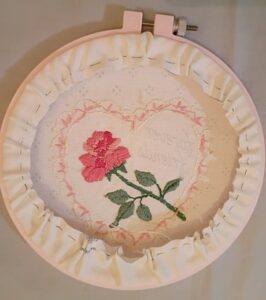
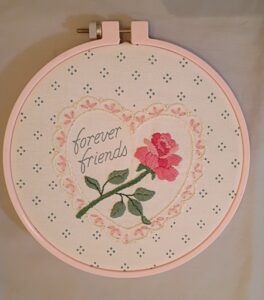
Another project from my clearing out my embroidery stash of projects and related UFOs. This time a “Forever Friends” modern crewel work project from “Learn a Craft”. I’ve never done Crewel before, and Satin Stitch is not my friend, so this will be a big learning experience for me. As this is the “meeting” project, I will not be taking regular pictures.
I have a couple Crewel embroidery projects I’ve been wanting to attempt from Crewelwork.com, but first I need to make sure I got the skills to do them before dropping bucks to import high-quality wool kits from across the ocean. (and by “a couple”, I mean nearly their entire product line.)
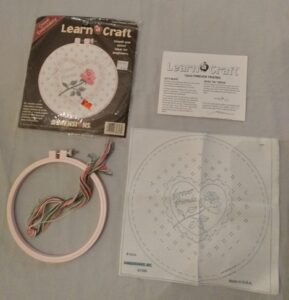
First picture is the basic materials, the instructions, the preprinted material (with a design that will not wash away), the hoop to sew in AND for the final display, and the generic cotton embroidery floss. Now true crewel work is done with wool, so this is more of a “feel like” project than an actual project. Stitches include Satin Stitch, Stem Stitch, Backstitch, Lazy Daisies, and French Knots.
10/18/2025 (Total Time 4.75) So far, I’ve been working on this project when I haven’t felt like working on more complicated projects. It has been three or four sittings for a total of 4.75 hours over the last two weeks. The rose and stem are complete – these used Satin Stitch, Stem Stitch, and Back Stitch. I am now working on the framing white heart which needs Stem Stitch again, plus French Knots. The final touch will be light pink lazy daisy. The pictures are the front, the back, and a closeup of the stitching.
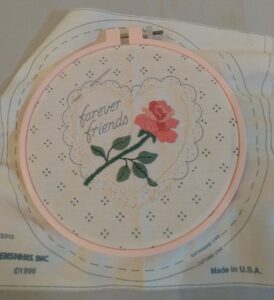
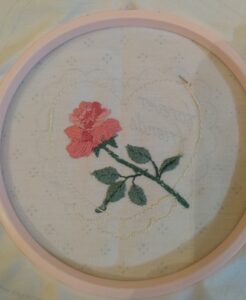
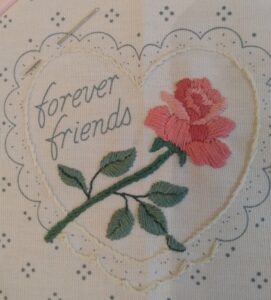
10/23/2025 (1.5 hours; overall 6.25) Lazy Daisy embroidery finished. Over the next several days, the embroidery is washed, dried, and ironed. Fray check applied to the round line marked “cut here”, then allowed to dry. Afterward the circle has been cut out. Next up is sewing the gathering circle, loading everything into the provided pink embroidery hoop, and tighten it.
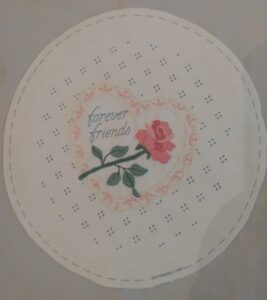
3/17/2026 (0.5 hours; overall 6.75) Life got crazy several ways at the end of October when a parent fell and broke their hip. I didn’t set for two months while helping them. Then another couple months of catchup. Now to finish some of the stuff laying about. Forever Friends got its gathering stitch at long last, placed within the hoop, and finalized.
Patrick Walsh, an editing youtuber, had DNF’ed (did not finish) a book very late in the reading process and thought that had to be strange. He sent out question to his circle of friends of “Why do you DNF a book? Where were you in the reading process?” And he found three areas of read-quitting, for three different reasons at each stage.
The first and easiest he mentions right off the bat is “no questions”. I’m sure I’ve done an editing rant on this; it is one of the easiest “thank you, no thank you” rejects I do when slush reading. Sure the book is beautifully written, you can see the word flow and the story evolving, but without a question to pull you in, the story will not sell through the present electronic selling method of – open sample and read until you MUST.PURCHASE.BOOK! No question(s), no pull into story, no drive to buy … the story isn’t making it out of slush.
Watch the full video for the other two beginning issues, the three middle DNF issues, and the three-late-in-the-book DNF choices.
These are many of the same reasons books are not picked up by publishers or agents. They are, after all, reading the book too.
“I Tracked Why 100 Readers Stopped Reading — The Results Shocked Me” by Patrick Walsh (April 2026)