Book Review: How to Write Magical Words

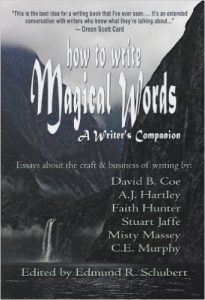
Book Cover for How to Write Magical Words

Book Cover from Amazon

BOOK BLURB ON AMAZON

How to Write Magical Words: a Writer’s Companion is a non-fictional collection of writing advice from the Magical Words blog participants.

A compilation of essays originally published on MagicalWords.net, a popular writing blog with thousands of regular followers. Distilling three years worth of helpful advice into a single, portable volume, it contains nearly 100 essays covering such wide-ranging topics as:

– Getting Started . . . Again
– Creating Characters in Small Spaces
– Storytelling Tropes: Belief
– Binding Character and Narrative: Point of View
– Word Choice and Pacing
– Metaphors, Similes, and Analogies, Oh My . . .
– Writing Action Scenes
– The Beginning of the End
– Developing Your Internal Editor
– Artistic Choices and the Market
– Business Realities for the Writer

Many of these essays are accompanied by comments and questions from the blog’s readers, along with the author’s response, making this volume unique among how-to books on any subject.

The core members of Magical Words — David B. Coe, A.J. Hartley, Faith Hunter, Stuart Jaffe, Misty Massey, C.E. Murphy, and Edmund R. Schubert — have experience writing and editing fantasy, mysteries, thrillers, romance, science fiction, non-fiction, and more. This group is uniquely qualified to cover the full spectrum of writing-related issues. How To Write Magical Words: A Writer’s Companion is a book that belongs in the library of anyone interested in the craft of writing, the business of writing, and the writing life.


MY REVIEW

How to Write Magical Words is a very good how-to writers book. But face it, there are dozen such books out there.

But not from seven different authors, each giving what works and doesn’t work for them. A tool that might work for one might not work for you – but with seven different people throwing out examples and hints, at least one set of tools will fit your needs. Faith’s metaphoric examples, David’s technical knowledge, Misty’s beginner’s enthusiasm and doubt, Edmund’s editor’s perspective … each author brings something unique to the table.

The best part for me was the Self-Editing section. As someone interested in self-publishing and not yet able to pay an editor – this is the true gem of the book. Describing crutches, and the difference between revising and copyediting, and how to revise dialogue. All gems. “BIC and Rewrite Tips” is something I am going to read through every time I complete a flirt from now on. In fact this book as a whole just became a must-read after completing each of my books and before I post it to Amazon.

(BIC means “butt in chair”)

The only issue is book covers the first 3 years of the MagicalWords.net blog – 2008 to 2011, and the section on “Business” is getting a little long in the tooth. Vanity press and POD is covered, but not the true self-publishing now available. For that you need to monitor the magicalwords.net blog and attend sci-fi/fantasy writer’s conventions such as ConCarolinas and DragonCon. The business has changed so much in the past three years and will continue to change dramatically for the near (and maybe far) future. 

(Review originally written on June 24, 2013)
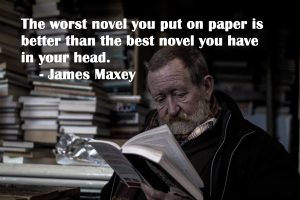
Other Cool Blogs: James Maxey January 7, 2011

Quote from James Maxey

Image courtesy of Unsplash photographer Jilbert Ebrahimi; quote from James Maxey. Combined by Erin Penn 2016.

 Somethings just hit home too perfectly. When I read this quote in James Maxey’s blog Five Writing Mantras That Bear Repeating, I had to make a picture of it to remind me the importance of writing. Because it is worth repeating. Writing requires one to write.
Go to his blog to find out his unique spin on this topic.

WRITING EXERCISE: Write 500 words today. Blog post, book review, flash, diary entry … just write something.

Creative Attribution

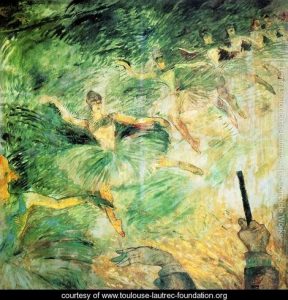
Ballet Dancers by Henri de Toulouse-Lautrec

Image courtesy of the Henri de Toulouse-Lautrec Foundation
Painting entitled: Ballet Dancers
Shared under the Creative Commons attribution

Creative Attribution. Giving credit where credit is due. You may notice, I always post where I get my pictures for my blog, even if it is from the Internet Hive Mind or Facebook posts. Creative attribution is important, not only because it is the (copyright) law, but by acknowledging the hard work of others you encourage them to continue and others to attempt.

Copyright is important. Economic and sociological studies have shown that in countries where people have their property protected from confiscation, physical or intellectual property, they are more likely to create beyond bare needs. If people don’t realize any gain from the hard work of creation, planting crops or developing software for example, they aren’t going to continue doing it. They are going to pour effort into those items where they or their family has gain, or at least meets the necessities.

At the end of the day, the priorities for people are food and shelter. If their work does not gain these items, and they have no other means of gaining them, they will switch work … or die.

A no-brainer decision.

If they have food and shelter, and leftover time beyond that, they may invest it in creative activities which don’t put food on the table. But if they have a choice between creative activities with different levels of profit, so they can get luxury items like clothing, Internet, and transportation, they will choose toward the greatest profit and personal enjoyment. For some people, like painters, the personal enjoyment comes from the activity.

By always acknowledging the personal efforts of people, and following the copyright levels they choose, you are supporting them … and they will create more cool stuff. Modern life allows a lot of free time, granting people the ability to post stuff online just to give away. Wikipedia is just one of the phenomena related to modern life’s free time.

In closing, I would like to mention posting the Creative Attribution is just good manners. Like writing a thank you note. Someone took the effort to make something you can use for free. Putting their name to it is a big thank you shout out.

Needless to say, this subject is important to me … as an painter, calligrapher, editor, writer, and embroiderer. I do a lot of free stuff I share; I also do a lot of stuff just to keep a roof over my head. Thank you for recognizing my work, for buying those things I do sell, and for sharing what I give away for free. I appreciate it. Without you, I would be doing my arts a lot less.

Editing Rant: Outline

Model Of Twisted Dna Chain Stock Photo

Image Courtesy of cuteimage at FreeDigitalPhotos.net

Why Outline?

On the days when your muse takes a day off, you can still keep going. Words on paper every day is how a book gets completed. You don’t need a detailed outline, just a line or two per chapter to do the trick. I am hoping to use my outline to get through my post-convention slump. 

In addition outlining helps with:

  1. Refining the concept – Sometimes the story is not about what you think it is about. Once you know what the important conflict is, keeping focused on the plot pacing is easier.
  2. Pacing – Essential for genres where you need to provide clues and red herrings, such as mysteries. You don’t want to give them up all at once or hold them back too long. Useful everywhere – quests (journey stages), relationship development (love at first sight still needs tension), and emotional changes (when does the first change occur, when the backslide, and the final new emotional habit develop?).
  3. Timeline pressure – Ticking clock, need to know when everything happens, and picking up the pace as the deadline approaches.
  4. Large casts – Don’t let people just disappear and keep the pivotal characters impact consistent throughout the manuscript.

And from the editing standpoint if you are under contract:

  1. Length – Get a feel for how long the book is. Over time you will know how many words are in a chapter. Do you need to add chapters to reach your word count or do you need to go on a path of destruction? An outline can help indicate which sub-plots you can remove.
  2. Synopsis – Hate synopsis? Providing one to your content editor will help them know what direction you are going.  Use the outline to figure out what is specific to the largest plot and present that.
  3. Time left to write – So that contract. It has a deadline. Just how far are you into writing that book? Your editor needs to know – YESTERDAY – if you are falling behind. … And if you are not under contract because you are a new writer, I recommend setting a personal goal to practice meeting deadlines. Many of the editors for hire have narrow windows for taking on new business; you are going to want to fit into one. (Yep, there is the editing rant as promised. Deadline, folks!!!)
  4. Pantser editing – After finishing your story, go back and outline it to help you refine how you need to edit your story. Which chapters might need moving? Where does the pacing slump? Is any chapter just an info/history dump and needs to be redistributed so it is not disruptive?

An outline is the scaffolding, the building blocks, the DNA of your story. What other things do you think an outline will help you with?