Author Spotlight: Sarah M. Anderson / Maggie Chase

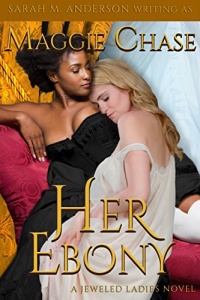
Amazon Cover

One of the marketing questions every author needs to ask when they change their primary genre, is should they go with a pen name or keep their primary name or work with somewhere in between. Sarah M. Anderson writes contemporary western romances, but wanted to create an erotica historic series set in the west. How to go about it? If she completely separates them under different names, she would need to create two web-presences, or only market one of her “people”. If she didn’t create some separation, the series where she explores MMF, FF, BDSM, and other non-Harlequin topics, some of her regular readers will feel betrayed buying the book unexpectedly. So she set up a alternate name, but provided a clear window between the two. The Maggie Chase cover indicates her primary writing name, and her website has her Maggie Chase personality under a tab.

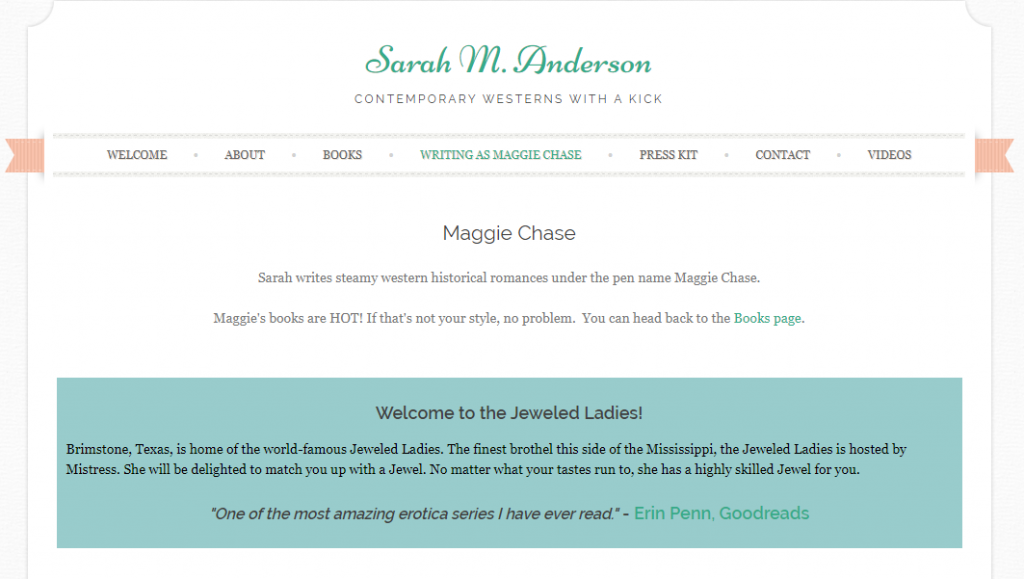
And when I went there – Good Grief! My name is there too because of my Goodread reviews of her books:
That was unexpected. I read a lot of books and review a lot of books on Goodreads – I cherry-pick from the 120 plus reviews I do in a year for the twelves I publish here. (I have over 400 reviews posted on Goodreads at this time.)

This particular quote comes from my review of His Sapphire, the BDSM book of the series.

Ms. Chase has created an amazing cast of character for her Jeweled Ladies’ series – each with different needs and wants. Each talk differently and have different goals. And – this is extremely rare – some of those goals are at cross-purposes! Usually everyone in a series are all good, likeable people in a circle of friends with similar goals. This series is set in the wild west with politicians, and freed slaves, with ladies of the night, and ancient feuds. One of the most amazing erotica series I have ever read.

If you like erotic romance and want something wild-west western, look into this series.
Writing Exercise: Tools of the Trade

Buffalo Skull Stock Photo

Image Courtesy of Witthaya Phonsawat at FreeDigitalPhotos.net

Tools of the Trade

Writers, as all occupations, need to know the tools of the trade and be skilled in their use. For a writer, knowing the language is key. Most people have a fairly solid grasp of noun and verb by finishing primary school levels; a slightly less solid grasp of pronouns, adverbs, and adjectives; and a questionable grasp on punctuation and grammar. Language includes parts of speech, punctuation, structure (like paragraphs and sentences), and more esoteric items like figures of speech.

I’m going to concentrate on figures of speech today. These can also be called rhetorical devices or stylistic devices.

figures of speech

“any expressive use of language, as a metaphor, simile, personification,or antithesis, in which words are used in other than their literal sense,or in other than their ordinary locutions, in order to suggest a picture or image or for other special effect.”
(from http://dictionary.reference.com/browse/figure+of+speech – copied Feb 26, 2015))

Painting pictures with words is what writers do; becoming skilled with the various figures of speech will hone that skill.

Examples of figures of speech: allegory, allusion, analogy, antithesis, catachreis, euphemism, hyperbole, hypocatastasis, irony, metaphor, oxymoron, paradox, personification, puns, simile, tautology, understatement.

(from http://www.myenglishpages.com/site_php_files/writing-stylistics.php#.VO877_nF-2F and http://grammar.about.com/od/rhetoricstyle/a/20figures.htm)

… the most complete list for those wanting to go to the next level is here: http://changingminds.org/techniques/language/figures_speech/figures_speech_alpha.htm

“The four fundamental operations, or categories of change, governing the formation of all figures of speech are:

  • addition (adiectio), also called repetition/expansion/superabundance
  • omission (detractio), also called subtraction/abridgement/lack
  • transposition (transmutatio), also called transferring
  • permutation (immutatio), also called switching/interchange/substitution/transmutation”

(from http://en.wikipedia.org/wiki/Figure_of_speech – copied Feb 26, 2015)

WRITING EXERCISE: Ready for this month’s challenge? Write a five sentence description of a character from your WIP (work in-progress) without any figures of speech. Then do it again using a least one figure of speech per sentence.

*****

Severance

Sheriff Severance was a little less than six foot tall. His wrinkled face had been exposed to lots of sun and had a permanent tan. His clothes were always dusty from the desert, worn and faded. The only thing on his person shiny and well-kept was his gun. Roy had never had to draw it on someone from his town. (words 60)

*****

Tall enough to make most men look up in the 1800s, Sheriff Severance was just shy of six foot. His leathered face was well-tanned from years in the sun, but new wrinkles had been carved deep on a face aged from the badge since the curse had consumed his town. Ill-fitting, worn clothes hung on him; desert dust clinging to the fabric with skeletal fingers sucking shine and color from Roy. Only his gun was in mint-condition, oiled and cleaned daily before he left the jailhouse. He never had drawn it on someone he knew and hoped like hell he never would. (102 words)

  1. “Shy” – height cannot be shy
  2. “Leathered” “tanned”
  3. “carved”
  4. “aged from the badge”
  5. “curse had consumed”

(ect.)

(first published 3/14/2015; republished in new blog format 9/27/2016)