BookQuotes: Percy Jackson and the Seas of Monsters

To the generation raised on Percy Jackson, and those who live alongside them in these times, always battle the monsters.

Bookquote from Percy Jackson and the Seas of Monsters by Rick Riordan

(By the way, my Percy Jackson Bookquotes were so popular over on my YouTube channel, I broke them out into their own playlist if you want to see them all.)

Flash: Persistence

Photo by Andre Sebastian on Unsplash

Constantly looking over her shoulder was not enough to see the one tracking her, Rani could feel it in her hollow bones. Closing her eyes and inhaling deeply, she chased her trail back.

There. Slippery.

Disguise. Masking. Camouflage.

She clawed back the concealment.

Hunting. Purposeful hunting. Specific hunting.

The creature, the being, had her scent, her spoor.

Intelligent.

Persistent.

Rani’s eyes popped open in fear.

Human.

Limited lifespan but unlimited patience. Each night it … he? She? Came closer.

Did it want her harpy feathers? A clipping from her hooves? A strand of hair?

Her life?

… Her soul?

 (words 99, first published 9/14/2022  – from a picture prompt for a Facebook writing group. Aim is about 50 words)

Flash: Bragi

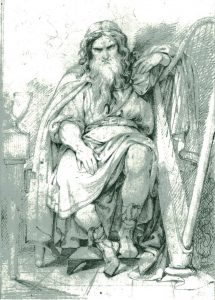
“Bragi” by Carl Wahlbom (1810-1858), Public Domain

There are those who claim the long-bearded one was just a ninth century midgard man named Bragi Boddason who traveled from hall to hall, plying gay tunes and romantic verse for an evenings meal. I say Nay, for I was blessed to hear the tales spun from the bardic god.

Twas only chance his and my paths crossed one night in a northern meadhall. He honored me with first tale after the king had waved us forward. And so I, with my merger skill, did share of news from my travels and twisted a tale about the Pennsic Wars.

Then he, Odinson and spawn of the giantess Gunnlod, did touch his hand to golden dwarven harp. Rune-shaped words fell from tattooed tongue and mesmerized with tale and song. Poetry is too mild a word for what I heard. Epic epeitath fell fire for armshiver. Warrior wept from sodden woesounds. Larksong and buoyant bells flashed forward for feastfamily festivity.

And I, not a sound could make.

My ears still rung with the runewords and yet my mind can not comprehend. Some mornings I wake hearing the harpstring, tears flowing for I will not hear it again.

Blessed are you who haven’t experienced this glory, and I fully pity you its lack.

But know you, the first thing you will hear in Valhalla’s hall after being let down by the Valkyrie maid will be Bragi’s harp for he is the Skald of Asgard. While he, for a time, did walk the earth in the guise of a midgard man, he is god born from a honeymead night.

(Words 265, first published 10/20/2019)

Flash: Saint David

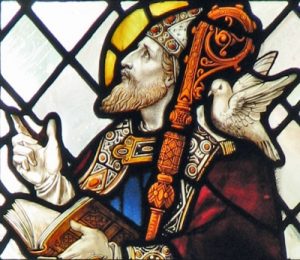
Appears multiple places on the Internet, no attribution given

One of the miracles of St. David, saint of Wales, retold in a bardic manner, meant to be performed

St. Dewi, pious and true saint of Wales, known in the English tongue as “David the Waterdrinker”, was man, monk, and missionary throughout Wales after making his right pilgrimage to Jerusalem where he was made Bishop.

During one of his missionary trips, he found himself at the Synod of Llanddewi Brefi. A large crowd gathered as he spoke, so large those in the back of the crowd asked him to speak louder. So he did, his powerful, God-blessed voice carrying and even more gathered until, again, those in the back of the crowd asked for him to speak louder. He reached within himself, drawing on his faith in the Christ, and his voice boomed. Even more gathered until, once more, those in the back of the crowd asked for him to speak louder. The Welsh Saint, feed only on water, bread and vegetable, who pulled his own plow instead of putting God’s creatures to work, looked to the heavens for help.

A dove, white and holy, flew down from the clouds and alight on the Saint’s shoulder. The ground his blessed feet stood upon started to rise and rise until a hill formed. Everyone now had a good view of the nephew of King Arthur who resumed his sermon, his voice carrying to everyone present. As more gathered, the hill would raise a bit more until finally the day and the sermon ended.

Upon the miracle hill a church was build.

As for Saint David, he continued to travel. He never again had difficulty with a crowd unable to see him or hear him speak. At home, he continued to eat only bread and vegetables, drawing his own water and pulling his own plow. Upon his deathbed he encouraged those around him to “Do the little things that you have heard and seen me do.”

Pope Callixtus II, during the 12th century, declared St. David’s Cathedral to be a place of pilgrimage. With two such pilgrimages being equal to one to Rome, and three such pilgrimages being equal to one to Jerusalem.

(words 342; first published 9/15/2019)