Book Review (SERIES): Magnus Chase and the Gods of Asgard

Amazon Cover

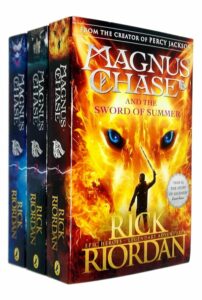
Rick Riordan has done more than just the Percy Jackson with the Greek gods of Olympus (reviewed here in 2024). There are Kane Chronicles with the Egyptian gods (reviewed here in 2025), Magnus Chase and the Norse gods (reviewed here today in 2026), and The Heroes series featuring the Roman legion and their gods (something for 2027 maybe?). Plus a ton of support material.

Now onto the Norse, and Anabelle’s dead cousin, Magnus.
Amazon Cover

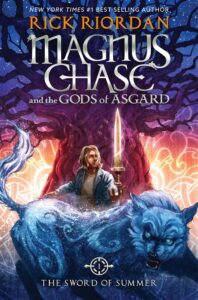
BOOK BLURB ON AMAZON for The Sword of Summer

Magnus Chase has always been a troubled kid. Since his mother’s mysterious death, he’s lived alone on the streets of Boston, surviving by his wits, keeping one step ahead of the police and the truant officers.

One day, he’s tracked down by an uncle he barely knows—a man his mother claimed was dangerous. Uncle Randolph tells him an impossible secret: Magnus is the son of a Norse god.

The Viking myths are true. The gods of Asgard are preparing for war. Trolls, giants and worse monsters are stirring for doomsday. To prevent Ragnarok, Magnus must search the Nine Worlds for a weapon that has been lost for thousands of years.

When an attack by fire giants forces him to choose between his own safety and the lives of hundreds of innocents, Magnus makes a fatal decision.
Sometimes, the only way to start a new life is to die . . .

MY REVIEW for The Sword of Summer

Magnus Chase is cousin to Annabeth Chase (yes, that Annabeth, daughter of Athena and mental powerhouse to Percy’s hurricane of loyalty). Seems like Greek gods aren’t the only ones to play the field on Midgard and the Chases have a much stronger link to the Norse pantheon than the Greek. The plus for Magnus is unlike the Greek clean-up squad for demigods, which usually start hunting the kids between 11 and 13, Magnus got a normal life until he turned 16. If by normal, the definition is your mother is killed by wolves with glowing eyes leaving you homeless at age 13 – sure.

Magnus is 16 and then he dies. A fire giant kills him in Boston; dying in battle gets him taken to Valhalla. Then things get interesting.

Magnus’ upbringing is very different from Percy (with a loving parent) or the Kanes (again, raised by loving parents or grandparents). He is a street rat; life has been hard, and then he died. Yes, he had a loving parent for his formative years, but three years on the street means he values things differently, sees interactions between people differently. He knows everyone has an angle.

The story isn’t as funny as Percy, but has strong action and forward movement which the dual narrative of the Kane Chronicles struggled with. Middlegrade silliness still exists in some of the twists on the gods, but the great one-liners and flat-out laughs of Percy are less prevalent. Still, strong action, great interpretation of mythology into something new without ignoring the old, and amazing characters. From Sam, Samirah al-Abbas, of mid-Eastern descent, a Valkyrie; to Jack the talking sword; to Hearthstone, homeless elf and rune mage – each character is unique, has a solid backstory, and have goals that work together and against the other characters.

Not the best of the Rick Riordan series but then Percy Jackson is a very high bar to hurdle. Magnus Chase book 1 is still very good.

Read through the local library.
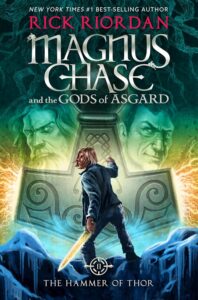
 

Amazon Cover

BOOK BLURB ON AMAZON for The Hammer of Thor

Thor’s hammer is missing again. The thunder god has a disturbing habit of misplacing his weapon–the mightiest force in the Nine Worlds. But this time the hammer isn’t just lost. It has fallen into enemy hands. If Magnus Chase and his friends can’t retrieve the hammer quickly, the mortal worlds will be defenseless against an onslaught of giants. Ragnarok will begin. The Nine Worlds will burn. Unfortunately, the only person who can broker a deal for the hammer’s return is the gods’ worst enemy, Loki–and the price he wants is very high.

MY REVIEW for The Hammer of Thor

I enjoyed this second Magnus Chase book much more than the first. Establishing a main character where dying was a step up, dragged some of the fun feels down in The Sword of Summer. The Hammer of Thor brings the connection of friendship, the snark of teenagers, and the complications of questing back to the high levels I expect of a Rick Riordan book.

Thor’s hammer is still missing, and Sam – our friendly Muslim Valkyrie – has finally tracked down a lead. From a wright’s cursed barrow to Heimdall’s bright rainbow bridge, our hero Magnus with his close friends Hearth and Bliz trace clues and quests. In the previous book we visited the dwarf underground homeworld where everything is handcrafted. This time we meet Hearthstone’s homeworld of Alfheim, a land of perpetual sunshine and even the poorest person (at least how elves define personhood) is rich. More Asgardian gods show their faces and more giants gather near Midgard borders.

New companions join them on this journey when Sam brings another child of Loki to Valhalla. Alex is crafty and killing it from the very first field exercise. Alex is also as gender bending as his/her parent.

Seeing the sibling similarities and differences between Sam and Alex is fascinating; you don’t doubt they are both Loki’s children, but also completely different people. They are as different as Hearth and Bliz’s homeworlds held in the singular worldtree.

The lore deepens. I adore how Mr. Riordan takes existing mythology and crafts a story around it. A wonderful adventurous story.
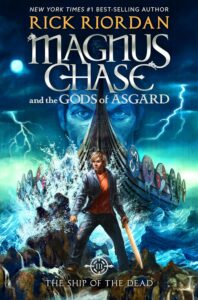
 

Amazon Cover

BOOK BLURB ON AMAZON for The Ship of the Dead

Magnus Chase, a once-homeless teen, is a resident of the Hotel Valhalla and one of Odin’s chosen warriors. As the son of Frey, the god of summer, fertility, and health, Magnus isn’t naturally inclined to fighting. But he has strong and steadfast friends, including Hearthstone the elf, Blitzen the dwarf, and Samirah the Valkyrie, and together they have achieved brave deeds, such as defeating Fenris Wolf and battling giants for Thor’s hammer, Mjolnir. Now Magnus faces his most dangerous trial yet. His cousin, Annabeth, recruits her boyfriend, Percy Jackson, to give Magnus some pointers, but will his training be enough? Loki is free from his chains. He’s readying Naglfar, the Ship of the Dead, complete with a host of giants and zombies, to sail against the Asgardian gods and begin the final battle of Ragnarok. It’s up to Magnus and his friends to stop him, but to do so they will have to sail across the oceans of Midgard, Jotunheim, and Niflheim in a desperate race to reach Naglfar before it’s ready to sail. Along the way, they will face angry sea gods, hostile giants, and an evil fire-breathing dragon. Magnus’s biggest challenge will be facing his own inner demons. Does he have what it takes to outwit the wily trickster god?

MY REVIEW for The Ship of the Dead
Magnus Chase book 3: The Ship of the Dead delivers the ending of this middle grade trilogy.
While never as humorous as Percy Jackson, Magnus Chase builds onto a universe already as deep and wide as an ocean, creating ships (banana yellow), gods (with beautiful feet), and icebergs melting along the edge of Ragnarök. Loki does Loki; Odin does motivational speaking, and Alex brings the chaos (s/he was a great addition to the series).
Great action, great mythology, great characters.
(checked out for the local library – remember to support your local library system)

Flash: Bragi

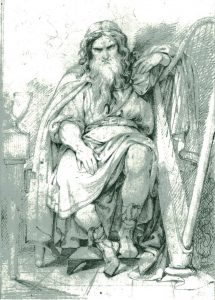
“Bragi” by Carl Wahlbom (1810-1858), Public Domain

There are those who claim the long-bearded one was just a ninth century midgard man named Bragi Boddason who traveled from hall to hall, plying gay tunes and romantic verse for an evenings meal. I say Nay, for I was blessed to hear the tales spun from the bardic god.

Twas only chance his and my paths crossed one night in a northern meadhall. He honored me with first tale after the king had waved us forward. And so I, with my merger skill, did share of news from my travels and twisted a tale about the Pennsic Wars.

Then he, Odinson and spawn of the giantess Gunnlod, did touch his hand to golden dwarven harp. Rune-shaped words fell from tattooed tongue and mesmerized with tale and song. Poetry is too mild a word for what I heard. Epic epeitath fell fire for armshiver. Warrior wept from sodden woesounds. Larksong and buoyant bells flashed forward for feastfamily festivity.

And I, not a sound could make.

My ears still rung with the runewords and yet my mind can not comprehend. Some mornings I wake hearing the harpstring, tears flowing for I will not hear it again.

Blessed are you who haven’t experienced this glory, and I fully pity you its lack.

But know you, the first thing you will hear in Valhalla’s hall after being let down by the Valkyrie maid will be Bragi’s harp for he is the Skald of Asgard. While he, for a time, did walk the earth in the guise of a midgard man, he is god born from a honeymead night.

(Words 265, first published 10/20/2019)

Geeking Science: Seed Banks and Bad-ass Scientists

By Frode Ramone from Oslo, Norway – DSCF0896.jpg,
CC BY 2.0,


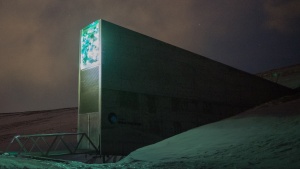
Bad-ass Viking Scientists. That’s how I think about the Svalbard Global Seed Vault and the Arctic World Archive. Norway is a culture who looks at the world dying and rebuilding as a given – and have prepped to jump start the next cycle after Ragnarok. The whole world is betting on them pulling it off.

Around the world, over 1,700 seed banks exist as a stop-gap between starvation and human stupidity – with Svalbard being the final line in the snow. At this time, 95% of humanity’s food comes from 30 crops. Monoculture agriculture at its scary finest. In case something happens like (cough) climate change (cough) making some of the food crops non-viable, humans (in an amazing feat of intelligence) have set aside historic seed for biodiversity.

Doing so wasn’t easy. Bad-ass Scientists around the world have died saving this hedge in the seed banks against humanity’s bone-headiness.  The St. Petersburg gene bank faced sure destruction during the siege of Leningrad from hungry citizens and a starving German army. The Russian scientists locked themselves in their vault, and some died waiting for the conflict to end surrounded by grain seed they could have eaten, hungry but never hungry enough to compromise their principles.

And just in case you were thinking this is all a pie-in-the-sky-someday-thing, in 2015 the first withdrawal of seed occurred. The Syria Seed Bank had been heavily damaged in a civil war and forced to be abandoned, so they asked for their wheat and barley seeds back. They had sent extra off to the Bad-ass Vikings for storage in the Doomsday Vault, as it is nicknamed. Doomsday just came a little early for them. The Bad-ass Farming Scientists then planted that defrosted seed in Lebanon’s Bekaa Valley and in Morocco – since home still wasn’t safe, and collected the seed, splitting it between their hopefully future rebuilt seed bank and the Doomsday.

Not having enough to do, the Viking Scientists decided to add a Data vault as well. They came up with data storage materials that can last 500 to 1000 years and offered their services to the world. They aren’t asking for the originals, just copies of what countries want to save. Like the golden record of Voyager.

“The data will remain searchable online … as long as the internet and servers are still functioning.” (Jones 2017)

A chilling thought, not to have the internet. But that is what Doomsday Vault is about. Against just that eventuality. Brazil and Mexico sent the first materials, Brazil from a collection of more than 300 life stories recorded between 2006 and 2016, and Mexico copies of documents dating back to the Inca period. 

addition 2019 – Since the initial deposit in 2015, other government and governmental agencies has sent in material. Such as manuscripts form the Vatican Library and the European Space Agency recording of data acquired by a 1991 satellite. (Piql 2019)

Scientists united around the world, picking up keyboards, digging holes, saving genetic material, and grinning with bloody teeth against humanity’s self-destructive tendencies and a planet who both is our mother and ready to throw the baby out with the bathwater. Geeking Science – Hear the Nerds ROAR!


Bibliography

Duggan, Jennifer. “Inside the ‘Doomsday’ Value.” Time. (undated). – Last viewed 12/2/2019.

Jones, Rhett. “Norway Gets a New Doomsday Vault That Stores Data.” Gizmodo. 2017 April 2 at 11:37 AM. https://gizmodo.com/norway-gets-a-second-doomsday-vault-that-stores-data-1793935778 – Last viewed 12/2/2019.

McCoy, Daniel. “Ragnarok.” Norse Mythology for Smart People. 2012-2019. https://norse-mythology.org/tales/ragnarok/ – Last viewed 12/2/2019.

Wikipedia. “Svalbard Global Seed Value.” (undated). https://en.wikipedia.org/wiki/Svalbard_Global_Seed_Vault – Last viewed 12/2/2019.

Addition 2019

Piql.com. “Arctic World Archive receives more world treasures.” 2019 February 21. – Last viewed 12/2/2019. (note – Piql oversees the Arctic World Archive)

Geeking Science: Space Archaeology

Leg Of Medieval Scottish Warrior Stock Photo

Image Courtesy of Serge Bertasius Photography at FreeDigitalPhotos.net

Vikings in Spppace

“Space Archaeology” (giggle). I love the juxtaposition of outer space with a science closely involved in mud and dust for the gravity-bound. 

In early 2016 Sarah Parcak used her special software imagery to discover a possible second Viking landing site in North America. You can read about it here “Did Alabama space archaeologist just help rewrite history of Vikings in North America” (written by Kelsey Stein on April 2, 2016).

You may have seen the information when it first came out. It was a big deal, especially among those interested in human history.

What really caught my attention was not the Vikings in North America, but the full implications of the software. Folks this is BIG! 

(As a computer geek, anthropology geek, science fiction geek – all types of geek – I am so geeking this geekdom!)

So let’s start with with the “special software”. Most of us are aware, at least peripherally, archaeologists have been using satellite imagery to comb the planet for digging sites. They have been limited to places with little to no vegetation – desert areas – and sites with large stone structures – pyramids and Roman stone & concrete roads.  Basically easy to spot stuff that just happens to be covered in sand. What Dr. Parcak’s software imagery processor has done is shift the paradigm.

The software goes over vegetation areas, the more the better, and looks for something “off”. Straight lines of color, geometric shapes created by differentiation in growth patterns, and other non-organic patterns in the organic materials. The areas are marked on the map and shunted over to human eyes for further review, and finally to human bodies for digging. What forms these vegetative differences? Not huge stone structures, but a dirt wall fortification, long-rotted timbers creating soil differences, and a couple hundred pound rocks moved around. Basically organic materials long claimed by the forest and jungle, but the history remains hundreds of years later because plants grown a tiny bit different in those locations.

Suddenly we can look for human history anywhere on the planet. South America, except for a few ancient stone cities, is a mystery waiting to be revealed. Africa, home of humanity, can be search for in the desert, savanna, and jungle. Huge Asia, from steppes to shore, can be explored. Egyptian and Mediterranean history move over, we are going to see if you are really the cradle of civilization. You got lucky because of the sand and stone clearly wrote your cities locations, now we may find the second-on-the-mother’s side cousin-cities you forgot to write down.

Now the real geeking maximum.

Imagine this software exploring other planets! Before we were limited to industrial markers to find aliens, figuring large roads and cities may be visible from space. But what if the sentient species hasn’t gotten beyond mud huts and stone tools. Would we even notice them before taking over their world?

The answer now is YES! We will find them even if they hide under hundred-mile tall trees.

Discovering a possible second Viking site in North America is nice. But the software which made it possible has some real legs to it; I can’t wait to see what else it does.