Other Cool Blogs: Liana Brooks June 26, 2016

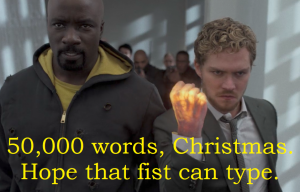
50,000 words, Christmas. Hope that fist can type.

Writing meme created by Erin Penn

The Good Guys

Way back in 2014 Liana Brooks created a National Novel Writing Month (NaNoWritMo) boot camp. When she migrated over to her new blog in 2016, the boot camp disappeared including Day 3: The Antagonist, which is perhaps the best ever explanation on how to create several levels of bad guys in a book. I contacted her, and she immediately dropped the material in her new blog, because she is awesome like that.

From her boot camp I have previously made posts about the Antagonist and Establishing a Baseline. As NaNoWritMo rears its head again, I thought to dip once more into the well of goodness and touch on Day 4: The Protagonist.

She has five exercises to help a writer define a hero. Not every manuscript needs every exercise, but someone thinking about writing a novel next month might want to try out one or two to level up their hero.

Exercise 1: Weaknesses; Exercise 2: Strengths; Exercise 3: Backstory (specific to strengths and weaknesses); Exercise 4: Personality; Exercise 5: One Thing

Of the suggested exercises, I found exercise 4 and 5 the most useful over the years. Knowing the characters Meyers-Briggs personality helps me come up with a decision-making process different from my own. Sometimes I post to my list asking for someone with the appropriate personality to contact me so I can run choices by them.

And “The One Thing” part is just pure gold. If you would like to see it, go here: http://www.lianabrooks.com/nanowrimo-boot-camp-day-4-the-protagonist/

WRITING EXERCISE: Choose one of the five Protagonist exercises suggested by Ms. Brooks, and implement it for your present Work-in-progress (WIP). If you are participating in NaNo next month, consider that your WIP.

Geeking Science: Too Smart

Image courtesy of zirconicusso at FreeDigitalPhotos.net

One of the harder things to write well is someone smarter than you. The top 2% of humanity can be as hard to decipher as a teenager – “What are you thinking? – and yet, we love to write about them. Kind-of like middle-grade and Young Adult (YA) likes to read about people one or two years above them; how do these people who have a slightly different view of the world interact with it?

So many romances feature a super-smart female who falls for the Alpha male. And Urban Fantasies love the tech-genius sidekick trope. With the added time allowing to think things out, a writer can create a portrayal of someone able to think a few steps ahead of those around them. And yet, is this how such a person will act?

Not necessarily.

Dr. Kohlenberg reposted an article from his old website on June 23, 2017: Understanding Very, Very Smart People. It’s been widely shared on educational and entertainment websites including Medium.

Some things to think about when writing the Very Smart are:

  1. The Very Smart are not allowed to talk about it. – In the age where everyone gets to talk about their neurological divergence, talking about the trials of a 140 IQ sounds like bragging instead of problem-solving like when one talks about being on the Spectrum. Thing is a mental outlier is still being a mental outlier even when it is “positive” – trying to figure out how to fit into the larger society doesn’t just happen even when one can process information faster than normal.
  2. Failure is very frustrating. – After twenty years of being the brightest, entering the job market and running into peers can be crazy intimidating. In addition, if one is in a job to push the brain limits, failure becomes real for the first time and the very smart have no experience with this. Often they start avoiding the problem and dumb down their job until failure isn’t going to happen. This is how doctorate holders flip burgers. It isn’t just because the doctorate is in Medieval English Literature.
  3. Depression is more common. – Not only because the difference of being a mental outlier, but because of seeing Too Much, the Very Smart are more prone to depression and hide it a hell of a lot better for a lot longer than most. Because it starts early. They understand more than their age indicates. While a normal eight year old just sees a sunset, a Very Smart eight year old understands the light refraction and sometimes wonders about the pollution adding to the colors. And then starts thinking about how to fix pollution and gets angry when most of their solutions are not possible at their age. Then tired and depressed the older they get when they realized they don’t have the pull to fix all the problems. By age 18, not 40.
  4. Very Smart isn’t knowing All the Things. – Especially among males (who are always more likely to be outliers in anything genetic thanks to less averaging factors in the X against Y DNA), intelligent specialization occurs. Great at Math and Music, not so hot at Social. Political genius can’t figure a checkbook or morality. Know all things Pre-Historic in flora and fauna, but don’t have time to study Current Events.

This is the most common issues seen in books and television – the Genius of Everything – hacker, history expert, and auto mechanic! If you are writing a genius, choose one specialization topic for work and one side interest per decade old.

For example, Computer Hardware Specialist – forty years old – also dabbled in medical field, brain studies, for an AI he was interested in, then again for muscles when he was into robotics. He had taken the violin middle school through college and continues to love classical music and has tickets to the symphony – and can name every Vivaldi piece within the first minute of hearing it. Recently, because of the woman he is dating, he has come to an appreciation of Roller Derby especially the architecture and crowd distribution to maximize sound and fan-fever.

Don’t do all the things. Go deep, not wide in subject matters.

Tony Stark did machines, while Bruce Banner does radiation. And Natalia Romanavoa, languages.

If you want to read the article, you can find it here: (or maybe not, it looks like it has been removed again)

WRITING EXERCISE: Review your body of work. Have you ever written about Very Smart people? How were they realistic, and how did they diverge from reality?

***

In Is the Sky Blue?, we met one of the Ranlo brothers, Eugene, for the first time. We see his failure at work, his emotional quagmire leading to depression at not being able to please his boss like he had his teachers, and his problems with his relationship with Jordan and both of them working at the mental outlier issues. By the way, Eugene is brother to Joe from the what I have nicknamed “the Joe and Cheryl Show,” and Eugene and Joe’s younger brother is mentioned in Memory of a Lifetime. Eugene is the eldest; Joe is the middle. Little bro prankster is unnamed as yet.

I really should return to this family and write out the three romances of the genius brothers and the women who have to deal with them.

Writing Exercise: Driven by Wants

Image courtesy of Theeradech Sanin at FreeDigitalPhotos.net

People don’t move out of their comfort zone unless they have a Want. Neither do characters. Maybe it’s just to get away from the pain, but in those cases, usually the character doesn’t move further than the next room – away from the pain. Close door, forget the trouble, like they are a baby who hasn’t master the permanency of object. 

To get a character to move and keep moving, they need to have a deep Want. In romances, it could be finding and then being with that special person. In Urban Fantasy, they may Want to save the world – more likely, they Want to save their favorite pizza joint who delivers, saving the world as a by-product.

If a story has stalled out, if the characters are just looking and talking and not doing much, maybe a huge glass of Want needs to be added.

Edmund Schubert went into this in the magical word post “The Importance of Wanting in Fiction”, and a huge light bulb went off in my head. Next time my story stalls out, instead of just blowing something up (which a lot of writers recommend), I’m going to see what my characters want. What is driving them. More details can be found here (and be sure to read the comments): (11/3/2023 – They have finally taken down the magicalwords.net.)

Want is also agency, or, more accurately, the ability to pursue and make choices to get what one wants. Want is very important to a character.

WRITING EXERCISE: For your current work-in-progress (WIP), write down what all the characters want by the end of the story. For a scene giving you trouble, write down what each character wants (1) in the next 10 years – their driving life plan; (2) by the end of the book – about a week out; (3) right now – by the end of the scene. Is the scene Want going to met (ending the scene) or change (also ending the scene, but now the character has a different driving Want)?

WRITING EXERCISE 2: Let’s play mad-libs for a moment. Think of a “noun”. Now a “person”. Okay, this is a person and their Want. Write a flash on it.

***

(my example added 11/15/2019) “Three” and “Editor”. 

An Editor Counts to Three

One, two … One, two … No matter how many times Janey counted, she couldn’t make it three manuscripts. She had put out a discount call on her website and Facebook. Three manuscripts would pay for her week’s bills, even if the final one was discounted by 20%. Only two would mean something would have to give.

Food most likely. She wasn’t sure about giving up dinner for a week again. Last time she started getting dizzy about Wednesday.

Maybe she should email blast her publisher friends to see if they have things, but most of them pay when the product gets published, not on delivery of an edit. Small presses suck for income; people who work for small presses are in an even bigger bind.

Nothing doing, except by the doing. Janey winged off the blast hoping against hope and sat down to complete the edits on the second manuscript. She had already sent the first one back hoping a third would come in while she worked on the first. When she started the second, she had done her “flash sale” to no effect.

Style sheet, cover sheet, and annotated manuscript number two appended to an email. Clicking sent, Janey moved to close Outlook when a ping sounded. In the lower left corner of her screen a little blurb of an incoming email flashed, “Greenman@EarthColony.US – manuscript available – Dear Janey Curtpatrick, I saw your flash sale. I have a four-book epic fantasy in need of …”

She quickly clicked on the black box before it went away and it opened to the full message. “…editing, but before I make such a large investment, I would like to meet in person and get a feel. I notice your website says you operate out of Riverside. By lucky coincidence, I flew in from the West for a conference this week. I’m available tonight at the Hilton, could you drop by? I’m sorry for any inconvenience and will pay for dinner. Would seven work? – Sincerally, Mr. John Greenman.”

A four-book epic fantasy!?! That is some serious cash. 

While she usually bumped into new clients at cons, Janey didn’t see much danger in meeting a new client at a hotel. Especially if he would feed her. Lunch had been skipped getting the last edit out. Hopefully he would be on a expense account, and she could pick up enough food to get a couple days worth of doggie bags. Even if things don’t work out for the fantasy series, and she hoped it did, she could still end up with enough food for this week.

She typed out a quick reply before rushing to get ready. (words 450, first published 11/15/2019)
Other Cool Blogs: Tor Feb/Mar 2017

Image courtesy of toonsteb at FreeDigitalPhotos.net

Costume and Story

Last year I attended a panel on costume in writing. Being one of two audience members, matching the two speakers, we had a lively round-robin discussion. (Sometimes smaller is better.) The panelists were steampunk writers; few other genres are as clothing driven as steampunk. But we ranged from the uniforms of the David Weber‘s science-fiction Manitcore Navy to the shawls of Robert Jordan‘s fantasy used to represent Ajah alliances. Clothing provides meaning, layering. World history. 

And sometimes clothing defines the character.

Tor, publisher of science fiction and fantasy, asks their authors to provide posts on occasion for their website. Sarah Gailey provided one on Storytelling through Costume. She stuck with the visual mediums of television and movies, but the ideas are sound for writing as well.

Iconic SFF Costumes: Storytelling through Costumes

The Allure of the Red Dress

The Woman in White

The Badass Black Tank Top Walks the Line 

While I am well familiar with the Red Dress and the Woman in White tropes, I hadn’t run into the Black Tank Top before. Very illuminating on finding a balance between the strong woman and the vulnerable woman, a person of competence and an object of objectification.

WRITING EXERCISE: Define a character through his or her costume.

***

In Honestly, during Chapter Four, Kassandra has the following observation of Troy:

Today, Troy had on his normal button down long sleeve shirt with collar paired with a set of slacks. Only the top button was unbuttoned, transforming a nerd look into sleek male. Was he brown all over, or did his father’s inheritance make him paler where the sun doesn’t shine? A golden yellow shirt and the forest green pants prevented her from finding out immediately. How he would tolerate what she was coming to think as his uniform once summer truly began, she had no idea. May first just past and the temperatures outside were peaking in the high eighties every day.

Troy’s formality shows through in his clothing choices, as well as the wish to hide the scars on his body and soul, but a hint of opening in his armor shows with the single button unbuttoned. As the story progresses, less of his body is covered and his clothing gets more informal but never completely informal or poorly maintained (wrinkled or torn).

Note the long clothing description did not occur until well into the story (chapter four), when the reader is committed to the story. The scene served two purposes: character development for Troy and hint at the emotional evolution of Kassandra who both admired him sexually and delved deeper into who he was as a person.

Writing Exercise: Out-Of-Alignment

Alignment by Pajamas
Acquired from the Internet Hivemind

WRITING EXERCISE: Today’s writing exercise comes in two parts. First write a scene, a hundred to two hundred words, nothing long. Should have a Point-of-View character (POV); may have other characters as well. Second, redo the scene by changing the POV character’s alignment. Define the old alignment, and then state the new alignment being attempted. Have the scene remain the same as possible, only change the motives and what the reader sees through POV character.

How does the morality/ethical code of the character change how the story unfolds? How important is the internal mindset of the POV to how the story unfolds? How hard is it for the other characters of the scene to judge the character’s intentions?

Alignments are a concept from Dungeons and Dragons and other roleplaying games. They help form a character’s personality for non-actors playing in the game. Lawful good are goody-goody while chaotic evil are psychotic. If you are not familiar with the concept or want to try something outside your comfort zone, change the basic moral code of the POV character. For example: will do anything for money; refuses to do actions to upset people; will only act in a legal manner; just don’t make me dress up; etc.

***

My Attempt – Text Flash: Dream Dancing

Chaotic Good Version

I don’t like the room, a tight classroom where the girl-woman-child-female is compressed into a desk, the tabletop pressing her knees into her body and her neck and arms constrained. The blackboard screeches as chalk writes a dozen formulas, while an overhead projector burns like the sun, flashing words slightly out of focus and too fast to read on a white board covered with half-erased scribbles. All the other children in the classroom are much smaller, middle-school age and chatting up a storm, making the sole adult at the front – a faceless being – inaudible in the din.

Slipping into the dream, I sweep all of the distractions away, expanding the desk so the woman full-grown is behind a business desk. As she relaxes, I change the scene once again so the overhead light becomes a disco ball, and the woman is at a table next to a dance floor. My hand is nut brown against her pale skin as she accepts and joins me on the dance floor. 

Her head tilts up, smiling in confidence as we dance around the dream room. My suit and her flowing gown touching only around the legs and at the wrists. Her alarm interrupts the dream just as I had been leaning down. Outside the window, behind a screen, I watch her fall back onto her pillows and scream in frustration. She isn’t alone, but this is the first night of many. (words 240)

***

Lawful Evil Version

The dream room of the woman doesn’t suit my purposes. The tight classroom twists in from all directions, compressing the female a school desk with the tabletop pressing her knees into her body and her neck and arms constrained. Across from her, the blackboard screeches as chalk writes a dozen formulas, while an overhead projector burns like the sun, flashing words slightly out of focus and too fast to read on a white board covered with half-erased scribbles. All the other children in the classroom are much smaller, middle-school age, and chatting up a storm, making the sole adult at the front – a faceless being – inaudible in the din.

Slipping into the dream, I sweep all of the distractions away, expanding the desk so the adult woman has a moment is behind a business desk, unlike her day-job but something she aspires to. Before she fully relaxes, I change the scene  again modifying the overhead light into a disco ball, and the woman sits at a table next to a dance floor. My hand is nut brown against her pale skin as she accepts and joins me on the dance floor. 

Her head tilts up, smiling in confidence as I lead her around the dream room. My suit and her flowing gown touching only around the legs and at the wrists. Her alarm interrupts the dream just as I had been leaning down. Timing is everything after all. Outside the window, behind a screen, I watch her fall back onto her pillows and scream in frustration. She isn’t alone, but this is the first night of many. (words 269)