Writing Exercise: Main Character, Protagonist, Narrator, Hero, Oh My Murderbot

ID 125627495 | Hero © Kiosea39 | Dreamstime.com

Often times people lump the Main Character, Protagonist, Narrator, and the Hero together in their head, but these parts of a story are actually all just a little bit different. I recently finished watching Murderbot Season One, and it inspired this post.

NARRATOR: As in the books, SecUnit is the Narrator in the television show. The person whose voice is telling the story. In some books, this is a generic omniscient speaker. Other times, it can be the person outside story, such as the grandfather reading the story in the Princess Bride movie. Fantasy loves telling stories from a historian’s point-of-view, writing the epic centuries after the events.

Much more often, in the present trends of storytelling, the narrator is the point-of-view (POV) character of the story as that is the POV we are seeing everything from, and whose emotional and experience lens the knowledge is being passed to the reader.

Now what caught my interest in Apple+ version of Murderbot is in order to make the story work in a television setting, the protagonist wasn’t SecUnit.

PROTAGONIST: Protagonist meaning “The Player of the first part / Chief Actor” from Ancient Greek dramas. But someone once gave me a definition to help me, as an editor, figure out who the protagonist of the story is: “The person who changes the most in the story.” This is the person the plot impacted; they changed because of the events around them.

These would be the main characters: Murderbot, Mensah, Arada, Pin-Lee, Ratthi, Bharadwaj, and Gurathin. Most of the group are the same people coming out of the story as going in; even SecUnit. Yes, it matured, but at it’s core it is still confused for purpose, a video addicted security expert, and very much a child in terms of understanding and accepting responsibility. It will grow up later; around book 3 or 4, it finally started understanding “adult” responsibilities.

The one who changed on the Apple TV version of Murderbot season one was Gurathin. He started outside the group, hurting and unsure. Jealous of the new member who Mensa had adopted as a new project. Acting out from the pain of isolation. By the end, he is still Gurathin, isolated, but instead of being just outside the circle, he is a step or two inside the community. He has let go of his jealousy, and acted to save his friend-enemy.

HERO: While many story structure analysis says the protagonist comes in three flavors: hero, anti-hero, or villain (again the one driving the story), I am going to say in this case, the hero is different. The Hero of the story is the Good Guy, the one you hope succeed, and aspire to be like. Again, this is very much not Murderbot. It likes killing. The one I would aspire to be is Mensah. She is the hero for all of them. Even for Murderbot. She isn’t its mentor, she is its favorite human. The one it goes out of its way to help succeed. The rest of the group is its humans, but Mensah is its hero.

MAIN CHARACTER: Finally, we have the Main Character (MC). In most stories, especially Urban Fantasies, the MC, narrator, protagonist, and hero are bundles into one person. In the Murderbot TV show, the narrator is clearly Murderbot. When it goes offline, we lose parts of the story. It is also, clearly, the title character. (Note that the title character is often NOT the main character.) SecUnit has the most screen time. In the case of the TV series, I would say Murderbot is the main character.

WRITING EXERCISE: Take a movie, TV show, novel, or story you are writing and figure out who is the Narrator(s), the Protagonist, the Hero, and the Main Character. Write it up on your blog and drop the link below, or just drop the results of the exercise below.

My attempt: Obviously, Murderbot AppleTV was used above. But I recently submitted a short story to an anthology. I don’t know what the final name will be, but the anthology should be coming out soon. In the superhero road-trip story,

NARRATORS: I have three point-of-view (POV) characters: Annie / Freakin’ Angel; Onyx / Fire Orb; and Vicky / (superpower name not chosen yet – nor whether she is a villain or a hero).

PROTANGONIST: The story doesn’t have one. The point of the story is a road trip. Everyone is the same at the end of the story as the beginning. The trip doesn’t change them, nor does their actions change the world. Some genres and story-plot-archetypes just break the rules that way.

HERO: Someone you want to be like, who inspires you. As this is a subsection of protagonist, we don’t have a hero/anti-hero/villain. The characters of this story are superheroes, but not necessarily heroes, not yet. That might happen in the next story.

MAIN CHARACTERS: That is the road-trip pair: Annie and Onyx / Freakin’ Angel and Fire Orb.

If you get a chance to read the novelette, be sure to drop in the comments below if you agree with my breakdown of the story.
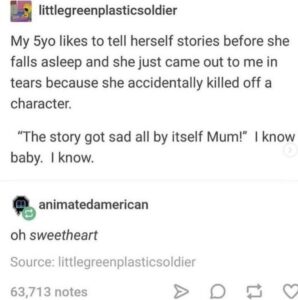
Writing Exercise: Story got Sad

Image acquired from the Internet Hive Mind 

I know last month we talked about B is for Bleed. This week could be entitled T is for Tears. Explore the emotion of grief / loss. It doesn’t have to be loss of life; there are many things devastating to lose.

WRITING EXERCISE: Create a scene where “the story got sad all by itself.” You know that story you told yourself once that went somewhere you never expected. Five hundred words or less. Good luck!

My attempt: Last month I mentioned the Ymir’s Songs duology.

Writing Exercise: The Stars of Character Development

Photo 127476676 | Astrology © Dwnld777 | Dreamstime.com (Paid for)

Creating unique characters to play off each other can be difficult. How do you make them sound different, act different, be different? I usually tap into the Sixteen Personality Types, but much of that is crouched in scientific mumbo-jumbo making it hard to access especially when you just want to pants a story. Struggling with the difference between Extrovert and Introvert when all you want to do is write a scene right now can take all the wind out of your sails.

What other groups of personality architypes are there that a writer can take and run with?

Astrology could be tapped to make each of your characters different. Just google a sign – the definitions provided are involved from romantic features to preferred jobs, how they are good and bad at relationships, familiar and romantic – from there you have the basics of a character. And since it isn’t a “scientific” thing, the websites are much more accessible and often give humorous examples. You can use the Western Signs like Pisces and Scorpio or the Eastern Signs like Dragons and Rabbits.

WRITING ASSIGNMENT: Pick two astrological signs and create a scene of 50 to 250 words. Comment below how it changed your character development.

My Attempt: When the Stars Align (12/24/2023) – I had named the first character Leo just at random, but as the scene went on, I decided to match characters to star signs. Some of the characters I named because they were already showing those traits (Virgo/Virga), and others had personality quirks driven by their astrology name (Sagittarius). I found it really helped make the characters be different people without much effort. In the future, if I think my characters are sounding or acting too much the same, I might tap into these architypes again as a character development tool.

Writing Exercise: Fancy That

Photo by Alvin Mahmudov on Unsplash

“Clothes maketh the man.” is often quoted in books and film. A bit pretentious, but also very true. They give a person confidence, or allows them to hide. Fabric can provide protection or make life dangerous.

What does it bring to the table for your character? For this writing exercise, we will be exploring what your character wears.

WRITING EXERCISE: Define what your character wears in different circumstances. Describe three different outfits – a work day outfit, nighttime attire, and a special occasion for example.

Here are some questions to think about why developing your character’s wardrobe:

  1. What is the fanciest and/or most expensive thing your character has ever worn?
  2. What are their favorite colors for clothes and do they actually look good in those colors?
  3. What do they wear around the house?
  4. Do they wash their own clothes? Do they shop for their own clothes?
  5. Would they repair their clothes or buy new? Have they ever borrowed or bought used clothes?
  6. Do they were clothing to match society? Are they cutting edge or behind?
  7. How much does their clothes costs, and how often do they upgrade them?
  8. Do they wear anything for protection?
  9. What do their shoes look like, and do they own more than one pair?
  10. Accessories are life: Watches, hair ribbons, earrings, lapel pins, rings, gun handles, hats, etc. How much accessories does your character choose?
  11. How does your character’s wardrobe look beside their friends and associates?
  12. How well can your character fight in the outfit?

SELF-CARE EXERCISE: Dress up. No particular reason, just put on a nice outfit, comb out the hair. Just be fancy.

Comment below about how either exercise helped you.

Editing Rant: Why do they love them?

Photo by Tyler Nix on Unsplash

Why?

Why would ANYONE love this person?

Let alone three different love interests?

The main POV runs over everyone. Plays the love interests against each other. Ignores what they are saying and does STUPID MC decisions just to contradict the advice of the love interests.

I get it. Really I do. Strong independent person.

But this isn’t that – this is toxic, manipulative, and unhealthy. If the love interests didn’t start of emotionally damaged, longing for this level of sadism, there is no way they would have lasted past their first encounter with their “true” love.

(Note that any gender may be applied to the romantic element – this editing rant is for an urban fantasy, but I have raised reacted this way for every genre in existence.)