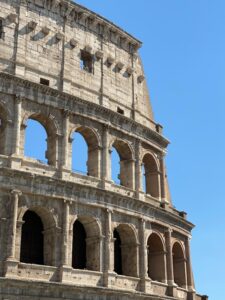
Photo by Jason Steele on Unsplash
Societies have lifespans, which is at once reassuring and terrifying. On one hand, the society you live in exists and will work to continue its existence like a determined beast. On the other, it will end, maybe not today or tomorrow, but it will end and bring chaos until a new structure is established. Establishing a stable society out of chaos takes time, maintaining one takes effort, and extending one requires adding elasticity to the system.
The older a society gets, the more rigidity sets into the system. Less flexibility means when stresses happen like climate changes, disease, or resource depletion, the society is unable to adjust quickly enough to absorb the crisis and its seismic waves crackling through the population. Size can help, spreading the issue over a wider area, or hinder, preventing resources and manpower to get where they are needed. According to a study of pre-Modern societies, the average age for a society’s survival is two-hundred years. (Kemp) Some make it three hundred, others don’t see their centennial.
Good news for America as we approach our 250th next year, our society has already undergone some deaths and rebirths by the common definitions.
Most people would immediately point to the civil war restructuring the United States of America in the 1860’s, about one hundred years after its inception, changing (somewhat) the definition of citizen and concentrating a change from agriculture to industrial base. Still, overall, the government and the daily life of citizens didn’t change much. The existing structure didn’t collapse, things continued forward as they were for the most part. Agriculture was agriculture, government remained the same, the people’s relationship with the government moved forward, and the economics continued on the same trajectory. Society didn’t shift so much as flexed within the established roles.
Bigger impact was the Great Depression seventy years later in the thirties. Climate change resulted in the dust bowl, loss of resources, famine, and disease, upending the structure of the society top-to-bottom. An economic collapse occurred. The old ways fought hard, but its concentration of wealth and resources and lack of flexibility failed too many. A new society rose out of the dust bowl and market crash creating nets to reduce poverty, environmental resources to prevent soil loss, and built a renaissance infrastructure of roads and public works. Women rights were modified, family structures started being redefined. A New Deal between citizens and government was struck. Government grew. The United States interaction with the world changed. Flexibility was incorporated into the new system.
Since the fifties, rigidity has been feeding back into the system, increasing the differences in wealth distribution and codifying expected behaviors. During the eighties and nineties, technology of computers stressed the society even as the elite of society isolated wealth distribution and created a culture of greed. As technology normalized, the stress lines became rigid cracks.
Societies cycle between flexible and rigid. For society to survive, a balance must be struck between the flexibility of chaos and the structure of law.
Back to the research related to this Geeking Science post.
Comparing two databases with different data points, each with around 300 entries on empires and established cultural states, there is a growth and then an aging time. Dynasties, tied to individuals, follow the arc in a single lifetime, maybe two – cult of personality outlast the person for so long. Cycles of population growth and urbanism fall to shocks, usually related to food supply.
Only in modern times, when the world shares its table across oceans, has food supply (so far) remained fairly steady. Previously, an earthquake, volcano, or change in el Nino could wipe out a single-country culture by preventing crops from reaching harvest. Now, between the north and south hemisphere, five continents, and nearly two hundred countries, a “small” event impacting millions can be mitigated by the billions on the planet.
Growth time for a culture is brilliant and wonderous, aging is soft and comforting. Death is predictable and, at the same time, abrupt. All the dominos are put in place, and then a stressor knocks over one, collapsing the table.
Society collapse is defined as when writing, buildings, history, education (passing down of the society) and monuments are disrupted. Communication falters
Things which make a society fail:
- Lack of food. Drought, removal of experienced farmers, poor treatment of soil until depleted, overfishing. Highly related to this category is environmental degradation.
- The Justinian plague (542 c.e.) took out communication networks. Entire cities disappeared. The Black Death (1350’s) about one third of the planet died.
- Wealth distribution imbalances. By directing resources to the very few, problems 1 (lack of food) and 2 (disease) from the artificial scarcity has the society react in the same manner as if it was just food shortage or disease. Inequality equals instability.
Before society collapses remained local. Now globalization has humanity sink or swim together.
During COVID, we swam. We swam so well – instant communication limited the spread, instant communication shared what worked medically and what didn’t, governments opened their wealth of brains to concentrate on creating a cure and then poured resources to making and distributing the cure. Everyone tracked the results, and we continue to share information about the damage (long-COVID), new strands, and effectiveness of vaccines. COVID death rate isn’t as bad as some diseases – but some of that low death is because the general health of everyone on the planet.
Getting hit by one problem, most structures do well. Society swayed under COVID, but we returned to the status quo quickly. But say, a volcano went off and blanketed the world for two years. We have a year without summer (like 1816), preventing harvests around the bread belts of the world. Countries fell and world-wide squabbles happened; half the world isn’t talking to the other half and terrorists are inserting themselves to widen the cracks. And then…COVID happened. People who are half starved, facing war. Scientists unwilling to give up locations because of terrorists. Society would have collapsed at the worst possible moment.
Societies need to work at remaining flexible so they can respond to disasters. Keeping communications open and feet on the ground around the world is a requirement in a global economy. Never forget:
“Mechanisms that destabilized past societies remain relevant today,” Sheffer says. “Indeed, perceived unfairness and scarcity exacerbated by climatic extremes may still drive discontent and violence.” (Santa Fe Institute)
The path of society collapse: something breaks the food production and distribution chain, then economic systems fail, then political ones. Once central authority cannot communicate with local people, the society functions fail. The bread portion of “bread and circuses” is the most important for maintaining a culture moving forward unmodified; food insecurity changes everything. People within the society must feel their most basic needs are met: water, food, shelter. Even if the society is producing enough of these items, if the individuals within the society do not have access to them because of the economic mechanisms used to distribute them redirect the basic needs to the elite to the exclusion of the workers, society will collapse because the workers no longer trust the culture to keep them alive.
Trust, through food and shelter, must be provided at all levels for a society to function.
All within the society must be given the right to food, water, and shelter. Otherwise the culture has failed in its duty and collapse will follow. Sometimes these problems happen through no fault of the society, such as a volcano blanketing the earth in a cloud for a year or a disease killing off a third of all farmers (like during the Black Death), but keeping a society vibrant and flexible by encouraging equality and environmental conservation will go a long way to surviving the bad times. Building infrastructure, education, and communication locally and abroad can help mitigate disaster.
Cut off polarization and corruption as quickly as possible. Direct the wealth of society to the benefit of society and the Fall of Society can be put off as long as possible. Add as much elasticity to the system as possible.
May you never live in the time of chaos.
Bibliography
Kemp, Luke and colleagues. “Why societies grow more fragile and vulnerable to collapse as time passes.” BBC. 25 April 2024. https://www.bbc.com/future/article/20240424-do-societies-civilisations-grow-old-frail-and-vulnerable-to-collapse – Last viewed 11/5/2026.
Mind Guild. “What Happens When Society Collapses: Civilizational Breakdown.” Undated. https://themindguild.com/what-happens-when-society-collapses-civilizational-breakdown/ – Last viewed 11/5/2026.
Santa Fe Institute. “Aging societies more vulnerable to collapse.” 1 December 2023. https://www.santafe.edu/news-center/news/aging-societies-more-vulnerable-collapse – Last viewed 11/5/2026.
Wikipedia. “Societal collapse.” Undated. https://en.wikipedia.org/wiki/Societal_collapse – Last viewed 11/5/2026.
