Other Cool Blogs: Magical Words – Five Senses (F is for Five)

Photo by Solstice Hannan on Unsplash

F is for Five Senses – Sight/Color, Hearing/Sound, Smell/Scent, Taste/Flavor, Touch/Texture & Temperature

I often talk “white box” writing. Drafting out a story, authors write quickly, getting dialog and thoughts on paper, moving from scene to scene until done. Then the author needs to go back and flesh out everything on the second pass – getting rid of the white box the characters are acting in.

Bringing the bigger world to life through the environment surrounding the story is one of my weaknesses. When I read novels and see all the layers people put in, I realize I must learn to do this better, integrate the action and dialog with the setting and world.

Humans have five senses to investigate the world (with some valid arguments of smell and taste being the same sense AND touch should be broken out to temperature and texture/pressure as these are reported to brain differently – but let’s stick to the five senses of school). Humans really depend on sight, so this is the go-to when expanding writing. What color things are, how bright the light is, how far can you see, what people are wearing, what is in the room. All the things the characters can see.

Hearing, the second most important sense to humans, comes second. Loud noise, soft whispers, scraps, ticks, hums, bangs. If the characters are eating, the readers might get a taste of the food – though smell is used more often.

Touch is usually only mentioned in romances. Maybe in a fight scene when being punched.

Faith Hunter did a three-blog series on using the five senses in writing during 2011. She skipped sight because everyone has a fairly good understanding on how to approach the technicolor world.

4/13/2011 – Part 1: Hearing and Sound –

4/19/2011 – Part 2: Scent and Smell –

6/1/2011 – Part 3 & 4: Taste and Touch –https://www.magicalwords.net/faith-hunter/how-to-write-description-part-3-and-4/


WRITING EXERCISE: Carry a small notebook for three days. When something hits one of your senses, record it. The voice recorder app on your phone can also work. Transcript the results to a folder used to remind you of things to keep in mind when doing the second draft. Maybe even use some of the descriptions you created in your current Work-in-Progress (WIP).

My Strategy Plan for 2022 (Making It Your Business)

Photo by Jeriden Villegas on Unsplash

For this month’s Writer’s Exercise, I discussed Ms. Klansky’s strategic plan implementation postings and then challenged people to create their own. Strategic Plans are great to have, especially if audited because you haven’t made a profit three out of five years on your tax documents. Having Plans on hand helps prove an INTENT to make money.

I wanted to do the writing exercise myself to shake things up that have slid because of the pandemic. With a strategic plan in hand, I can focus on my writing.

Mission Statement:
Create entertaining and marketable stories which show healthy relationship choices, present educational items, and challenge people to do better.

Setting Goals:
1. Increase sellable words volume.
2. Get blog up-to-date by December 2022. (Edit: According to a reasonable production amount, goal changed to March 31, 2023)
3. Produce novels regularly, setting up a successful production line by December 2022.
4. Stay healthy.

Developing Strategies (Brainstorming):
1. Increase sellable word volume

  • Write Daily – showing up / Butt in Chair (BIC); Daily word goal (worked before for about two months); Daily time goal (never worked). Prime the pump mini-stories to kick-start the day (distracting for me). Control doom scrolling and internet time – so BIC is focused properly. Ritual to set the mood and drop into writing quickly.
  • Writing day/”Date Your Writing” – A day set aside for writing or a time set aside specific to writing, like a date which cannot be superseded.

2. Blog up-to-date – Approach by doing one type of blog at a time. Or maybe a year at a time. Keep up on the now and do a couple extra daily. Figure out how much I need to do so I can figure out how to split it up.

3. Produce novels regularly – Focus on getting a series out at a time. Focus on singles because easier to complete. Is series or singles better? Outline – draft – or jump in? I’ve always thought of myself as a planner, but I seem to be working better as a pantser with the blogging. What process? Which stories?

4. Stay Healthy – Movement, Doctor appointments, keep health insurance $$$, and eating. Walk / collect litter every day; yard work, work for post office two or three days a week, buy healthy food to eat at home. Dentist and doctors visits.

Specifying Actions:
1. Increase sellable word volume

  • Write daily through one flip of the hourglass.
  • Caveats – missing one day a week is allowed.
  • Evaluation – Review monthly to see if this habit is still working for me. (Note: It has been working okay for a week now (March 2022)).

2. Get the blogs up to date. – Make December 1 to March 30 “Blog Season” to keep writing skills up during package months and tax season, but acknowledging not having the energy for bigger works.

  • During Blog Season – Write at least two blogs a day until caught up. (Edit for evaluation: Fourteen blogs weekly)
  • During Novel Season – Do three blogs a week to maintain blog so don’t fall behind
  • Evaluation – Make sure reach weekly requirements.

3. Produce novels regularly – Create two genre novels a year while working for post office and doing taxes.

  • “Novel Writing Season” – From April 1 to July 30 (novel 1); From August 1 to Nov 30 (novel 2) – four months each.
  • Tuesday is “Novel Writing Day” – All day for the novel and only the novel. Flip the hourglass at least three times. (Morning, afternoon, evening) Not allowed to schedule against it, unless moving the Novel Writing Day to another day.
  • Word goal per week for novel – 5,000 words for the first three months (65,000), fourth month is editing and cleanup. Aim on novel writing day is half the volume (2,500) and five other days of (500) each.
  • Evaluation – Daily counts, but more importantly weekly evaluation on Saturday. (Week counts will be from Sunday to Saturday).

4. Stay Healthy

  • Doctor appointments – Make and keep the four recommended doctor appointments: Eye Glasses (done in Feb); Dentist; General Doctor; Woman Doctor. Evaluation: Make one a quarter. Are they complete at the end of the year?
  • Daily exercise – On days not working for the post office, do yardwork or collect litter in the neighborhood.
    • Caveat forgive during tax season.
    • Evaluation: Reassess monthly and see if need to be redirected.
  • Healthy food – Plan weekly meals on Monday.
  • Overall Evaluation: Keep weight below 200. Happy goal would be 185 by the end of 2022.

Writing Exercise: Making It Your Business

Photo by Sharon McCutcheon on Unsplash

Writing as a Business

If you are writing for fun or passion, you can skip this post. Today, we are talking about Writing as a Business.

Mindy Klasky, a best-selling author, wrote an amazing series about “Making it Your Business” for Magical Words back in 2011 and most of it still applies. Creating a Strategic Plan helps you focus your energies on what works.

I have a great example of why it works from when I took some business courses. Most businesses know their business – so they know the direction they want to travel. But accounting works from the tradition of keeping costs as low as possible no matter what (pulling the company a little to the right); and sales knows that they need to sell, so they promise whatever will make the sale (twisting the company hard to the left); and the custodian is totally turned around and been counterproductive because his instructions on OSHA cleanup requirements haven’t been adjusted to the industry specifics of the company (a U-turn every day, erasing about two people’s worth of effort). Everyone in the hundred-person company is mostly aimed in the right direction, but a little off here and there. Lots of swerving. Basically 100 people are producing 78% of the time what the company needs. Good, but not perfect.

A Strategic Plan gets rid of the swerves. A force multiplier, each part of the company is examined and re-aimed to shoot true, straight ahead. OSHA requirements are examined for best course. Accounting doesn’t nitpick everything because they know what the company needs to create the best product possible. Sales no longer making promises outside of the company’s core business. 100% from 100 people.

Same holds true for an individual business like writing. Writing for passion gets you words. Writing with a strategic plan in place – to direct that passion gets you income. The difference is “I feel like writing something romantic today” to “I feel like writing romance today, and I know a romance anthology is looking for fairy tale spin-offs.”

Making It Your Business isn’t ignoring the muse, but harnessing it. Muses ride the writer enough, turn about is fair play.

Ms. Klansky’s Strategic Plan implementation appears in the following Magical Word postings:

  1. Mission Statement (1/20/2011) –
  2. Setting Goals (2/17/2011) –
  3. Developing Strategies (3/17/2011) –
  4. Specifying Actions (4/21/2011) –

WRITING EXERCISE: Create your Strategic Plan for either your life or for your art (writing, editing, or other creative endeavor).

My attempt

Mission Statement: Make a difference in the world by creating more stories showing healthy relationship choices, while making half the income I need to sustain my lifestyle.

Setting Goals, Developing Strategies, Specifying Actions: Wow, this is involved, but exactly what I need to shake of the pandemic paralyzation … I will need a few days to complete. I will be posting it as a 5th week blog. Link will be provided once it is up.

Writing Exercise: Spelling Games

Image acquired from the Internet Hive Mind

I text with a sister every weekday morning. She homeschools and our little exchange gives her a bit of adult-time every day while letting me stay in touch with family. At the start of February 2022, she texted: “Good morning, we are trying to do a month of spelling for Feb. and to fix our sleeping patterns.”

As a writer and reader and tax preparer in the middle of tax season, sleeping patterns suggestions would be an exercise of speculative fiction on my part so decided my goal for the month would be to send her a spelling game every day we text. This means the goal was to find or create 20 spelling games. I decided the collected materials could make a good writing exercise – how to do spelling games to help your writing and vocabulary. Many of these games are available as small electronic apps and/or have teacher materials available online.

I’ve also gave suggestions of where these can cross-topics outside of the typical “English” subject, since that is important for teaching.

Twenty Spelling Games with Variations
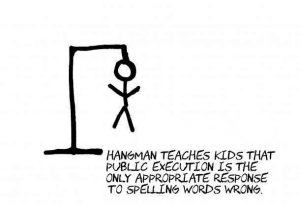
1. Hangman – (See above illustration)

2. Pictionary – a great board game for the whole family. Where art and vocabulary meet.

3. One Letter at a Time – Change a three (or more) letter words to another word, but every in-between stage also must be a word. JUG-BUG-BOG-DOG
Variations: (a) Encourage the older kids to create base start and stop for the younger kids (my sister’s kids range from kindergarten to teens). (d) Another option is option is having a middle word they must go through, like LOG. (JUG – LUG – LOG – DOG) (c) Instead of an unspecified number of steps (with the goal of as few possible between the first and last word), have a fixed number of steps like 5, 10, or 20. (5 STEPS – JUG-BUG-LUG-LOG-DOG) (d) Fourth variation, have some of the steps have letters already filled in (PREFILL – JUG – _O_ – DOG)

4. Describe This – Take an item and write down the five senses, and each person going around gets to describe one thing (since this is spelling and not just vocabulary and art related, they have to spell the word). Can’t repeat senses until all five are used. At least three times around, so they start working on harder descriptions. Helps with art because you start to really LOOK at things. Can also help with panic attacks and sensory issues as a grounding exercise. In addition, it crosses with science in observation skills and describing an object.
Variations: (a) You might have the older kids be limited to scientific words and descriptions. (b) Other ways to make it harder for the older kids, their words must have a minimum number of letters and/or syllables. Ages 0-6 can have any number; 7-10 at least two, over 10 three or more. Or whatever age breaks work. (c) As a writing, instead of head-to-head, fold the paper into quarter length-wise, write the five senses, and fill in three columns. Then flip the paper over and write a paragraph of prose (or poetry) either with a creative writing description OR a scientific description. At least half the words on the front should be used in the paragraph. The prose paragraph could also be a product review, instead of a creative writing or scientific description, like for Amazon or a Google review. Writing reviews is a growing skill set many people are developing.

Sister texted: “The kids like that game idea, since it is similar to the group stories they write.”

5. Cyphers – Cyphers are the place where math and spelling met. Toss in history because the games (in newspapers) nearly always are quotes (which is also cultural indoctrination). After introducing the concept of cyphers, at the start of each history section, have a famous quote by a person in a cypher. I was thinking they read the opening chapter – you find a quote you like and make a cypher for it. Easy ones at first, where you just move each letter one or two spots in the alphabet. I bet a lot will be online, especially since this is a standard newspaper thing in the games section. A great time to introduce cyphers is WWII and/or discussing the Indigenous codetalkers (any code can be broken, so US used codetalkers from the Native nations including Navajo, Cherokee, and Comanche).

6. Scrabble – The most obvious board games for spelling is Scrabble.

7. Subtract One / Add One / Permutations – Start with a word and subtract a letter. Make a new work – you can jumble the letters to create a new word. If the remaining letters don’t form a word, then remove another until you get a word. Less points if you skip a level (Reverse for add one). Example: meant – name – man – am – a / (alternate path) meant – tame – mat – at – a. Starting words with common letters work best – I – in – tin – thin – hints. Math can be a related subject you call the game permutations, tying the concepts to matrix and multiplication.

8. Wheel of Fortune – Board game and video game. You can create your own if you want. Teaches common letters and the importance (and difference) vowels bring to the table. Cultural training in common phrases. Looking on Amazon (in Feb 2020), there is a board game, a mobile app, and a puzzle challenge book for the Wheel of Fortune. At the website, teacherspayteacher.com there are several Wheel-of-Fortune type games for free.

9. Word Jumbles – Where all the letters are there for several words. The solve area has circles for the jumble answer. A standard newspaper challenge.

10. Foreign Roots – This is more a research game (for people who like to go down rabbit holes). Take a word that breaks normal spelling or grammar rules and find out why. Things like goose becomes geese (from Proto-Germantic), but the plural of moose is moose because moose from the Algonquian language (the Innu people of Quebec Canada). This spelling game is very much tied with History.
Variations: (a) you can focus on Latin Roots to get a strong tie-in to science, especially biology and the naming of animal species.

11. Draw the word / Spell-Draw – Tree, running, red. Make the word into a picture. Where art and spelling meet. To create these pictures, the artist must concentrate on each letter.
Variations: (a) Nouns for the younger group, and verbs and adjectives for the elders. (b) If they get a vocabulary list each week, you could have them choose one word from it to spell-draw. (c) Use this concept to introduce concrete poetry (if unfamiliar with it, search for “concrete poetry examples” in the images part of an online search). Concrete poetry can describe the thing in poem, prose, phrase, or just writing the components parts. Like a tree could be Trunk, branch, life – OR green growing tall, hard rough brown, climbing reach sit – OR I never seen a thing as lovely as a tree (writing around the outline form of a tree.

12. Crosswords – They are available for all ages, and specialize in topics like history and science.

13. Boggle – Available in board and electronic game version.

Sister texted: “We like Boggle. They put it on the tables in the waiting room at the spelling bee.”

14. Tongue Twisters – Fox in Socks (by Dr. Seuss) is a book example. The fun part will be the kids creating their own after being introduced to the traditional examples.

15. Spelling Train – The last letter of the first word is the first letter of the next word. This concentrates on the first and last letters, which is how humans read. Zebra – armadillo – octopus – songbird – dog.
Variations: (a) theme (like animals); (b) number of syllables required and/or minimum or maximum number of letters in each word; (c) at least one (or more) words from this week’s vocabulary list before the train is complete; (d) a set number of words in the train (like 100 words required)

16. Word Roundups – A matrix of letters appears in a square, the object is to find the words from a list appearing below the square of letters. The words may appear forward, backward, going up, going down, or even diagonally. Newspapers often have a theme for the challenge, and the letters remaining un-circled will be the answer to the theme. This type of puzzle really concentrates on the letters of a word.

17. Rhymes With – Concentrates on words rhyming. Start with a word and see how many words you can come up which rhyme with it. Can be fun to discover words which rhyme which don’t look the same when spelled; and words which look the same when spelled and don’t rhyme. Overlapping this game with studying Shakespeare or historical poetry, can show where changes in pronunciation have happened in language drift.

18. Bananagrams – A spelling game available for sale.

19. Overenunciation – When speaking, concentrate on saying every pronounced consonant within the word. This is a speech therapy as well as a singing exercise, and helps clean up many accents. It also helps with spelling since the speaker, when writing the word, can hear all the letters in their head. When singing (and in many accents), the end letters are dropped. “Go(d) is goo…(holding ooo).” “I lo(ooo) yoooo. You R beau-i-fu.” Better singers include the closing consonants, making the song have clearer meaning. As a game, it is fun to use this when reading songs, poetry, or even plays. “I aM GoING ouT To THe SToRe.” Be prepared for the kids to use this as a teasing method for several days after the game happens – Overenunciation is a habit which is easy to develop.

20. Head Pop – This is a word association game. Come with a stack of words – the word is read and the group has to come up with an immediate response … and spell it. Apple – Red. Mouse – Cheese. You can have each child take a turn reading them with all responding or have each child respond in turn. The challenge is the words popping into the head might not be the easiest to spell – usually they are simpler words during quick association, but not always.
Variations: (a) Synonym – the word has to mean the same somehow. Apple – Fruit, would work, but Red would not. (b) Antonym – opposite meaning. Mouse – Elephant.

WRITING EXERCISE: Play a spelling or vocabulary game today. You can choose one of the above, hit the word puzzle section of the newspaper, or play a word app on your phone. Comment below on what game you played, and if you learned anything new playing it.

Writing Exercise: Rocking Your World Foundation

I ranted earlier this month about a shifter story where the shifter didn’t shift. Ending tagline was “Don’t do shifting sands. Rock your world foundation.”

Today’s writing exercise explores how different types of paranormals may adjust a scene. Break out of the boringly normal cycle where the generic “paranormal” plays out, where a vampire could be replaced by a mermaid without affecting the plot.

WRITING EXERCISE: Create a short scene with one paranormal character among normals. Any type of paranormal (vampire, witch, gargoyle, brownie, etc) in any type of scene (getting on a bus, checking out at a cashier, ordering a meal, moving to a new school, etc.). Aim for about 500 words.

PART TWO: Now rewrite the scene, but change the paranormal to a different type of paranormal. Vampire for genie, zombie for dwarf, good witch for dark necromancer, demon for shifter.

REVIEW: Once done, review the two scenes. What changes did you need to make for the different types of paranormal. Did the night scene need to become day? Did concentrating of the sounds of living from the hungry zombie become concentrating of the scenes for the shifter nose? Were quick demon tempers switched to fairy flitting and teasing? Add a comment below of what you discovered in Rocking Your World Foundation. If you want, include a link to the two flash scenes you created.

***

My attempt – Review

I started from this month’s flash of Prepping a Meal (1/9/2022) and switched the vampire for a zombie (the flash is below). The biggest changes were related to the social status normally associated with the vampires and zombies. Both of the climate-conscious monsters (because if you live a long time, keeping the human food-stock healthy is important) had electric cars, but the vampire has a Lotus Evija (costing more than $2 million) while the zombie has a used Toyota Prius (costing him much less). While both monsters used cash payments, the vampire splurged for wine, appetizer, and a dessert where the zombie struggled to pay for pizza for the woman he was escorting. Clothing differed with the zombie’s clothes deteriorating and the vampire’s tailored-made.

Another change involved the mystique surrounding the monsters. Vampires have a shiver sexy-terror, while zombies are associated with end-of-the-world depressive gut-terror. The vampire remained polite and cosmopolitan. The zombie threatened some and his conversation was simpler. Mild flirting occurred with one but not the other.

Final change was what was driving the women to be escorted as meals to the monsters, oops, I guess that should read “for meals with the monsters”? Nah. You know what is gonna happen in the next scene of these stories, right? Both women have a history of dead-end jobs, are on the heavier side of weight, and love their pizza. But for the scene to work, I had to change the motivation.

The action-arc of the scene remained the same: arrival, ordering, eating, and leaving to the next location. In neither case did the undead do undead things, but by the end of each flash you know exactly what is about to happen. As these are just quick (about) 500 word flashes, readers can be expected to fill in the genre troupes and does so. (The rant about shiftless-shifters involved a full-length novel, which should be long enough to do all-the-things.)

Could I change out another paranormal monster for the vampire or zombie in the stories? Not without other major twists in the plot and character. The motivation for both the monster and the meal-woman would need to change even more. Could a shifter work here? No. A random monster could not just switch out with either of these men.

Remember “Don’t do shifting sands. Rock your world foundation.”

***

Flash Title: Prepping a Meal (Zombie Version)

“Are you sure?” I ask a final time as the battered electric Prius buzzed into a parking space, waving my hand at the neon lights of the chosen restaurant. “Italian?”

My zombie date. Well, more like warden, smirks. “Your bio said you could eat pizza every day. We thought you might like it for tonight.”

Making my way to the paper-covered door proclaiming the daily specials, I feel Jacob’s dark eyes blackened further as they focus on my ass in my overtight jeans. I forcefully suppress the shiver rolling through my belly and along my spine, refusing to consider if it is fear or anticipation.

I’ve been hoping for years to accomplish what will happen tonight and only recently had the energy to carry through with a workable plan. Thank you Doc Woods for those happy pills, I think toward the northern part of the city where Health and Human Services has its clinics.

“I wasn’t lying.” I say once we were inside the pizzeria, my eyes darting to the other patrons. “This will be great.”

“No talking to others,” he said growled, his eyes roaming from my eyes to my t-shirt, also several sizes too small. I’ve packed on some pounds doing the Netflix and chill thing after work this year, only my version of the chill part being a pint of ice cream most nights huddled in my bedroom behind locked doors with the earphone on.

“Of course.” I wasn’t looking to escape. It took me forever to find this situation, and I didn’t want to lose this opportunity.

A waitress waves us toward a small table with a red and white checkerboard vinyl table. I glance over the paper placemat menu, while Jacob orders me a soda when the waitress returns to drop a bread basket with oils in front of us. She raises an eyebrow at his shoddy appearance but doesn’t say anything. Though he was the youngest of the zombies I met tonight, he still lacks the freshness of the living. He had to have been buried in his best suit like most people, but sometime since then he changed out to a worn t-shirt and jeans. They hung much looser on him than mine did on me.

“Can you stuff a large in that chubby stomach of yours?”

I reach down to pop the top button of my jeans. I’m going to ache, but it’s not like I’m worried about nightmares in my sleep tonight because I climbed into bed stuffed to the gills. “Sure. I didn’t get chubby by dieting.”

“Good, good.” He takes out the bills his group had shoved at him.

I watch him struggle to count them and put them in some sort of order. Jacob’s fine motor control was lacking and I’m fairly sure the poor math skill existed before his change. Exasperated, I grab the paper and get the money in order. I had done it enough in my dead-end jobs all my life.

Once my soda arrives, I place my order for a large supreme pizza, plus a dessert. I’m going to go out with chocolate on my lips. And there would still be enough to cover taxes and a decent, but not great tip. He doesn’t argue. In fact, he just sits with the unmoving weirdness of the dead while I sip my soda and break apart the bread sticks. I mix the oil and vinegar just right and savor the warm bread. Closing my eyes, I let the yeasty bread, sour vinegar, and rich oil transport me to somewhere else. Someplace without pain and yelling and loneliness. The food is gone before I reach that place, like always. So close and always so far.

When the pizza, smelling of grease, and melted cheese, and hot pepperoni, and tangy tomato, hits the table, my eyes focused on it and I inhale deeply.

“Does it smell good?”

For a moment, I had forgotten about my escort. I look up to find his eyes gazing at the pizza with longing. Not the bottomless hungry like when he looked at me but a melancholy wistfulness.

“Yes, like a piece of heaven.”

“Tell me about it.”

So I do. From the first napalm bite of too hot cheese, to the last slice cool and congealed. In between we talk. He tells me of his memories, what it is like to be owned by a necromancer, but skirts around why we are here together tonight. Somehow he keeps focused on me-me, instead of body-me, and that is nice.

As suicides go, I think this one is a keeper.

Eventually the only thing left is a few chocolate crumbs from my brownie and the full refill on my drink.

“Are you ready?” he holds up a small cloth packet as I stack the money on the receipt.

I nod, pushing the red plastic glass at him. He dumps the potion in and I stir it a couple times before sucking it down quickly. Doesn’t taste bad. Actually the more I drink, the more I want to drink.

By the time I’m done chugging, I have a head rush. I let Jacob help me stagger out of the restaurant and back to the car. Last chance to run, I think as I collapse on the passenger side smiling. No need to run ever again.

(words 881, first published 1/25/22)

Series – No Regrets, All Dead

  1. Prepping a Meal (Zombie Version) – Link to 1/25/2022
  2. You Have Mail – Link to 2/6/2022
  3. Naked Truth – Link to 2/20/2022