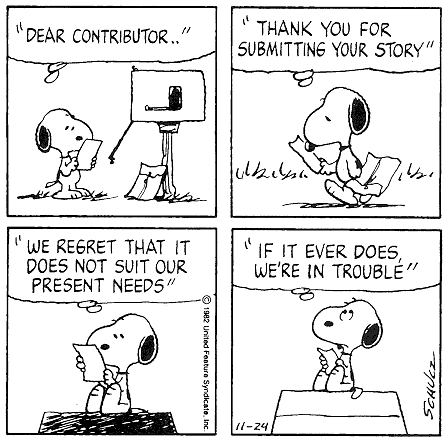
Image acquired from (multiple) Facebook postings
Published November 24, 1982 – Peanuts by Charles M. Schulz
Peanuts comics can be found here: http://www.peanuts.com/
(I could not find link to original strip on the website.)

Image courtesy of Stuart Miles at FreeDigitalPhotos.net
Authorship is a solitary task, except when it isn’t.
This makes for a dichotomy of skill sets – one, the ability to spend hours and hours alone with the voices in your head, and the other, hours and hours in the middle of the crowded floors of conventions networking with fans and associates. For many introverted writers, the second skill set a work in (non)progress in desperate need of development.
Being around others is uncomfortable. For some writers, it is shyness. For others, fear of people finding out their hacks (not that the author is a hack, just one of the voices in their head says they are – Note, not all the voices in authors’ heads are marketable characters. They have all the normal voices people have (good and bad) PLUS potential books). In my case, I hate to be a bother.
So how can one overcome the discomfort? Faith Hunter suggests an excellent path – write your way out of it!
See the full post here: http://www.magicalwords.net/faith-hunter/part-twodifferent-subject/

Image courtesy of tawatchai at FreeDigitalPhotos.net
All I want for Christmas is no more Mary Sue manuscripts. The outpouring has been strong.
A character loved by her family, has to leave them through no fault of her own, immediately loved by the new people. Perfect in every way, but tragically sick (hence the leaving). Named after the author writing the original fiction story. A slush read rejected.
A character physics major in college, had Asperger as a child but now can go to loud parties and drinks, superpower of knowing exactly how much time has passed. Bad with words, yet gets his girl the freshman year. Freshman, yet intern to an internationally famous physicists. Skinny, yet can climb easily and run everywhere. Superpower of everything has gone right about him when he needs it to. Superpower of time travel – note only the last superpower is presented as superpower. This Gary Stu has hooked up with her perfect girl Mary Sue, tragically sick, amazing beautiful, time travel lock to help him meet his destiny. A book initially intending for pleasure reading and the inspiration for this post.
What is a Mary Sue? The term originally came from fanfic where a writer would insert an idealized version of herself into the story. We’ve all done it in daydreams, entering Twilight, Star Wars, Supernatural, and the characters fall in love with the perfect us. The problem occurs when writing out these personal fantasies and sharing them with others without adding rough edges to the idealization. Gary Stu is the male version.
The term has spread out from fandom to other formats. You know a Mary Sue/Gary Stu when you see them. Perfect people, beautiful, athletic, everyone loves them and the hottest person of appropriate gender falls in love with them at sight. They are perfectly smart, easily solving issues, never say a bad word about anyone. They are avatars of everything good wrapped up in a sentient being.
You’ve met them and hated them in visual mediums, Wesley Crusher (Star Trek: Next Generation) and Bella Swan (Twilight) being the standout examples. You’ve met them and loved them, James Bond and Nancy Drew pops into the head. If you are a writer, some of your earliest works have them. If you ever roleplayed in a Monty Hall campaign, you’ve rolled dice for some.
Some writers try to sneak by a Mary Sue/Gary Stu as a “poor puppy” with a tragic past being their flaw. Other try to pass them as an “everyman” (then reveal a thousand-year old line of wizards, or uber-fighting skill, or amazing intelligence) – one example which stuck with me is the “ordinary accountant” over six foot tall, able to throw around a werewolf, sniper level ability to guns, speaks multiple languages, and two black belts (Monster Hunter International by Larry Correia – get the preview through amazon for a taste; not going to do a link for this one, it’s on you).
It’s easy to make a Mary Sue as a writer. You just love your main character a little too much and stop torturing them and instead give them unicorns and rainbows. This downfall gets easier to avoid the longer you write; sitting in a chair forcing yourself to write every.single.day inspires you to pass on the torture. I highly recommend reading the TV tropes article listed below for learning about how Mary Sue characters evolve in writing: the poorly written character, the cliched character, the author avatar, the idealized character, the power fantasy, and the infallible character.
The biggest obstacle to prevention of Mary Sues/Gary Stus is writing a marketable manuscript often requires a likable protagonist facing amazing odds and overcoming them. Mary Sue originated from people putting themselves in a narrative, yet that is exactly what we want our readers to do: identify with the main character on some level and insert themselves into the narrative. We need the MC to be likable, even lovable, to have powers. In short, every likable protagonist is related to Mary Sue on some level.
The talisman against Mary Sues is “show don’t tell”. Don’t tell me she is lovable, show me why she is lovable. If it makes you sick showing every kitten in a tree rescue, likely you got a Mary Sue. Don’t have the gal fall immediately for the Gary Stu, show why she is attracted and moves into the male’s orbit. Why do the powers exist, given or earned? Show me.
The amulet against Gary Stu is “too much of a good thing”. List all the defining characteristics of the protagonist. If somewhere in the list you start going, “I don’t believe this character” likely your readers won’t either. Cut some of them back. Share them with the supporting characters. Look at the challenge facing the character in the plot and REMOVE the easy solution from his abilities.
Mary Sue and Gary Stu have their place. We love to love our characters, but don’t make the main characters avatars of perfection. Please. Do you think I can get my Christmas wish? I’m off to check under the slush pile.
Bibliography
“Is your character a Mary Sue?” – GoToQuiz, https://www.gotoquiz.com/is_your_character_a_mary_sue_2 (last viewed 12/6/2017)
“Mary Sue” – TV Tropes, https://tvtropes.org/pmwiki/pmwiki.php/Main/MarySue (last viewed 12/6/2017)
“Mary Sue 101: How to Spot Her and How to STAY AWAY” – fanpop, https://www.fanpop.com/clubs/writing/articles/4391/title/mary-sue-101-how-spot-how-stay-away (last viewed 12/6/2017)
Reddit discussion “Famous Mary Sue Examples” – https://www.reddit.com/r/writing/comments/3rgk3b/famous_mary_sue_examples/#bottom-comments (last viewed 12/6/2017)
“Who are the most notable ‘Mary Sue’ characters in books and literature” by Monika Kothari – Quora – https://www.quora.com/Who-are-the-most-notable-Mary-Sue-characters-in-books-and-literature (last viewed 12/6/2017)

Created by fantasy author Althea Kontis. Used with permission.
Visit her website at: altheakontis.com (on 4/28/2024 the website wasn’t working)

Image courtesy of FreeDigitalPhotos.net
Chapter Breaks – Stepping Stones in a Story
“Why Divide Your Book Into Chapters?” was asked of the Magical Word crew in 2009, and David B. Coe responded giving insight into how books are structured.
The most direct answer is seeing all those words strung together without any breaks exhausts a reader before they even start.
The working answer is writers get exhausted thinking about writing all those words at once. For plotters, outlines and chapters can walk hand-in-hand.
The more subtle answer is dividing the work up provides clues and prompts to a reader’s mind which can be exploited by authors.
Breaking down the basics from the post:
If you would like to read the full post and related comments, go here: http://www.magicalwords.net/david-b-coe/why-divide-your-book-into-chapters/