
Image acquired from the Internet Hive Mind
Image acquired from the Internet Hive Mind

Photo by Gun Kimm on Unsplash
On a starship, an engineer reports over the comm to the bridge. “Captain, we have a problem.” “What is it, Tools?” “I can’t describe, come down here.”
Really, what the ever-loving frig? The captain is on the bridge, that is where she should be, the center of command, gathering information from all parts of the ship. So she should drop everything and head to a DANGEROUS area by herself to eyewitness something the EXPERT in the matter cannot deal with? Every.sci-fi-TV.show.e.v.e.r.
Fantasy. Romance. Every single genre has the “no time to explain, just follow me.” Like parents telling children, “don’t ask questions, just do what I tell you.”
Misty Massey wrote a full blog (with the related responses from experienced published authors) on the subject for Magical Words on 10/18/2011 called “Blind Trust.”
I’m totally with her on this on how LAZY and UNREAL the lack of explanations is. – the URL http://www.magicalwords.net/misty-massey/blind-trust/
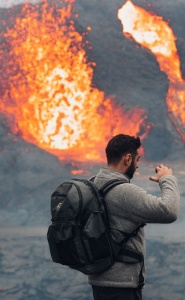
Photo by Eriks Cistovs on Unsplash
Do you have a Bug-Out Bag for when disaster strikes? Or a “stay-in-place” for three days – the things in the backpack are the same either way usually.
My area is hurricane season (June to November with the focus August to October). Further North could be a snow or ice event. Out West fires. Recently for Hawaii, volcanoes. Also on the list are man-made issues with nuclear plants and riots. Recently in North Carolina, some eejit decided to disable the electric grid for Moore County by shooting it up right before a cold snap in early December, leaving forty-five thousand people without power for nearly a week in border-line freezing temperatures. Christmas shopping was shelved for survival spending – the entire county businesses had a devastating hit right before their biggest money making of the year, and all those people expecting overtime instead scrambled to find a shelter not filled to capacity.
Anyway, Liana Brooks put together a basic checklist for a 72-Hour Kit (basically the three days it takes relief organizations to mobilize). Whether shelter-in-place or getting the heck-out-of-Dodge, X-scape is the key (okay, not the perfect X for A-to-Z, but still important).
“72-Hour Checklist” by Liana Brooks (9/11/2018) – (spelled out URL: http://www.lianabrooks.com/72-hour-checklist/?fbclid=IwAR3aoCd6fjz3n29BWrJwv65oTBEQRluS3Wpvs3BOkgRiZhEk5VQrH6zkhL4) – Last viewed 12/13/2022 – note that the site is HTTP, not HTTPS (secure).)
Other helpful sites and lists:
(Bug Out Bag Builder . com)
WRITING EXERCISE: Okay, not really writing this time, but still essential. Make your WUSH kit (Wake Up, Stuff’s Happening) for by your bed. As a writer, I really like the suggestion by the Bug Out Bag Builder to keep your USB backup drive there. Yes, I will still be freaked out about losing my computer to a fire, but I won’t have lost everything.
This is the minimal kit – just grab and go to escape a fire or other house disaster. Store it by your night stand or under the bed, so you can wake and get outside in seconds. This go-bag is small; it should sling over the shoulder like a purse to keep the arms free to grab the children and pets.
May you never need it and may you have it if you do need it.
A) Wallet and Cell Phone – either store them in the bag at night or set things up so they are easily sweep into the bag in an emergency. Store an extra phone charger for your phone in the bag.
B) Keys – one for the house and one for the car. These are the extra keys and should live in the bag. Don’t waste time looking for keys – these should be there.
C) USB backup drive – As a writer/creative, you should be backing up your computer at least monthly. Store the backup in the WUSH bag. Digital copies of the following should be in a fire: Driver’s License, Passport, Marriage License and Birth Certificates, Social Security Cards, Deed for House and Car, Insurance Polices for House and Car, Health insurance info, Credit cards (front and back – so you can call the issuer if they get destroyed).
Bonus storage for family photos, phone numbers (in case the phone is lost), and other things you don’t want to live without.
(Set a calendar alert on your phone or computer to remind you to backup the computer once a month.)
Store the backup drive in a ziplock bag in case of wet.
D) Physical copies of: Passport (if you don’t carry it daily), Marriage License and Birth Certificates, Social Security Cards, Deed for House and Car, Insurance Polices for House and Car, Health Insurance info, Physical print off of copies of both sides credit cards and driver’s license (so you don’t have to find a computer for the USB backup), blank checks (if you have them), printoff of phone numbers and addresses of family, friends, and neighbors emergency contacts.
Plus some extra cash. A mix of small and large bills, enough to get a single meal and pay for overnight stay in a hotel.
E) Medications and prescription glasses – Remember to rotate the prescription medications. Keep three days in the WUSH bag, the full bug-out kit should have another four days for a total of seven days between them. For the glasses, when you get a new pair, the old pair goes in the bag. They won’t be the best, but at least the old glasses are better than nothing.
F) Flashlight – because 50% of the time, disaster will strike during night hours.
G) Food – Just one or two snack bars, especially if you have kids. Not much though, so you don’t attract ants to your bedroom.
H) Small first aid kit – a couple Band-Aids, nail clippers, and some tweezers will do. One mensuration pad (doubles as a big bandage). Don’t go nuts, this is a small kit.
Now that you have the WUSH, set aside time to put together a full go-bag as well. Remember to rotate stock in both regularly – maybe set a calendar reminder like that USB backup.
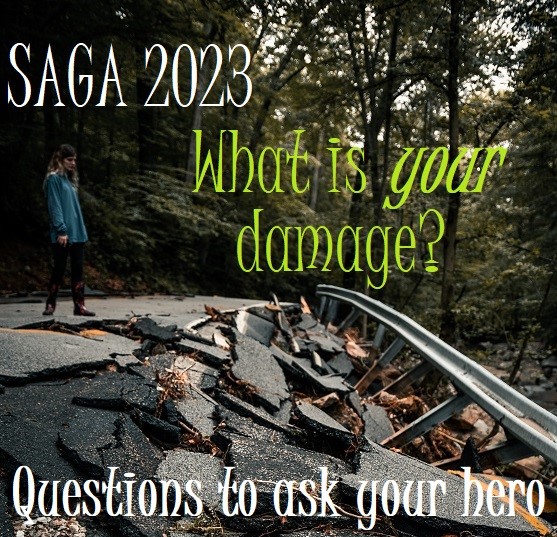
Meme created by Erin Penn
Today is the last of the SAGA Professional Writer’s Conference memes. If any of them sparked interest in SAGA, you can find out more about the annual conference at: sagaconference.com. The next one is scheduled for Winston-Salem in July 2024.
The full list is:
1. Enter Late, Leave Early
2. Give Your Characters Trouble
3. Better Verbs Make Better Writing
4. Everything you want is on the other side of fear
5. What’s Your Damage?
These were supported by other memes I’ve made: Don’t walk through doors; You are my Favorite character, I’m going to hurt you the most; Write with Style; Don’t get it right, get it written; The secret to writing fiction is always tell the truth.
What’s your damage? is a question you need to ask your hero. What is the shard of glass, the dagger in their belly, that makes them make wrong, or at least less than optimal, decisions? What makes them not perfect?
The damage which makes a person depend only on themselves, so doesn’t ask for help even when they should, because as a child they couldn’t trust their parents. The damage of a trick knee, so they can’t run, but they insist on coming to fight the monster anyway.
In Honestly, my hero has injuries making him weaker than pictures himself, and my heroine is still living with her last (ex-) relationship in her head. I really should have played with their damages a bit more, but the novelette is my first completed work. I learned a lot writing it.
You might not need to ask the point-of-view character What’s Your Damage until the first draft is done. Then you go back and hone the story, sprinkling the emotional journey throughout. Do they learn something that will heal their Damage? Do they learn a workaround to bandage the Damage for now?
The Damage is important. It makes the hero not-perfect. It makes them real. The Damage is what makes a story of Dragons and Wizards, of Spaceships and Blasters, of Love-at-first-sight and Billionaire-loving-Waitresses real. Damage pulls genre into reality.

Meme created by Erin Penn

Photo by João Marinho on Unsplash
Find your voice. In writing, in singing, in the world. Candence, rhythm, volume, smoothness, word choices – these are your own and no one else’s. Claim them.
Your Voice might change between blog posts and novels, talking to adults in a professional environment and children on the playground, singing blues or rock. But still, at the core, it’s your Voice.
It takes time to find your Voice. Understanding. Writing a lot of words or singing a lot of different songs. My voice has children and playfulness, short phrases haphazardly put together, and then weird asides of scientific thought.
If when people say, “I heard you read when I read your novel.” your speaking and writing voice are the same and it’s coming through (yay!). But sometimes the speaking and writing voice are completely different. As is genre changing things up and your different characters might have different personal voices (wait, no MIGHT – they SHOULD have different voices).
Kalayna Price has a wonderful blog posting “On Voice and Timing” in Magical Words (10/1/2011). URL: http://www.magicalwords.net/kalayna-price/on-voice-and-timing/
WRITING EXERCISE: Think about your writing voice and write down what you know about it. Is it short and sweet or long and detailed? Political or fluffy or introspective or…? What writing strengths do you have – dialog, action, characters, etc.?
Now, write one paragraph with a voice aimed at Fantasy (your choice of Urban, High, Sword & Sorcery, etc.) and a second one for “real life” type genres (Murder Mystery, Thriller, Horror Contemporary, Disaster, Romance Contemporary, etc.). Have the scenes in the paragraph be similar number of characters and situation. How did the Genre Voice change the paragraph … and what things remained the same between the two scenes that could be your underlying voice and how does that match up to your initial thoughts about your voice?