It’s been a while since I made a meme:
It’s been a while since I made a meme:
 Photo by Bogdan Farca on Unsplash
NaNoWriMo is looming its 50K word head again. Last year I Frankensteined it, stitching together several projects including getting this blog prepared for 2024. It has held me in good stead not to worry about creating things on the regular and I’ve been able to concentrate on longer works throughout the year.
One of the cool things about the NaNoWriMo team is their constant support of writing throughout the year at their blog “The NaNoWriMo Blog”. (okay, not the most original name, but it is easy to remember.)
A great post is “Write Meow! 4 Writing Tips Cats Teach Us” written by Megan Jenkins posted October 30, 2023. (https://blog.nanowrimo.org/post/732643913309011968/write-meow-4-writing-tips-cats-teach-us?utm_medium=email&utm_campaign=NaNo%2023%20Engagement%201&utm_content=NaNo%2023%20Engagement%201+CID_caf0cfb6a1acca00b6c60815d98e4e90&utm_source=Email%20marketing%20software&utm_term=Write%20Meow%204%20Writing%20Tips%20Cats%20Teach%20Us)
Your cat wishes you luck, though they will never admit it.

Image acquired from the Internet Hive Mind
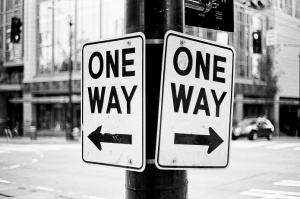
Photo by Ian Taylor on Unsplash
What path does a book follow? Is it one step after another, haphazardly finding its way to an conclusion, or is it driven down the inevitable street until it reaches the only ending possible?
Carrie Ryan write about plotting using “therefore” and “but” rather than “and then” in her Magical Words post from August 22, 2012, “Therefore”. The post gives a method to plot more strongly.
If you line up every scene or plot beat in your book, and the only words that connect them are “and then,” you have a problem; instead, each scene needs to be connected with either “therefore” or “but.”
Put simply, your book should go something like: “A therefore B therefore C but D therefore E but F.” Rather than “A and then B and then C and then D…”
It sounds easy, but the point is to make things flow because they connect. The difference between all the cars on a road going the same direction, and a train with interconnected carts. If you disconnect a train, things fall apart. On the road, a car could take an exit and you might never notice it is now missing from the story.
Boy meets girl. (and then) Girl flirts with boy. (and then) Boy and girl argue. (and then) Boy and girl make up.
We all have read this story. But how about…
Boy meet girl. But girl flirts with best friend. Therefore boy and best friend argue. But girl doesn’t want to come between them and leave. Therefore the males must talk things out. Meanwhile, girl runs into trouble outside and screams. Therefore both males run outside to rescue her. …
Now every scene escalates. The energy moves.
Ms. Ryan does mention
“Yeah, but I could just as easily replace each ‘therefore’ and ‘but’ with “and then,’” and you’d be right. But that’s not the issue — the problem comes when you can’t replace an “and then” with a “therefore” or “but.”
Be aware of the connections of your plots, whether at the outlining, first draft, or editing stage. Make sure that every scene and plot beat, when you move from one car to the next is a “therefore/but” and not “and then” – you want a train car, not an automobile.
Again the URL is: http://www.magicalwords.net/really-i-mean-it/therefore/ (The post may not be there. It looks like they finally took the website down.)

Photo by Brian McGowan on Unsplash
Mr. Matthew Salesses raises some interesting points in his Catapult blog, “On Worldbuilding and the Question of Resistance” (January 19, 2021). The original can be round here: https://catapult.co/stories/matthew-salesses-craft-worldbuilding-the-question-of-resistance
Central to the post is whether reading dystopian novels or watching dystopian movies, where we see the hero win, models a behavior of resistance people then follow in real life.
His observation of himself and others says ‘no,’ usually. The reason why? Because in the movie and books, the hero or heroine WINS. The issue is resolved. There is nothing left to fight.
Why usually, because in some stories, the protagonist rebelling against the system does lose. Those stories leave the consumer of the story angry, hurt, and scared. They see the issue, often an issue they face in real life, and it isn’t solved.
Instead of making people want to start a revolution, American dystopian stories say just wait for the Chosen One to rise and all will be resolved.
Guess what. That is fiction.
If you read non-fiction, dystopian isn’t solved by one person but groups of people acting in concert as scientists and leaders. Against fascists, lines must be drawn in concrete (not sand) and armies raised when they even poke their toe beyond their area allowed by their rights.
Voting is happening in about a month. Do the research. Figure out who is wanting an Empire, who is supporting a dystopia, who is naming people “acceptable humans” and “undesirable animals”.
Humans are humans. Acting together global humanity stopped air pollution and the ozone hole, and together we through treaties and unity can stop water pollution and climate change. And for the Americans out there – we have no king. We have a president.
Our story hasn’t finished. It isn’t a neat little happy ending. Rebel against tyrants. Vote.