
Editing Rant: Distance

Image courtesy of nitinut at FreeDigitalPhotos.net

Check the simple stuff. If you have internet, check distances and dates. People know this stuff.

A book I just read – the main character has “lived her entire life within a seventy-five mile radius of her small <home> town” according to the blurb on the back. Two locations were named – the small town and a well-known third-tier city. I searched these two locations because passing off someone as a country hick that lived for an extended period of time with over a million other people annoyed me. Turns out the locations were 110 miles apart.

The book has a bunch of other issues with fact-checking and continuity. But this, THIS, inability to get distance right really, REALLY bugged me. All they needed to say was one hundred miles, not seventy-five.

Fact checking previously have been discussed

  1. Rosemary / Know your topic
  2. Other Cool Blogs / Futurama date check
  3. Medical topics
  4. Distances

Hint: If I keep coming back to a topic in the Editing Rants, (A) It’s Important and (B) People Keep Getting It Wrong.

Editing Rant: Different Dance Moves

Image courtesy of Stuart Miles at FreeDigitalPhotos.net

Rating: Mature

Choreography

Two aspects areas of storytelling take choreography to the extreme: fighting and sex. Normally, stating where a person is standing in a conversation has little impact on the situation other than providing an anchor of time and place. During sex and fighting where the two (or more) characters are located, where they are located in relation to each other, and how they interact with each other and the scenery (beds and cars) and props (guns and bedsheets) are all important.

And like any choreography, the moves need to vary to keep interest. If writing fighting, each battle needs to be different – not a one-punch and done. To Beat the Devil  by M.K. Gibson does an amazing job of changing up the dance from single couple to large scale ballroom/battlefield, from no props (fist only) to canes and top-hats (magic and guns). No altercation repeats aspects of previous fights. If writing sex, similar rules apply.

Recent books deserving rants:

BOOK 1: All sex scenes followed the same pattern: oral/manual simulation followed by vanilla intercourse. All emotional levels are the same (no crying, hurt, joy, happy, anger). All sex happened in the same room, on the bed. This would be like all the fights in an urban fantasy happening in a boxing ring.

BOOK 2: A five-way relationship (one female to four males). Two complete rounds of intercourse follow the same exact order of the males doing the same exact actions; the only variation is the location, once in the living room and once in the bedroom. No emotional level variation. Even the dialogue did not vary. 

For choreography to work, variation in location, emotions, number of characters, order of activities, and the props is required, whether fighting or sex. When done right each major choreographic encounter should advance the plot. In a romance, each encounter advances the romance. In an action-thriller, each encounter teaches the main character a new skill or reveals a new portion of the plot.

Each dance results in movement, emotional sweeps to plotting quicksteps.

Limiting the dance of fighting or romance to a single step or pattern of steps is like watching the tango with no dips or spins.

WRITING EXERCISE: Create a fight or romantic scene of 1,000 words or less between two characters. Change one of the following and only one of the following and rewrite the scene: (1) location or (2) emotional driving force behind the scene.

READING EXERCISE: For your most recent read, write down every “dance” within the book – include location, emotional level, number of characters, prop/powers used, and activities. Did the variation help keep the “dances” fresh?

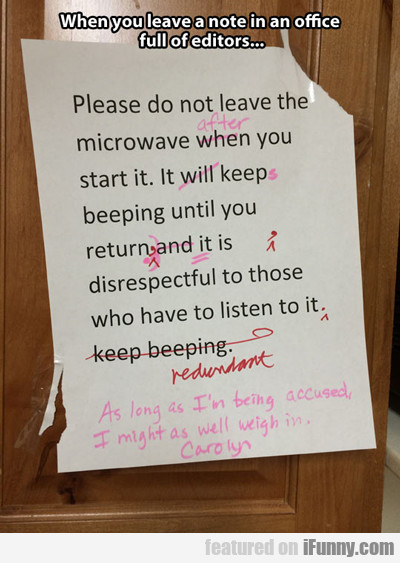
Editing Rants: Oxford Comma Rules!

Image acquired from the Internet Hive Mind

It’s official; the Oxford comma rules! Yes, a Maine Court on March 13, 2017 ruled in favor of a labor dispute based on the Oxford comma.

Happy, happy dance. Read all about it here: “A court’s decision in a Maine labor dispute hinged on the absence of an Oxford comma“

…. why no, I am not obsessed about the Oxford comma in the least.

Previous comma posts are here: Editing Rant: Clean up #1 – Commas; Editing Rant: No just no; Other Cool Blogs: Pictures.

(okay, maybe a little)

Editing Rant: Medical Topics

Image courtesy of Stuart Miles at FreeDigitalPhotos.net

Words cannot describe how badly CPR is presented – in books or TV shows. 

I’ve taught myself to ignore the CPR done on beds and with bent elbows on television. These things are part of the medical TV trope. But books. Books!

For the love of goodness, does no one know how CPR works? The main character of this book is finishing off her Chemistry bachelors to support her eventual medical degree. The following is first person narrative.

“When I first saw them , I thought they were all dead, but they had pulses. Some quick CPR helped keep them alive until …”

1) How the (blank) did one person do CPR on three people?
2) PULSE! equals no CPR – pulse means heart is working!

If you have CPR being done in a book, take a CPR course – a recent CPR course (in the past decade rescue breaths have been dropped). If you don’t have time, ask your friends who have – or just go to your local Red Cross and see if one of their instructors can review the scene. I’ve yet to read a book where CPR is done at an appropriate time in an appropriate manner.

By the way, this applies to any medical procedure. Get a recent fact-check; as my Geeking Science posts indicate, the field is always changing. In fact, checking with subject matter experts applies to any, ANY, .A.N.Y. topic.