I have never done this … yet.

Image acquired from the Internet Hive Mind
I have never done this … yet.
Image acquired from the Internet Hive Mind

Image courtesy of Stuart Miles at FreeDigitalPhotos.net
In May’s Editing Rant on No Squiggles, I mentioned requesting a Revise and Resubmit (R&R) and said I would come back to it.
So here we are.
A R&R is when a writer has sent in a manuscript, either solicited or unsolicited, and the publisher came back with – “not good enough, try again” and here as some suggestions on how to do that based on what they thought was wrong.
Now what should the writer do? Make the change or leave it the same?
Remember the publisher has REJECTED the original submission. The writer is NOT under contract. There is no pay, no guarantee of acceptance, and no obligation to make the change on the writer’s end or accept it on the publisher’s end.
Some writers say never change a manuscript unless you are under contact. That is good advice. Why do changes when the publisher might reject those, and the next publisher might ask to put those changes back in? If the writer has a solid product, changing stuff to please instead of just sending it off to the next publisher is a waste of good writing time. Better to write new words while waiting on a sale than forever updating one book.
The question that must be asked is – is the manuscript a solid product?
Well, what changes are the editor/publisher asking for?
When they say things like “make the main character (a different gender) because it will sell better” – that one is a “no” unless the writer wants more than anything in the world to be published by that particular publisher. And really, the writer should rethink that – because it is a big world out there.
When they say things like “the ending is too abrupt, it’s missing the falling action and resolution after the climax. Did you mean it to be a cliffhanger?” And the writer answers the question, “No.” Then heck yeah, the writer needs to sit down and do an R&R and make the story what it was intended to be.
The problem is most R&R requests lie somewhere in between.
So a writer should review the R&R request and see if the problems mentioned are the personal taste of the publisher or an actual weakness in the manuscript. And also see if the suggestions provided are good suggestions, or if the writer has an even better solution. The request to bump up the tension of the sagging middle by adding a fight between the love interest might be better resolved by adding a limited sidequest plotline with a time crunch – which would be truer to the story of soulmates in danger.
So what should you do if you get an R&R request on a submission. First celebrate – the publisher/submission editor cared enough about your submission to give it a second chance. They want to see if it can be made better.
Second, decide if what they want is something you want to do. If not, send them a thank you, but at this time, you will be considering other options in lieu of a resubmit. If yes, send them a thank you and the approximate date to get back the changes to them. Two to three months is an expected window. If it runs longer, get in touch again – this is important as editors can change and you need to keep current with where to send your R&R.
Good luck.

By West Midlands Police from West Midlands, United Kingdom – Operation Intrusive – BirminghamUploaded by palnatoke, CC BY-SA 2.0, https://commons.wikimedia.org/w/index.php?curid=27889282
I don’t have time for this.
I was driving my 10 hour drive and the character for a flash – all set to automatically post since I am on vacation and will be away from computers for two weeks, decided he wanted a name change – then changed nationality with the name change. And made the character about 500 years older than he already was.
On the upside, once I made the fix, it will make the world better – more consistent. Drat it.
Just spent an hour fixing the flash in West Virginia rest stop with wi-fi.
It was a FLASH!
Stupid characters.

Image courtesy of Stuart Miles at FreeDigitalPhotos.net
“Look you, she had the look so I looked at her.”
Oh, the editing pain. Look has so many definitions:
Noun – (1) The act of directing one’s gaze – “give a closer look”. (2) An appearance or quality – “she had the look”
Verb – (1) directing one’s gaze – “I looked at her”. (2) have the appearance or impression – “he looked good”
Exclamation – (1) call attention to what you are saying. “Look, this is too many definitions.”
Serious. Pain.
Today’s writing exercise is to create a tool to reduce the pain.
WRITING EXERCISE IN THREE PARTS
PART ONE: Devote a notebook page or file to common words and start collecting synonyms for them. Some of the bad boys are: Look/see/saw, felt, start/began/begun/begin, angry/anger, try/tried, said, go/went
I’ll help you start the look one: Stare, eye, glance, peek, see, gaze, contemplate, survey, watch
Google something like “other ways to say ____” and hit the image option. You should see lists created to help high schoolers expand their vocabulary. Take advantage of this.
An example from Pinterest (and originally from teachstarter.com):
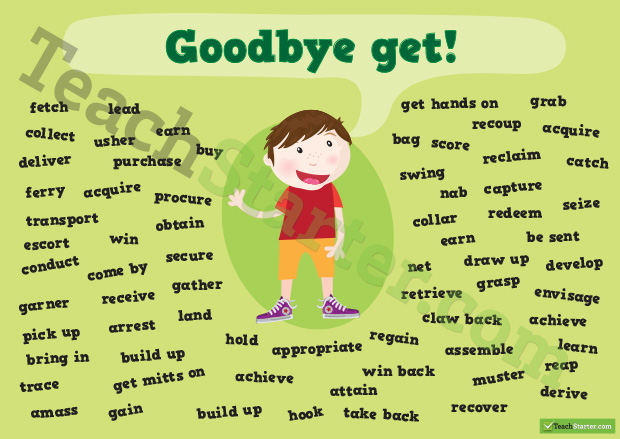
PART TWO: Now you have a starting point fix the following paragraph and post your version below:
He looked at her and she smiled back as she handed him a cup. He felt good about the smile, a start to a relationship, and he smiled too. The woman looked at the customer in front of her, starting to take a new order. The sudden shift of her look felt bad. He began to get angry. The fast food girl had looked so nice. Then he got it, he needed to try harder.
PART THREE: Finally go through your present work in progress (WIP) and search on the words. Write down how many times each appears in your manuscript. Now fix the ones that appear too many times.
How much is too much? If this is the first time you working of fixing issues like this, you will see it quick enough. For example, in 171-page manuscript I worked with the word “look” (or a variation thereof like “looked” and “looking”) appeared 420 times during the first pass. Over twice per page. That would be too much.
Below write your worst offender, how many times it appeared, and how many double-space, normal margins pages are in presently your WIP. If everyone shares, we can all see what words we need to watch for.

Image courtesy of the internet Hivemind
You know something is a common issue when TV Tropes has an entire section devoted to defining it and providing examples. “As you know, Bob…” has just such a section.
And still, it persists.
What exactly is an “As you know, Bob” moment? It’s when characters share information which is common knowledge to those involved but might be unknown to the reader. For example:
“As you know Bob, cell phones had a major jump in technology when microprocessors because atom sized.” Bob-two said in the traditional speech of the twentieth century.
Bob responded in the way of modern people *Yes, Bob-two, and then bioprogramming allowed us to integrate it into our DNA allowing us to have the appearance of telepathy if a visitor from the past should visit our space-faring culture.* (As you know bob – 67 words)
These two Bobs both know all of this, having received learned this information years ago. To have them talk about it makes no sense. And yet something along these lines happens all the time in books and television.
The challenge is how does a writer provide the information to the reader without doing a data dump or having a “As you know Bob” moment? How to show without telling?
The following ways are popular: (1) a school setting where background information is shared such as in this Firefly video where the background of colonization is taught to River Tam at the beginning of the Serenity movie. (2) a military briefing where everyone may or may not know all the details and the military is going to make sure everyone knows. (3) a data dump – sometimes you just got to go with informing the readers.
And the best option, integrate into the narrative. Imply and trust your reader.
“Bob, toss me the spanner will you?” Bob-two’s voice rasped from the strain of shouting over the machines.
*When are you going to give in and get the bio-app, you old fossil?* The maintenance apprentice sent to the external-bud the master guildsman had tucked into his ear. The younger man chucked the lightweight alumcarb spanner over.
Bob-two snatched it midair, ignoring the question, instead turning his attention to mechanism which required mechanic intervention. The thought of reprogramming his DNA gave him hives. (As you know bob-two – 83 Words)
WRITING EXERCISE: Create an “As you know Bob” scene of 100 words or less, then change it so it works without the lazy writing trope. Share the results below if you want.