Book Review: Were- (an Anthology)

Book Cover from Amazon

Were-, an anthology published by Zombies Needs Brains, LLC.

BOOK BLURB ON AMAZON

Werewolves rule the night in urban fantasy, but everyone knows there are other were-creatures out there just as dangerous and deadly, if not as common, each with their own issues as they struggle to fit into—or prey upon—society. What about the were-goats? The were-crows and were-wasps?

Here are seventeen stories of urban fantasy by today’s leading science fiction and fantasy authors that introduce you to some of those other were-creatures, the ones hiding in the dark background shadows, waiting to bite. Join Seanan McGuire, Ashley McConnell, Susan Jett, Eliora Smith, David B. Coe, April Steenburgh, Gini Koch, Mike Barretta, Elizabeth Kite, Danielle Ackley-McPhail, Jean Marie Ward, Katharine Kerr, Sarah Brand, Anneliese Belmond, Faith Hunter, Patricia Bray, and Phyllis Ames as they take you into the hidden corners of our world to see some lesser known were-creatures. You may want to bring along some silver … just in case.


MY REVIEW

Normally I give anthologies four stars, because while one or two stories are standouts, usually I run into a couple clunkers as well. I loved all the stories in Were- – most of the stories created solid worldbuilding in a few short strokes. 

Avoiding the ubiquitous werewolf, Were- follows the dozens of other shifters of folklore and urban fantasy: weregoats, shape-shifting unicorns, young children-cubs, murders of were-crows, were-plants. … Yep, were-plants … and many more things which will make your skin crawl or, maybe, shift.

The stories and writing style varied as much as the were-creatures – from detective noir to superhero. A+ read!

Best in Show by Seanan McGuire – Detective noir sent to a cat show.

We Dig by Ashley McConnell – Worldbuilding with miners and historical industrial (and racial) issues.

Eyes Like Pearls by Susan Jett – You never forget your first holiday crush.

Among the Grapevines, Growing by Eliora Smith – Were-plant.

A Party for Bailey by David B. Coe – Children bite, and momma bear really should keep her cub closer to home.

Cry Murder by April Steenburgh – Age old issues of crows versus owls.

Missy the Were-Pomeranian vs. the Masters of Mediocre Doom by Gini Koch – Wonderful superhero snark!

Paper Wasp by Mike Barretta – Who put this back to back with Missy the Were-Pomeranian? Really the whiplash between the upbeat superhero story and this horror one is mind-blowing. After all the light and joy building from A Party for Bailey, to the family vibe of Cry Murder and pure fun of Missy vs. the Masters, Paper Wasp stings deep. 

Well done editors with the pacing of stories funny, sad, scary, and thoughtful.

Point Five by Elizabeth Kite – Email format writing style and an amazing “if this, then this would happen” worldbuilding.

**Usually about here in anthologies, things start to be the second stringers. A reader feels like they got their money worth and is willing to try a couple new authors who are learning the craft. I swear, in this anthology, things got even better after the half-way point.**

The Promise of Death by Daniell Ackley-McPhail – Unicorn without a horn.

The Five Bean Solution by Jean Marie Ward – I’ve read the first short-story about these characters in a different anthology and this one is even better. The characters and POV character’s voice in the story are nicely nuanced.

Witness Report by Katherine Kerr – Historical were- story.

Attack of the Were-Zombie Friendship with Benefits by Sara Brand – Another worldbuilding twist – when it is no longer safe to go out at night, how does the night-scene teenagers and early-twenty adjust? 

The Whale by Annelies Belmond – Even humans unconsciously recognize the majestic and tragic hidden in human form. The worldbuilding of Weight-bound gives an entirely different approach to shifter/were- relations and activities. I would say this one was my favorite short story, except I want to say that about a few others as well. I will say this is the most original in a collection of very original material. A must-read.

Anzu, Duba, Beast by Faith Hunter – A story from the Jane Yellowrock world.

Shiftr by Patricia Bray – Again with the worldbuilding. If you have “this” then “this”. Love the apps – from hook ups to family tree to DNA investigation.

Sniff for Your Life by Phillis Ames – If you like rats, this short is a must-read. Big alpha werewolf needs a nose even more sensitive than a canine’s to save the city.
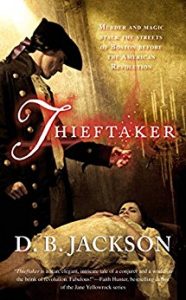
Book Review: Thieftaker (Thieftaker Chronicles, #1)

Book Cover from Amazon

Thieftaker by D.B. Jackson

BOOK BLURB ON AMAZON

Boston, 1765: In D.B. Jackson’s Thieftaker, revolution is brewing as the British Crown imposes increasingly onerous taxes on the colonies, and intrigue swirls around firebrands like Samuel Adams and the Sons of Liberty. But for Ethan Kaille, a thieftaker who makes his living by conjuring spells that help him solve crimes, politics is for others…until he is asked to recover a necklace worn by the murdered daughter of a prominent family.

Suddenly, he faces another conjurer of enormous power, someone unknown, who is part of a conspiracy that reaches to the highest levels of power in the turbulent colony. His adversary has already killed—and not for his own gain, but in the service of his powerful masters, people for whom others are mere pawns in a game of politics and power. Ethan is in way over his head, and he knows it. Already a man with a dark past, he can ill afford to fail, lest his livelihood be forfeit. But he can’t stop now, for his magic has marked him, so he must fight the odds, even though he seems hopelessly overmatched, his doom seeming certain at the spectral hands of one he cannot even see.


MY REVIEW

Harry Dresden meets Revolutionary War Boston

I have a new author to add to my faves – D.B. Jackson. The worldbuilding in Thieftaker is superb. Normally I avoid “alternate histories” – the tweaks never follow out to logical conclusions.

Example: The American Revolution inspired the French Revolution. Keep America loyal to British Rule so no American Revolution and jump forward 200 years … what happened in France and does the emperor still rule there and how does that affect France during WWII … do they accept occupation or fight? All of history feeds off itself; you can’t change just one thing.

But this book is not an alternate history, Thieftaker is an urban fantasy set in historical time. Ethan Kaille could be Harry Dresden, if the Chicago wizard lived in Boston just before the revolutionary war.

The characters are real, from the flawed hero to the merchants rivals on the warf. The arguments are urgent from the dreamers driving the country to the brink of revolution to the honest (and not-so-honest) people who just want to make a living and fear changes to the status quo. The scenes are authentic from the riots in the cobblestone street to the country manors of the Crown government. D.B. Jackson does an outstanding job blending his academic background as a historian with his occupation of fantasy author. A reader can immerse in fictional history.

Is the main character likeable? Not always, but I always rooted for him – even when he was being unlikeable. Can’t buy a good tea without paying England her tax, can’t have a good detective without him also being a Dick when interrogating suspects. And that is also part of the excellent worldbuilding.

If you like urban fantasy via detectives, pick up this book.

Other Cool Blogs: Literary Hub July 6, 2017

Image courtesy of Stuart Miles at FreeDigitalPhotos.net

Do better.

Reading book reviews about your babies is hard. Real hard. Not just because some of the bad reviews  are spiteful, but because some of them are right. They shine a light on an error which got through your work and ask you to “Do Better”.

The  first review I received for Honestly was entitled “missing an ending”. I hadn’t intended the book to be a happily ever after (HEA), just a happily for now. I got the couple to setting up their first date, showing the slow path they would follow because one had a child and the other romantic lead was still physically recovering from an injury. Everything following, I figured, would be boring and predictable. But the abrupt cut off didn’t tie things together for an emotional ending.

The reviewer correctly one-starred me.

Two additional chapters later, with a jump in time, I uploaded the emotional payoff to the couple getting together for future readers. I received no further one-star reviews. The plus side of self-published work is you can do tweaks like that.

Daniel Price similarly faced reviews for his book The Flight of Silvers. The few negative reviews had the vague ” I didn’t like” but focused on two of the point of view (POV) characters. Frustrated but not knowing how to fix whatever might be wrong, Mr. Price continued pounding out the second book of the series until one reader contacted him directly. Erin (not me) indicated her vague feelings and he asked her for details. She provided it in detail; boiling down the barely noticeable issues (at least overtly) of lack of agency and excessive trope replication without a twist on two of the female POVs. Publishing through a house, Penguin in this case, prevented a direct fix but he applied her words to his final edits on his work-in-progress and sent it to her to beta read. After a 2000-word commentary about her problems with Flight, her second letter to the book he had fixed had only four words. Interested in knowing what those words were?  Read “How a Reader’s Feminist Critique Changed My Sci-Fi Novel.”

Writers do read their reviews. Going with the ambiguous “It stunk.” doesn’t help much. You want better things to read, better reviews can help.

Writers, want better feedback, have someone read your reviews and let you know which one you need to see. Be sure to show them this post to let them know bad reviews are okay when useful. (Unless you got real thick skin, then you can try it direct. Mine is in development and that one-star review still stings.)

Book Review: Duplicate Effort (Retrieval Artist #7)

Book Cover from Amazon

Duplicate Effort (Retrieval Artist #7) by Kristine Kathryn Rusch

BOOK BLURB ON AMAZON

Retrieval Artist Miles Flint has a mission: take down the law firm of Wagner, Stuart, and Xendor. He enlists the aides of old friends and old enemies. But as the mission gets underway, one member of his team dies horribly.

Flint can no longer take on the entire universe. He violated the rules of his Retrieval Artist mentor and now has a lot to lose. But he can’t reverse the events he set in motion—and the crisis he caused might destroy everything—and everyone—he loves.

International bestselling writer Kristine Kathryn Rusch has won two Hugo awards, a World Fantasy Award, and three Asimov’s Readers Choice Awards. IO9 called her six (so far) bestselling, award-winning Retrieval Artist novels, inspired by this novella, one of the top ten science fiction detective series ever.


MY REVIEW

First off, love.the.book.title “Duplicate Effort”, which has more than one meaning in the story.

This is the first of the fifteen-book “Retrieval Artist” series I read and it is the 7th of the series and works well as a stand-alone, though I believe it would work better if read in order. The author does provide good insight to the other books like a universe building on itself.

Second, I love the initial premise. What is a cop to do with a self-cleaning crime scene? How do you save the evidence before it is destroyed?

Each layer of the book get more and more interesting. I’m not going to go any further so I don’t give any of the mysteries away. 

Book Review: A Sword Into Darkness

Book Cover from Amazon

A Sword Into Darkness by Thomas A. Mays

BOOK BLURB ON AMAZON

HUMANITY IS NO LONGER ALONE IN THE UNIVERSE. AN UNKNOWABLE THREAT APPROACHES EARTH . . . AND WE ARE COMPLETELY UNPREPARED TO FACE WHAT’S COMING.

Aerospace tycoon Gordon Elliot Lee cannot stand idly by while a mysterious alien presence from Delta Pavonis bears down upon mankind’s only home. Shut out from NASA and military support, Gordon is forced to go it alone, to sow the seeds for an entirely new sort of planetary defense: a space-based naval force.

Joined by Nathan Kelley — a bloodied naval warrior, scarred by his own actions in the waters off North Korea — and Kris Munoz — an avant garde scientific genius with more ideas than sense — these three will scour the very edges of fringe science and engineering to attempt development of Earth’s first space navy in time to oppose the Deltan invasion.

Beset by ridicule, government obstruction, industrial espionage, and their own personal demons, it will take a miracle just to get off the ground. But the challenges on Earth are nothing compared to what awaits them in space. Against an unknown alien enemy with vastly superior technology, a handful of human scientists and warriors must become the sword that holds the darkness at bay.

MISSILES WILL FLASH, RAILGUNS WILL RUMBLE, LASERS WILL BURN, AND DEFENDERS WILL DIE.


MY REVIEW

Excellent Military Sci-Fi trip to the near future. This stuff feels like we may actually be able to do it, and the reason for the need of creating the first interplanetary warship is equally urgent as we realize just how many worlds upon worlds there are in the heavens.

Not everyone out there is going to be friendly, not everyone who drops by will want a cup-of-tea and biscuit, not everyone in the big black is on the side of life. The question raise by this story is what do we do when we see someone coming to visit? Do we roll out the red carpet or bar the door? Do we assume the best or plan for the worst?

And what do you do if you are the first one to see it and no one believes you? How do you make them believe before it is too late? Should you even try? Can loners save humanity or will you need a planetary navy? (The answer to the final question is yes.)

A mixture of tech, politics, and humans being human drive this story, in the tradition of David Weber.